Tuesday, July 19, 2011

George Bush, Barack Obama, and the Politics of Peanut Butter and Jelly Sandwiches

Published in 2011, George W. Bush's memoir Decision Points has been described by the New York Times as "an autobiography focused around 'the most consequential decisions' of his presidency and his personal life from his decision to give up drinking in 1986 to his decision to invade Iraq in 2003 to his decisions regarding the financial crisis of 2008."

According to the Product Description of the book:

President Bush brings readers inside the Texas Governor’s Mansion on the night of the hotly contested 2000 election; aboard Air Force One on 9/11, in the hours after America’s most devastating attack since Pearl Harbor; at the head of the table in the Situation Room in the moments before launching the war in Iraq; and behind the Oval Office desk for his historic and controversial decisions on the financial crisis, Hurricane Katrina, Afghanistan, Iran, and other issues that have shaped the first decade of the 21st century...

With so many momentous political issues to review, it's not surprising that Mr. Bush didn't spend much time discussing his favorite foods, but...in an interview with Oprah Winfrey during the 2000 presidential campaign, he did say that his favorite sandwich is peanut butter and jelly on white bread.

Eight years later, during the 2008 presidential campaign, peanut butter and jelly sandwiches once again made national headlines. Responding to charges "that his economic policies were socialistic in nature," Barack Obama ridiculed his opponent John McCain for constantly resorting to trivialities and distractions. Here is a video of Obama's remarks:

Now, because he knows that his economic theories don't work, he's been spending these last few days calling me every name in the book. Lately he's called me a socialist for wanting to roll-back the Bush tax cuts for the wealthiest Americans so we can finally give tax relief to the middle class. I don't know what's next. By the end of the week he'll be accusing me of being a secret communist because I shared my toys in kindergarten. I shared my peanut butter and jelly sandwich."

Although neither Bush nor Obama mentioned how they prefer their PB&Js to be made, we do know that John Harvey Kellogg, the cereal pioneer, was the first person to receive a patent for the process of making peanut butter butter in 1895. According to Andrew Smith's Peanuts: The Illustrious History of the Goober Pea, early peanut butters had several problems:

The first was that peanut oil has a melting point below room temperature. Gravity separated the oil, which then oxidized and turned rancid. Likewise, salt added to the peanut butter separated and crystallized. Grocers received peanut butter in tubs or pails and were advised to use a wooden paddle to stir it frequently...

During the early years of the twentieth century, William Norman, an English chemist, invented a method of saturating unsaturated and polyunsaturated fatty acids, thus preventing them from turning rancid. In 1922, Joseph L. Rosefield...applied these principles to peanut butter [and] developed a process to prevent oil separation and spoilage in peanut butter...The result was a semisolid peanut butter [that]...was thick and creamy and did not stick to the roof of the mouth as much as previous products.


Selecting the name "Skippy" for his product, Rosefield introduced creamy and chunky-style peanut butter in 1932. Three years later, the company inaugurated its first wide-mouth peanut-butter jar, which quickly became the industry standard. And in less than twenty five years, peanut butter had "evolved from a hand ground delicacy to a mass-produced commercial commodity sold in almost every grocery store in America."

FOOD FACT: Florence Cowles' 1928 cookbook Seven Hundred Sandwiches includes dozens of creative recipes for peanut butter sandwiches, including: Peanut Butter and Egg Sandwich, Peanut Butter and Cabbage Sandwich, Peanut Butter and Marshmallow Sandwich, Peanut Butter and Prune Sandwich, Peanut Butter and Cherry Sandwich, Peanut Butter and Cheese Sandwich, and Peanut Butter and Olive Sandwich made with Mayonnaise on Rye. Oh my!

Thursday, July 14, 2011

Abraham Lincoln Chicken Fricassee

Despite the exigencies of the Civil War, Abraham Lincoln took his entertaining duties at the White House seriously, and if the only extant culinary records of his administration were the menus of his gala state banquets and balls, one could justifiably conclude , according to food historian Poppy Cannon, that he was "a gourmet to end gourmets, a connoisseur of exquisite sensitivity [and] a bon vivant supreme."

But nothing could be further from the truth. Not prone to eating breakfast every day, it has been said that he had an egg and biscuit only occasionally. Lunch was often only an apple with a glass of milk, and dinner could be entirely forgotten unless a tray of food was forced on him. “Abe can sit and think longer without food than any other person I have ever met,” Lincoln’s former law partner in Chicago wrote. And, shortly after his death, Lincoln’s sister-in-law recalled, “He loved nothing and ate mechanically. I have seen him sit down at the table and never unless recalled to his senses, would he think of food.”

But when Lincoln did turn his attention to food, he ate heartily and never lost a boyhood taste for Kentucky Corn Cakes, Gooseberry Cobbler, Rail Splitters, Gingerbread Cookies, and Corn Dodgers. And it has been said that one of the few entrees that would tempt Lincoln was Chicken Fricassee. According to A Treasury of White House Cooking by Francois Rysavy, Lincoln "liked the chicken cut up in small pieces, fried with seasonings of nutmeg and mace and served with a gravy made of the chicken drippings."

Although Abe's favorite recipe for Chicken Fricassee has surely been lost to posterity, you can try this more recent one for Tarragon Chicken Fricassee from Gourmet Magazine:

3 1/2 to 4 pounds chicken pieces with skin and bone
3/4 teaspoon salt
1/2 teaspoon black pepper
2 tablespoons vegetable oil
1/2 cup finely chopped shallots
1 garlic clove, finely chopped
1 Turkish or 1/2 California bay leaf
1/2 cup dry white wine
1 cup heavy cream
1/2 cup reduced-sodium chicken broth
1 1/2 tablespoons finely chopped fresh tarragon
1/4 teaspoon fresh lemon juice

Pat chicken dry and sprinkle all over with salt and pepper. Heat oil in a 12-inch heavy skillet over moderately high heat until hot but not smoking, then sauté chicken in 2 batches, skin side down first, turning over once, until browned, 10 to 12 minutes total per batch. Transfer to a plate.

Pour off all but 2 tablespoons oil from skillet, then cook shallots, garlic, and bay leaf over moderate heat, stirring occasionally, until shallots are softened, about 2 minutes. Add wine and bring to a boil. Stir in cream, broth, and 1 tablespoon tarragon, then add chicken, skin side up, and simmer, covered, until just cooked through, 20 to 25 minutes. Transfer chicken with tongs to a platter and keep warm, loosely covered. If necessary, boil sauce until thickened slightly. Stir in lemon juice, remaining 1/2 tablespoon tarragon, and salt and pepper to taste. Discard bay leaf; pour sauce over chicken.

Tuesday, July 12, 2011

Dickens Meets Tyler at the White House

One of the most famous guests to dine at the White House during John Tyler’s presidency was the great English writer, Charles Dickens. Upon his arrival in the United States, Dickens was honored at a lavish ball in New York City, where he was greeted by such famous American writers as Washington Irving, Henry Wadsworth Longfellow, Harriet Beecher Stowe and Edgar Allan Poe.

A few days later, Dickens met Tyler in the White House and later penned this about the president:

He looked somewhat worn and anxious, and well he might; being at war with everybody - but the expression of his face was mild and pleasant, and his manner was remarkably unaffected, gentlemanly, and agreeable.

Although Dickens seemed to like Tyler, he strongly disliked slavery. Describing a particular meal in Baltimore, Dickens wrote:

We stopped to dine at Baltimore, and…were waited on, for the first time, by slaves. The sensation of exacting any service from human creatures who are bought and sold…is not an enviable one. The institution exists, perhaps, in its least repulsive and most mitigated form in such a town as this; but it IS slavery; and though I was, with respect to it, an innocent man, its presence filled me with a sense of shame and self-reproach.

After returning to England, Dickens wrote his first travel book entitled American Notes. In it, he criticized Americans for their poor table manners and disgusting habit of chewing and spitting tobacco. He also devoted an entire chapter to slavery in the United States.

FAST FACT: Oliver Twist is perhaps Dickens’ most famous novel. Set in England, the main character is a nine-year old orphan in a London workhouse where the boys are given only three meals of thin gruel a day. When Oliver asks for more (“Please, sir, I want some more”) he is dubbed a troublemaker and treated even more cruelly. Oliver Twist called attention to the problem of poor and starving children in England and, to a lesser extent, the United States.

For the announcement of my new children's book, please click here.

Thursday, July 7, 2011

Richard Nixon, U.S.-China Relations, and the 40th Anniversary of Ping Pong Diplomacy

During Richard Nixon's administration, one of the first public signs of improved U.S.-China relations came on April 6, 1971, when the American Ping-Pong team, in Japan for the 31st World Table Tennis Championship, received "a surprise invitation from their Chinese colleagues for an all-expense paid visit to the People's Republic of China." Four days later, on April 10, 1971, "nine players, four officials, and two spouses stepped across a bridge from Hong Kong to the Chinese mainland," thus becoming the first group of Americans allowed into China since the Communist takeover in 1949 and ushering in an era of what has been dubbed "Ping-Pong Diplomacy."

According to PBS:

Ten journalists, including five Americans, were also invited to cover the team’s visit, ending the information blockade from the People's Republic in place since 1949. From April 11th to 17th, a delighted American public followed the daily progress of the visit in newspapers and on television, as the Americans played - and lost - exhibition matches with their hosts, toured the Great Wall and Summer Palace, chatted with Chinese students and factory workers, and attended the Canton Ballet.

Premier Chou En-lai worked the public relations opportunity beautifully, receiving the Americans at a banquet in the Great Hall of the People on April 14. "You have opened a new chapter in the relations of the American and Chinese people," he told the unlikely diplomats. "I am confident that this beginning again of our friendship will certainly meet with majority support of our two peoples." He also extended an invitation for more American journalists to visit China, provided they do not "all come at one time." That same day, the U.S. announced plans to remove a 20-year embargo on trade with China.


Despite the public rapproachment between the two states, Nixon and Secretary of State Henry Kissinger "decided to keep their back-channel negotiations with China to themselves [and] it was not until July 15, after Kissinger's secret mission to Beijing, that Nixon announced that he, too, would make the journey the following year, as the first American president to visit China."

This week, The Richard Nixon Foundation will commemorate the 40th anniversary of this extraordinary series of 1971 and 1972 Chinese-American matches in "The 40th Anniversary of Ping Pong Diplomacy: The Rematch," to be held July 8, 2011 in the White House East Room at the Richard Nixon Presidential Library, featuring members of the original '71 and '72 teams.

According to the official press release, "an impressive lineup of American and Chinese Olympic and World champions, including original players, will go head-to-head in free exhibitions on July 8 beginning at 9 a.m. The competition will showcase exciting youth, elite and collegiate rounds, with a spectacular finale of rematches of the original games. Huiaiying Zheng and Liang Geliang will again represent the Chinese and Judy Hoarfrost and George Braithwaite, the first Americans to visit China since 1949 at the time, will represent the U.S."

The Foundation will also host an All-American Welcome BBQ in the Library's East Room on Thursday, July 7 at 5 p.m. The program will feature remarks by President Nixon's brother Edward, Ping Pong Diplomacy veteran Tim Boggan, U.S. and Chinese officials, and table tennis matches between celebrities and world champions. If you happen to be in Southern California this week and would like to get in on the action, please click here.

Wednesday, July 6, 2011

Meat Rationing at the Roosevelt White House

When she toured the White House kitchen in 1933, Henrietta Nesbitt, Eleanor Roosevelt's housekeeper, reportedly found cockroaches crawling about. In her book White House Diary Nesbitt described her first inspection of the premises: “I can’t work up any charm for cockroaches. No matter how you scrub it, old wood isn’t clean. This was the ‘first kitchen in America,’ and it wasn’t even sanitary...The refrigerator was wood inside and bad-smelling. Even the electric wiring was old and dangerous. I was afraid to switch things on.”

“There is only one solution,” she told Mrs. Roosevelt. “We must have a new kitchen.”

And so it was that Public Works Project No. 634 was instituted, with demolition and construction on the kitchen beginning in the summer of 1935. But because the jobless rate was so high during the Great Depression, President Roosevelt insisted that "relief workers be employed for the reconstruction whenever possible." According to historian Mary Barrett:

The renovation, planned by the White House staff and engineers from General Electric and Westinghouse corporations, reconfigured the working space, replaced rusted pipes, put in a whole new electrical system with all-new electric appliances, and installed more efficient dumbwaiters to transport the food to the State Floor dining rooms above.

New equipment included six roasting ovens, a sixteen-foot-long stove, eight refrigerators, five dishwashers, a soup kettle, a meat grinder, waffle irons, multiple mixers, a thirty-gallon ice-cream storage freezer, and a deep fryer that held five gallons of fat. Stainless steel storage and counter tops were installed throughout.

The President and Mrs. Roosevelt were delighted, but Mrs. Nesbitt reported that the staff was overwhelmed by the latest technological innovations. They continued to do things the way they had been done in the past: washing dishes, as well as chopping and slicing food—by hand. And unfortunately for President Roosevelt, a new kitchen did not improve the quality or variety of Mrs. Nesbitt’s menus.

Mrs. Nesbitt believed in economical, simple, American fare: cheap cuts of meat including brains, sweetbreads, and beef tongues; mashed potatoes; flavorless canned vegetables; molded gelatin salads dotted with marshmallows; and insipid desserts. Franklin Roosevelt once joked that the only reason he sought a fourth term of office was so that he could return to the White House to fire Mrs. Nesbitt!


Of course, Roosevelt did win a fourth election, but Mrs. Nesbitt "and her bland menus remained." In her biography of Eleanor Roosevelt, Blanche Cook conjectured that Eleanor's "curious disregard for her husband’s tastes suggests an explanation for her persistent defense of Henrietta Nesbitt: The housekeeper was one expression of her passive-aggressive behavior in a marriage of remarkable and labyrinthine complexity.”

But culinary historian Barbara Haber offers a different take on the relationship between Eleanor, Nesbitt, and the meals that appeared on the Roosevelt's table. In an essay titled, “Home Cooking in the FDR White House,” Haber explains that Eleanor cared little about what she ate. Her goal for White House menus was to "keep them strictly within the bounds of culinary propriety for a nation that was suffering first from economic hardship, and later from the restrictions of rationing." It was her social conscience, Haber claims, not her marital frustrations, that ruled the table.

Whatever the case may be, Nesbitt herself confirmed that when meat was rationed during World War II, the White House had to stretch its meat allotment, too, which led to some rather bland meals at the Roosevelt White House. Some of Nesbitt's usual “meat-stretcher foods” included stuffed peppers, stew, ham scallops, noodles and mushrooms with chicken scraps, spaghetti with meat-cakes “cut down to the size of mere marbles,” curries and omelets with meat tidbits, croquettes for “a sustaining meal in themselves,” minestrone soup, fish chowder, gumbo z’herbes, stuffed eggs with meat bits for stuffing, baked beans, deviled meats, and casseroles.

And at an old-fashioned, American-style picnic held in the summer of 1939 in honor of Queen Elizabeth and Prince Philip of England, menu items included Virginia Ham, Smoked Turkey, and Hot Dogs! The next day, news of the picnic made the front page of the New York Times under the headline, “KING TRIES HOT DOG AND ASKS FOR MORE.” While the King reportedly “ate his hot dog by hand like an American,” the Queen daintily cut hers with a knife and fork.

Although that particlar recipe may have been lost to posterity, you can try this recipe for Hot Dogs with Homemade Pickle Relish from Bobby Flay for your next old-fashioned, All-American style barbecue:

8 link hot dogs
quality hot dog buns
Homemade Pickle Relish, recipe follows

Directions: Heat grill to high. Grill the hot dogs until golden brown on all sides. Place in buns and top with your favorite mustard and the homemade pickle relish.

For the Pickle Relish:
1 1/2 cups cider vinegar
1 teaspoon mustard seeds
1 teaspoon coriander seeds
2 tablespoons sugar
8 large dill pickles (sour, not half-sour), finely diced
1 small red pepper, grilled, peeled, seeded, and finely diced
1 small yellow pepper, grilled, peeled, seeded, and finely diced
1 small white onion, finely diced
2 tablespoons chopped fresh dill

Bring vinegar, mustard seeds, and coriander seeds to a boil in a medium saucepan on the grates of the grill; cook until reduced by half and slightly syrupy. Remove from the heat, add remaining ingredients, and gently toss to coat. Season with salt and pepper, to taste. Cover and refrigerate for at least 1 hour before serving.

To read an excerpt from my new book from Simon and Schuster click here

Wednesday, June 29, 2011

John Adams Gooseberry Fool

As a delegate to the Second Continental Congress, John Adams was one of the fiercest advocates of the Declaration of Independence. Contrary to popular belief, the Declaration wasn't signed by all of the delegates on July 4, 1776. Instead, it was initially approved on July 2, 1776. The delegates then continued debating and slightly revised it the following day and formally adopted it on the fourth of July. Most historians agree that the Declaration wasn’t signed by all the delegates (with a few holdouts) until nearly a month later, on August 2, 1776.

On July 3, 1776, John Adams wrote a letter to his wife Abigail in which he described these momentous events. This is what he wrote:

The second day of July, 1776, will be the most memorable epoch in the history of America. I am apt to believe that it will be celebrated by succeeding generations as the great anniversary festival...It ought to be solemnized with pomp and parade, with shows, games, sports, guns, bells, bonfires, and illuminations, from one end of this continent to the other, from this time forward forever more.

You will think me transported with Enthusiasm but I am not. -- I am well aware of the Toil and Blood and Treasure, that it will cost Us to maintain this Declaration, and support and defend these States. -- Yet through all the Gloom I can see the Rays of ravishing Light and Glory. I can see that the End is more than worth all the Means. And that Posterity will tryumph in that Days Transaction, even altho We should rue it, which I trust in God We shall not.

Although no one knows what the delegates ate on those momentous days, we do know that Adams was fond of Gooseberry Fool, a traditional eighteenth century British dish. As an example of how national food preferences change over time, gooseberries were abundant in John's day but are not widely available in the United States today.

Unless you have your own little gooseberry patch, you can substitute blueberries and call this dessert Blueberry Fool. Or you can use strawberries or raspberries, whichever you prefer. Either way, this delicious and refreshingly sweet little treat would make a great addition to your Fourth of July festivities next week. If you'd like to whip up a batch, here's a simple recipe to try from epicurious.com

3 cups pink or green gooseberries (or blueberries)
1/2 cup granulated sugar
1/2 cup well-chilled heavy cream
1/4 cup crème fraîche
1/4 cup superfine granulated sugar

Pull off tops and tails of gooseberries and halve berries lengthwise. In a heavy skillet cook berries and granulated sugar over moderate heat, stirring occasionally until liquid is thickened, about 5 minutes. Simmer mixture, mashing with a fork to a coarse puree, 2 minutes more. Chill puree, covered, until cold, about 1 hour, and up to 1 day.

In a bowl with an electric mixer beat heavy cream with crème fraîche until it holds soft peaks. Add superfine sugar and beat until mixture just holds stiff peaks. Fold chilled puree into cream mixture until combined well. Fool may be made 3 hours ahead and chilled, covered.

Credit: Declaration of Independence, painting by John Trumball

Thanks for stopping by THE HISTORY CHEF! For a free excerpt of my new book from Simon and Schuster click here

Monday, June 27, 2011

Betty Ford and a Royal Bicentennial State Dinner

On the evening of July 7, 1976, President Gerarld Ford and his wife Betty hosted an elegant state dinner at the White House dinner in honor of Queen Elizabeth II and Prince Philip of England. The royal visit was part of the celebration of the Bicentennial of the American Revolution. In her memoir, The Times of My Life, Mrs. Ford recalled the Queen's dinner this way:

We put up a tent for the Queen's dinner. There were so many state events coming up one right after the other that without the tent we'd probably have had to close the White House to the public for a good portion of the summer, and it was the Bicentennial year and the influx of tourists was heavy. A tent over the Rose Garden would be the answer, just a great white tent which would also enable us to invite more guests than we could have served indoors.

An hour and a half before the Queen's dinner, there was a sudden downpour with torrential rain, thunder, lightning. Three trees on the White House grounds were struck. Fortunately, I'd insisted that our tent have a floor...I'd seen it done at the French Embassy and been very impressed...For the Queen's dinner, we had violinists stationed along the paths, and to be out in the gorgeous night air, with the moon shining down and the violins playing as you walked by, was unforgettable.

The Queen was easy to deal with. She was very definite about what she wanted and what she didn't want. She loves Bob Hope and Telly Savalas, so we invited Bob Hope and Telly Savalas...and if I hadn't kept mixing up Your Highness and Your Majesty (he's His Highness, she's Her Majesty) I'd give myself four stars for the way that visit went off.


As for the dinner itself, more than two hundreds guests dined on New England Lobster en Bellevue and Saddle of Veal with Rice Croquettes and Broccoli Mornay. Dessert items included Peach Ice Cream Bombee with Fresh Raspberries and a Demitasse. Although Mrs. Ford didn't include the recipes for these dishes in her memoir, you can whip up this recipe for Peach Ice Cream Bombee from Rachel Ray:

2 pound peaches - peeled, pitted and coarsely chopped
1/2 cup plus 2 tablespoons sugar
1/2 teaspoon fresh lemon juice
1 pinch salt
1-1/3 cups heavy cream
1/2 cup milk
1/2 teaspoon ground cinnamon

In a medium saucepan, combine the peaches, 7 tablespoons sugar, the lemon juice and salt. Cook over medium heat, mashing, until jam like, about 15 minutes. Let cool. In a medium bowl, whisk together the cream, milk, remaining 3 tablespoons sugar and the cinnamon until the sugar is dissolved. Stir in the peach mixture and refrigerate for 4 hours. Using an ice cream machine, process the peach mixture according to the manufacturer’s instructions. Transfer to an airtight container and freeze until firm, about 4 hours.

FAST FACT: A gifded athlete, Gerald Ford was offered two contracts to play in the NFL (from the Detroit Lions and Green Bay Packers) but turned the offers down to continue his education. After graduating from the University of Michigan at Ann Arbor, Ford became a boxing and football coach at Yale University and later graduated from Yale Law School in the top 25 percent of his class despite the time he had to devote to his coaching duties.

Wednesday, June 22, 2011

George Bush Apple-Cranberry Brown Betty

According to New York Times columnist Maureen Dowd, George H.W. Bush has always had a "whopping appetite," but it isn't for vegetables like broccoli (as he made clear to reporters at a news conference in 1990) or other healthy, nutritious dishes. Instead, our 41st president loves to munch on pork rinds, beef jerky, nachos, tacos, gaucamole, chile, refried beans, hamburgers, hot dogs, barbecued ribs, and popcorn. And "even when he eats something healthy, like yogurt or oat bran," according to Dowd, "he tries to spice it up with Butterfingers or something else to give it a little zip."

Given his unpretentious tastes, it’s not surprising that George and Barbara Bush made no particular culinary demands on their Executive Chef and both often “exulted in the pleasures of White House dining.” In a burst of gustatory fervor, Mrs. Bush reportedly wrote, “Duck soup, smoked trout, delicate salad and peaches and passion fruit! Glorious. The food is so special that you cannot believe it.”

As for Mr. Bush's culinary preferences, the Washington Post reported that, shortly after taking office, the new president was making them known:

For a black-tie $1,500-a-plate inaugural dinner what did he choose? A baked bean and scrod dinner to commemorate the great state of his birth, Massachusetts? Oysters a la Connecticut to note the days of his youth? A messy Texas barbecue from his adopted home state? Or, from his Kennebunkport summer home, Maine lobsters? Instead George and Barbara Bush for the first of many presidential dinners designed a meal around the taste buds of George Washington and called it "From George to George."

If you'd like to whip up the delicious dessert that was served at that gala dinner, here is the recipe for Apple-Cranberry Brown Betty:

Butter and sugar for preparing the souffle dish
10 Granny Smith apples
1 teaspoon lemon juice
6 tablespoons butter, plus additional 1/2 cup melted
3 tablespoons sugar
2 cups fresh cranberries, washed and dried
1 cup golden raisins, soaked in warm water for 15 minutes then squeezed dry
Zest of 2 oranges
1 cup light brown sugar
1/4 teaspoon mace
1 teaspoon ground cinnamon
3 cups stale white-bread crumbs, crusts removed

Preheat the oven to 375 degrees. Butter a 2-quart straight-sided glass souffle dish and then sprinkle with sugar. Peel, core and quarter the apples, then cut each quarter into 3 chunks. Reserve in a bowl. Sprinkle the lemon juice over the apples and toss to combine.

In a large frying pan, heat 2 tablespoons of the butter until hot and add 1/3 of the apple pieces. Sprinkle with 1 tablespoon of the sugar and saute over high heat until the apples are lightly caramelized. Remove the apples from heat and reserve in a large bowl. Repeat process until all the apples are cooked. Combine the apples with the cranberries, raisins, orange zest, brown sugar, mace and cinnamon and mix well. Mix the bread crumbs with the remaining 1/2 cup melted butter.

Line bottom of souffle bowl with 1/3 of the bread-crumb mixture. Add 1/2 of the apple-cranberry mixture, then sprinkle with 1/3 more of the bread crumbs. Add rest of apple-cranberry mixture, then top with the remaining bread crumbs. Bake in the preheated oven for 1 1/4 to 1 1/2 hours.

Thanks for stopping by THE HISTORY CHEF! For a free excerpt of my new book from Simon and Schuster click here!

Tuesday, June 21, 2011

George Washington's Fishery

So did you know that before he became president, George Washington ran a successful fishery in the Potomac River near his Mount Vernon home. During the annual spring run, Washington's slaves would catch and harvest more than a million herring, shad, striped bass, oysters, crabs, and clams.

The Potomac River, of course, flows into the Chesapeake Bay, which is the largest estuary in the United States. Back in George’s day, it was known for its great abundance of shellfish and fish. Today, it is not nearly as productive due to overharvesting, pollution, runoff, and disease, but it still yields more fish and shellfish (about 500 million pounds each year) than any other estuary in the United States.

What are estuaries? Estuaries are typically defined as partially enclosed coastal bodies of water that are formed where freshwater from rivers and streams mix with salt water from an ocean. Some estuaries, like the Chesapeake Bay and the lower part of the Hudson River, were formed thousands of years ago when melting glaciers caused sea levels to rise and flood low lying valleys and lands.

Others, like those found in Northern Europe, Alaska and Canada, were formed during periods of glaciation. Still others, like the San Francisco Bay, are known as tectonic estuaries that were formed by the buckling or folding of land surfaces along major fault lines. Regardless of how they were formed, estuaries are critical for marine life and have provided an important source of food for human beings since the beginning of recorded time.

So what do estuaries have to do with George Washington and food? Alot, if you consider the fact that by the time he became president, George had lost almost all of his teeth and had to eat soft foods, like fresh fish from the Chesapeake and its many rivers, throughout most of his adult life.

Baked Shad was another Washington family favorite. Although no recipes for it are contained in Martha Washington's Booke of Cookery, historians explain that cooks at Mount Vernon were "undoubtedly so familiar with it that directions for preparation were unnecessary. Like boiling eggs, cooking shad was something everyone could do!"

Although it can be difficult to find, shad is now in season and so here is a simple and delicious recipe for Broiled Shad with Thyme to try from Food and Wine magazine:

2 pounds shad fillets, cut to make 4 pieces
1 tablespoon olive oil
3/4 teaspoon chopped fresh thyme
1/2 teaspoon salt
1/8 teaspoon fresh-ground black pepper
1 tablespoon butter
4 lemon wedges, for serving

Heat the broiler. Lightly oil a broiler pan or baking sheet. Put the fish in the pan and rub the surface with the oil. Sprinkle with the chopped or dried thyme, the salt, and pepper. Dot with the butter. Broil the fish until golden brown and just done, about 4 minutes for 3/4-inch-thick fillets. Decorate with the thyme sprigs, if using. Serve with the lemon wedges.

FAST FACT: Contrary to popular belief, George Washington did not wear wooden dentures. Instead, a talented dentist named John Greenwood hand-crafted his dentures from elephant ivory, hippopotamus tusks, and parts of horse and donkey teeth!

Monday, June 20, 2011

James Buchanan Snickerdoodles

Presiding over the nation during a time of great strife, James Buchanan is the only president who never had a wife. And while he dined very fine at many White House parties, historians say that James retained a childhood taste for Scrapple, Confederate Pudding, and sweet Dutch-German cookies called Apees.

Snickerdoodles are another traditional Dutch-German cookie that are usually covered with cinnamon and sugar and baked in the shape of a snail. Some food historians say that their fanciful name comes from the German term Schnecke Knödel which can be translated as “snail dumpling.” Others say that “snicker” comes from the Dutch word snekrad or the German word schnecke, both of which refer to a small, snail-like shape.

Although no one knows who came up with their name, we do know that these sweet little sugar cookies have been popular in Buchanan's native state of Pennsylvania for centuries. If you'd like to whip up a batch of Snickerdoodles today, here's a fabulous recipe to try from Emeril Lagasse:

For the topping:

3 tablespoons sugar
1/2 teaspoon cinnamon

For the cookie dough:

3 1/2 cups flour
1 tablespoon baking powder
2 teaspoons baking soda
1/4 teaspoon salt
1/4 teaspoon cinnamon
1 cup butter
2 cups sugar
2 eggs
1 tablespoon light corn syrup
2 1/2 teaspoons vanilla extract

In a small bowl, stir together the sugar and cinnamon and set aside. To make the cookie dough, stir together the dry ingredients. In a bowl with a paddle attachment, cream the butter. Add the sugar and continue to mix, then add the eggs, corn syrup, and vanilla, and mix thoroughly. Add the dry ingredients and mix until blended. Chill dough 1 hour if it's sticky or difficult to handle.

Preheat oven to 375 degrees F. Roll balls of dough about the size of a walnut then roll in the cinnamon sugar to coat. Place on an ungreased sheet pan 2 1/2 inches apart. Bake for 10 to 12 minutes until puffed up and the surface is slightly cracked. Let cool on the sheet a few minutes then remove to a wire rack to cool.

FOOD FACT: At Buchanan’s inaugural reception in 1857, five thousand guests dined on eight rounds of beef, seventy-five hams, sixty saddles of mutton, four saddles of venison, four hundred gallons of oysters, five quarts of jellies, twelve hundred quarts of ice cream, and "pates of infinite variety." The high point of the night was a Pyramid Cake that stood four feet high and was decorated with a flag bearing the insignia of each state. As president, Buchanan’s annual $25,000 salary wasn’t enough to cover his tabs and he often had to pay the bills for his extravagant White House parties out of his own pocket!

Friday, June 17, 2011

A Brief History of Father's Day and Lyndon Johnson's Barbecue Diplomacy

Some historians say that the origins of Father’s Day in the United States can be traced to a young woman by the name of Sonora Smart Dodd, who reportedly came up with the idea while listening to a Mother’s Day sermon in Spokane, Washington in 1909. Raised by her widowed father, a Civil War veteran who had lost his wife after the birth of their sixth child, Sonora felt that her father should be honored in the same way that mothers were on Mother’s Day.

Toward that end, a special Father’s Day observance was held on June 19, 1910. Although that celebration was a local affair, the idea of a national Father’s Day picked up steam when it was endorsed by President Calvin Coolidge in 1924, but it would take another thirty years before Father’s Day was recognized by a Joint Resolution of Congress. Then, in 1966, the first proclamation honoring fathers was issued by President Lyndon Johnson, who designated the third Sunday in June as Father's Day.

Today, of course, Americans celebrate Father's Day in a wide variety of ways, with perhaps the most traditional festivity being an old-fashioned, American-style barbecue, and so it seems only fitting this week to honor President Johnson, who was well-known for his love of down-home country barbecues at his beloved family ranch in Gillespie County, Texas.

Barbecuing, of course, has been used as a tool in American political campaigns and elections for more than a century, but no politician ever used “the conviviality and informality of cooking and eating outdoors” more than Johnson. As his political career progressed, LBJ's barbecues got bigger and more elaborate, and as more important guests visited the ranch, his wife Lady Bird “undertook the first of several remodeling plans to host them in style. Eventually the ranch would include several guest suites, a swimming pool, a radio tower, and an airstrip capable of handling small jets.”

But the most important barbecue ever planned for the LBJ Ranch never happened. It was scheduled, according to historians,

for November 23, 1963, when Vice President [Johnson], President Kennedy, and their entourages were planning to dine beneath the oaks on the Pedernales. But a few hours before they were to board the choppers from Dallas to Johnson City, on November 22, Kennedy was assassinated two cars in front of Johnson as they drove in a motorcade. Instead of taking his boss for a tour around his spread and feeding him barbecue, Johnson found himself back in Washington attending memorial services, and meeting with the cabinet, leaders of Congress, and former Presidents Eisenhower and Truman.

A month later, frazzled from, as Ladybird described it, the "tornado of activity that has surrounded us", the Johnson family retreated to the ranch on Christmas Eve. West German Chancellor Ludwig Erhard was scheduled to visit the President to discuss the Soviet threat, the Berlin Wall, and other important matters. Rather than return to Washington for a formal State Dinner, Lyndon invited Erhard and his entourage on down to what historians claim was the first official Presidential barbecue in history. Yes, Johnson's first state dinner was a barbecue for 300 catered by Walter Jetton on December 29, 1963.

When his staff realized it would be chilly that day, the sit-down part was moved indoors to Stonewall High School gymnasium, about two miles away. Workers did an admirable job of creating an outdoorsy feel with bales of hay, red lanterns, red-checkered table cloths, saddles, lassos, and mariachis. According to Lady Bird's diary, "there were beans (pinto beans, always), delicious barbecued spareribs, cole slaw, followed by fried apricot pies with lots of hot coffee. And plenty of beer."


Although those particular recipes may have been lost to posterity, biographers say that some Johnson family favorites included Chipped Beef covered with Cream, Pedernales River Chili, and Beef Stroganoff. And Lady Bird reportedly enjoyed handing out her own recipe for Barbecue Sauce.

If you’d like to add a little history and zip to your Father's Day celebation this weekend, here is the original recipe for Lady Bird's Barbecue Sauce:

¼ cup butter
¼ cup vinegar
¼ cup ketchup
¼ cup fresh lemon juice
¼ cup Worcestershire sauce
Salt, pepper, red pepper flakes, and Tabasco to taste

Melt butter in a medium sauce pan over medium-high heat. Add other ingredients and bring to a boil. Yields 1 ½ cups.

FAST FACT: With the Vietnam War raging overseas, the Johnson family cut back on the lavish White House entertaining that had been a Kennedy hallmark. There were occasional barbecues at the White House, according to historians, but most social occasions were used to elicit political support. Johnson's Texas ranch provided the real refuge from the pressures of office, and the family retreated there often, where Johnson could be seen driving the dusty ranch roads in a large Cadillac convertible or relaxing on long walks."

Thursday, June 16, 2011

Civil War Rations and Hard Tack Crackers

Civil War rations generally consisted of 12 ounces of pork or bacon or one pound of fresh or salt beef; beans or peas; rice or hominy; sugar; coffee or tea; and hard biscuits or crackers known as Hardtack. Hardtack was usually square or rectangular in shape with small holes baked into it, similar to the soda crackers we are familiar with today.

According to historians, factories in the north “baked thousands of hardtack crackers every day, packed them in crates, and shipped them out by wagon or rail.” Sometimes the hardtack didn't get to the soldiers until weeks, or even months, after they had been made. By then, the crackers were so hard that soldiers called them "tooth dullers" or "sheet iron crackers."

Older crackers were often infested with maggots or weevils and so soldiers referred to them as "worm castles" because of “the many holes bored through them by these tiny pests.” Civil War soldiers dreaded these crackers so much that they sang a wartime tune about them called “Hard Tack, Come Again No More!” Here are some of the lyrics:

Let us close our game of poker, take our tin cups in our hand
As we all stand by the cook's tent door
As dried monies of hard crackers are handed to each man.
O, hard tack, come again no more!

CHORUS: 'Tis the song, the sigh of the hungry:
"Hard tack, hard tack, come again no more."
Many days you have lingered upon our stomachs sore.
O, hard tack, come again no more!

'Tis a hungry, thirsty soldier who wears his life away
In torn clothes - his better days are o'er.
And he's sighing now for whiskey in a voice as dry as hay,
"O, hard tack, come again no more!" - CHORUS

'Tis the wail that is heard in camp both night and day,
'Tis the murmur that's mingled with each snore.
'Tis the sighing of the soul for spring chickens far away,
"O, hard tack, come again no more!" - CHORUS


But to all these cries and murmurs, there comes a sudden hush
As frail forms are fainting by the door,
For they feed us now on horse feed that the cooks call mush!
O, hard tack, come again once more!

'Tis the dying wail of the starving:
"O, hard tack, hard tack, come again once more!"
You were old and very wormy, but we pass your failings o'er.
O, hard tack, come again once more!


Despite the bad rap that Hardtack got, soldiers prepared it in a number of ways. Some would crumble it into coffee or tea or soften it in water and fry it in bacon grease. Others made a popular dish called "skillygallee" by crumbling the crackers into salted fried pork. If you’d like to get a sense of what Hardtack tastes like, here is a simple recipe to try from americancivilwar.com:

2 cups of flour
1/2 to 3/4 cup water
1 tablespoon of Crisco or vegetable fat
6 pinches of salt

Mix the ingredients together into a stiff batter, knead several times, and spread the dough out flat to a thickness of 1/2 inch on a non-greased cookie sheet. Bake for one-half an hour at 400 degrees. Remove from oven, cut dough into 3-inch squares, and punch four rows of holes, four holes per row into the dough. Turn dough over, return to the oven and bake another half hour. Turn oven off and leave the door closed. Leave the hardtack in the oven until cool. Remove, eat with coffee or tea and sing "Hardtack, Come Again No More!"

FOOD FACT: According to researchers at visitgettysburg.com, rations also consisted of fresh vegetables (sometimes fresh carrots, onions, turnips and potatoes), dried fruit, and dried vegetables when available. Men also "foraged and scavenged the countryside for fresh food at times." Many also "received supplements mailed from their family, or they could buy foods from sulters who followed the troops selling pickles, cheese, sardines, cakes, candies, beer, and whisky, even though the troops were forbidden to drink alcohol."

For the announcement for my new children's book, please click here!

Wednesday, June 15, 2011

A Royal State Dinner at the Reagan White House

The wedding of Prince Charles and Lady Diana Spencer on July 29, 1981 has been aptly described as one of the most celebrated spectacles of the Reagan era. But because of the assassination attempt on President Reagan four months earlier, he couldn't attend, but he encouraged his wife Nancy to “serve as the United States representative at the event.”

Rising to the occasion, Mrs. Reagan traveled to England and spent one week in London, which was the longest amount of time she had been away from her husband in their then-twenty-nine years of marriage. During her stay, the First Lady reportedly attended eighteen events on behalf of the nation, including "a ball at Buckingham Palace, a dinner at the American Embassy, tea with the Queen Mother, and lunch with Prime Minister Margaret Thatcher.”

According to the Ronald Reagan Foundation,

Mrs. Reagan was an especially appropriate delegate for the United States to send to the Royal Wedding. The Reagans had met Prince Charles many years earlier, when Ronald Reagan was Governor of California. Also, in March of 1975 Ronald and Nancy had met Margaret Thatcher, and the future president and future prime minister found they shared a special connection even then...

Over the years, the President and Mrs. Reagan expressed their immense respect for their British friends in many ways, saving the first and last state dinners to honor Margaret Thatcher. Her Royal Majesty Queen Elizabeth II attended the first dinner in February 1981, and the Queen returned the honor when she hosted a state dinner for the Reagans’ visit to London when the president addressed Parliament in 1982.


The following year, Queen Elizabeth II and her husband Prince Philip visited Rancho del Cielo, the Reagans’ Santa Barbara ranch, and invited the Reagans aboard the royal yacht Brittania to celebrate an anniversary dinner. But of all the Royal visits to the Reagan White House, none were more memorable than the star-studded State Dinner held in honor of the Prince and Princess of Wales on November 9, 1985.

As the BBC reported at the time:

Prince Charles and Princess Diana have ended the first day of their much-vaunted trip to the USA at a gala dinner in Washington, hosted by President Reagan and his wife Nancy. They mixed with movie stars, such as Clint Eastwood, John Travolta, Tom Selleck and the singer Neil Diamond as well as politicians and businessmen.

A small group of anti-British IRA supporters protested outside and there were a few slip-ups during the glamorous event. For a moment President Reagan forgot the Princess of Wales' name during an after-dinner speech to guests. "Permit me to add our congratulations to Prince Charles on his birthday just five days away," he said, "and express also our great happiness that...er...Princess David...Princess Diane (sic) is here on her first trip to the United States."


According to the report, the Princess herself, still suffering from jetlag, momentarily forgot to return the toast. But all that was forgotten when she famously took to the dance floor with John Travolta in her "midnight blue velvet dress and sapphire and diamond choker."

Earlier in the evening, an elegant dinner was held in the State Dining room, where ballet great Mikhail Baryshnikov was seated next to Princess Diana, while Prince Charles sat between actress Beverly Sills and the First Lady. In addition to Neal Diamond, Clint Eastwood, Tom Selleck, and Travolta, other well-known personalities who attended the affair included fasion icons Gloria Vanderbilt and Estee Lauder, Olympic figure skater Dorothy Hamill, and architect I.M. Pei.

According to White House chef Henry Haller, the dinner menu that evening "was carefully designed to suit the noble tastes of the Prince and Princess, and to appeal to the varied tastes of their table mates. Since the Prince favors fish and fowl, the meal featured fennel-flavored lobster mousse as the first course and lightly glazed chicken for the entree."

If you'd like to whip up some Lobster Mousse for your next formal gathering, here is a delicious recipe to try from the New York Times:

1/2 pound cooked lobster meat
3/4 cup clam broth
1 tablespoon unflavored gelatin
2 ribs celery, chopped fine
2 tablespoons finely chopped onion
1 1/2 teaspoons Dijon mustard
1/2 cup minced parsley
1/2 cup heavy cream, whipped
3/4 cup mayonnaise
Salt, white pepper to taste
Juice of one lemon
Curly kale

Cut lobster into 1/2-inch pieces. Sprinkle gelatin over broth. Place over low heat; stir until thoroughly dissolved. Cool. Whip cream. Combine celery, onion, mustard, parsley, whipped cream, 1/4 cup mayonnaise, salt and pepper, lobster and cooled broth and mix thoroughly.

Spoon into 1-quart mold and seal tightly with plastic wrap. Refrigerate until firm, at least four hours or overnight. To serve, mix remaining mayonnaise with lemon juice. Unmold mousse and serve on curly kale, with lemon mayonnaise poured over the top. Serve with homemade Melba toast.

FOOD FACT: In The White House Family Cookbook, Chef Haller recalls that, even in the White House, Ronald Reagan preferred Macaroni and Cheese, Meat Loaf and other simple foods of his youth. The President usually had lunch in the Oval Office, and preferred "a light meal such as soup, bread, and a fruit dessert." He also liked minestrone with a wedge of fresh Italian bread, lentil soup with sliced frankfurters, navy bean or black beans soup, and Scotch broth made with barley." His favorite soup, however, was reportedly "a home-style hamburger soup made with beef broth, lean ground beef, fresh tomatoes, and hominy."

Thanks for stopping by THE HISTORY CHEF! For a free excerpt of my new book from Simon and Schuster please click here!

Tuesday, June 14, 2011

Benjamin Harrison and the American Corn Belt

Now please don't tell People magazine or TMZ, but Benjamin Harrison and his wife Caroline were reportedlty "corn-addicts," which isn’t surprising since they were born in Ohio and lived for many years in Indiana, two of the states that make up the American Corn-Belt, which produces more than half of the corn grown each year in the United States.

The other states that make up the Corn-Belt include Iowa and Illinois and parts of Kansas, Nebraska, Minnesota, and Missouri. Experts say that the warm nights, hot days, and well-distributed rainfall of the region during the growing season are ideal conditions for raising this highly versatile vegetable.

And did you know that more than half of the corn grown in the United States is used to feed cattle, sheep, chickens, hogs and other livestock? The rest is used to produce an astonishingly wide array of consumer foods and products, including ketchup, crayons, soap, detergent, cough syrup, marshmallows, graham crackers, pancake mix, chewing gum, soft drinks, toothpaste, salad dressings, breakfast cereals, licorice, disposable diapers, shoe polish, paint, peanut butter, and, of course, popcorn.

Although the popcorn that Harrison ate was nothing like the microwavable kind we are familiar with today, biographers say that he was fond of such traditional midwestern dishes as Corn Muffins, Stewed Corn, and Green-Corn Fritters. And being the "corn-addict" that he was, he surely would have enjoyed this delicious recipe for Corn Chowder from the Food Network's Paula Dean:

1 cup (2 sticks) butter
1 small onion, diced
1 small carrot, finely diced
1 small celery stalk, diced
1 clove garlic, minced
1/2 cup all-purpose flour
3 cups white corn kernels, fresh or frozen
3 cups chicken stock
2 cups half-and-half
Pinch freshly grated nutmeg
Kosher salt and freshly ground black pepper

Melt 1 stick of butter in a large saucepan over medium heat. Add the onion, carrot, celery, and garlic, and saute for 2 minutes. Add the flour and stir to make a roux. Cook until the roux is lightly browned; set aside to cool to room temperature.

Meanwhile, combine the corn and chicken stock in another saucepan, and bring to a boil. Simmer for 10 minutes. Pour the boiling stock with the corn (a little at a time) into the saucepan with the roux, whisking briskly so it doesn't lump. Return the skillet to the heat and bring to a boil. The mixture should become very thick.

In a small saucepan, gently heat the half-and-half; stir it into the thick corn mixture. Add the nutmeg and salt and pepper, to taste. Just before serving, cut the remaining stick of butter into large chunks. Add it to enrich the soup, stirring until the butter melts.

FOOD FACT: Popcorn's ability to "pop" lies in the fact that corn kernels contain a tiny amount of water stored in a circle of soft starch inside a hard outer casing. When heated to a high enough temperature, the water expands which exerts an increasing amount of pressure until the outer casing eventually gives way and the kernels explode, or “pop,” allowing the water to escape as steam and turning the kernels inside out!

Credit: Oil Portrait of Benjamin Harrison (1895), Eastman Johnson, White House Historical Association (White House Collection)

Saturday, June 11, 2011

Thomas Jefferson's Favorite Vegetables

So did you know that Thomas Jefferson's vegetable garden at Monticello was one thousand feet long and contained more than 250 varieties of more than 75 species of plants from around the world?

Tended by elderly slaves, called “veteran aides,” Jefferson’s garden was divided into twenty-four squares, or growing plots, arranged according to which part of the plant was to be harvested, be it roots (carrots and beets), leaves (lettuce and cabbage) or fruits (tomatoes, peas, and beans). Among the many exotic new plants grown there were beans and salsify collected by the Lewis and Clark expedition, figs from France, peppers from Mexico, and broccoli and squash imported from Italy.

As methodical as a botanist, Jefferson recorded the results of his planting experiments in his Garden Book, noting such events as the dates that seeds were planted, when leaves appeared, and when his favorite vegetables were ready to eat. Biographers say that Jefferson’s favorite vegetables included tomatoes, turnip greens, corn, and sweet potatoes. He was also particularly fond of the English pea, and, by staggering the time of their planting, he and his many dinner guests were able to enjoy them from mid-May through mid-July.

According to scholars at Monticello:

Jefferson might have taken special note of the English pea because of an annual neighborhood contest to see which farmer could bring to table the first peas of spring. The winner would host the other contestants in a dinner that included the peas.

Though Jefferson's mountaintop garden, with its southern exposure to warmth and light, should have provided an advantage for the contest, it seems that the contest was almost always won by a neighbor named George Divers.

As Jefferson's grandson recalled: "A wealthy neighbor [Divers], without children, and fond of horticulture, generally triumphed. Mr. Jefferson, on one occasion had them first, and when his family reminded him that it was his right to invite the company, he replied, 'No, say nothing about it, it will be more agreeable to our friend to think that he never fails.'"


Given his great fondness for peas, it's not surprising that these tiny green vegetables often appeared on Jefferson's table, both at Monticello and at the newly built President's House in Washington D.C. In her popular 1824 cookbook, The Virginia Housewife, Mary Randolph (a relative of Jefferon's) included a recipe for preparing this simple, slightly-minty dish:

To have them in perfection, they must be quite young, gathered early in the morning, kept in a cool place, and not shelled until they are to be dressed; put salt in the water, and when it boils, put in the peas; boil them quick twenty or thirty minutes, according to their age; just before they are taken up, add a little mint chopped very fine, drain all the water from the peas, put in a bit of butter, and serve them up quite hot.

If you'd like to make some English Peas with Mint, you can't go wrong with this more modern recipe from epicurious.com

1 spring onion, sliced
2 tablespoons olive oil
2 cups English peas, shelled (about 12 ounces)
6 mint leaves, torn
Salt
Water

Sauté the spring onion in two tablespoons olive oil over medium-high heat. Add the shelled peas, a pinch of salt, and enough water to barely cover. Cook over high heat for 2 minutes, then add the torn mint leaves. Continue cooking until the peas are tender, a few more minutes. Add more salt if needed.

FAST FACT: When English colonists arrived in America, "pease" were one of the first crops to be planted. This makes sense as peas are nutritious and required little storage space on ships. They would also keep for long periods of time, as reflected in the children's rhyming song "Pease Porridge Hot." Maybe you remember the lyrics: Pease porridge hot/Pease porridge cold/Pease porridge in the pot/Nine days old.

Friday, June 10, 2011

Martha Washington's Booke of Cookery

Martha Washington’s Booke of Cookery and Booke of Sweetmeats is a family cookbook that Martha compiled and used for fifty years. It contains more than five hundred recipes, mostly dating back to Elizabethan and Jacobean times, the golden age of English cookery.

In her insightful introduction to the Booke of Cookery, food historian Karen Hesse explains some reasons why the art of home cooking has been neglected for so long by historians:

Few scholars are cooks – and ever fewer cooks scholars. Perhaps this accounts for the fact that no other aspect of human endeavor has been so neglected by historians as home cooking. I cannot help but feel that this neglect is also related to the ageless depreciation of the work of women. Yet since time immemorial – when not searching for food, making baskets and pottery, tilling the soil and tending livestock, spinning and weaving, and bearing and raising children, of course – women have been inventing and perfecting the art of cooking. The importance of agriculture and the significance of the spice routes were always well understood by the historians...but the homely art of the hearth has never been worthy of the same study as are other disciplines.

Hesse’s points are well-taken and will hopefully help stimulate serious public and scholarly discussion of the fertile and fascinating new field of culinary history. In the meantime, if you'd like to get a sense of the type of recipes that are contained in Martha's Booke of Cookery and Sweetmeats, here is a quaint if antiquated "receipt" titled, "To Season Apples for Puffs"

Take apples, pare & cut them in quarters, & core them, & put them into colde water; & set them on ye fire in a pan; let them boyle softly, then put them into a dish, & cover them over a chafing dish of coles, & put to it some slyced nutmegg, slyced giner, & 2 or three colves, some slyced orring & leamon pill candied, or citron pill & a little red wine. & sweeten them with sugar, & then put them into your puffs.

Now, you could try to make this recipe today, but, as Hesse rightly explains, "Most apples nowadays disintegrate when boiled, no matter how softly." That said, a better bet might be to try this more recent recipe for Apple Turnovers from the Food Network's Ina Garten. If Mrs. Washington were here with us today, she'd probably say that this delightfully light and slightly-sweet apple dish tastes simply delicious!

1 teaspoon grated orange zest
3 tablespoons freshly squeezed orange juice
1 1/4 pounds tart apples, such as Empire or Granny Smith (3 apples)
3 tablespoons dried cherries
3 tablespoons sugar, plus extra to sprinkle on top
1 tablespoon all-purpose flour
1/4 teaspoon ground cinnamon
1/8 teaspoon ground nutmeg
Pinch kosher salt
1 package frozen puff pastry, defrosted
1 egg beaten with 1 tablespoon water, for egg wash

Preheat the oven to 400 degrees F. Combine the orange zest and orange juice in a bowl. Peel, quarter, and core the apples and then cut them in 3/4-inch dice. Immediately toss the apples with the zest and juice to prevent them from turning brown. Add the cherries, sugar, flour, cinnamon, nutmeg, and salt.

Flour a board and lightly roll each sheet of puff pastry to a 12 by 12-inch square. Cut each sheet into 4 smaller squares and keep chilled until ready to use. Brush the edges of each square with the egg wash and neatly place about 1/3 cup of the apple mixture on half of the square.

Fold the pastry diagonally over the apple mixture and seal by pressing the edges with a fork. Transfer to a sheet pan lined with parchment paper. Brush the top with egg wash, sprinkle with sugar, make 2 small slits, and bake for 20 minutes, until browned and puffed. Serve warm or at room temperature.

FOOD FACT: Among many other interesting if somewhat curious entries in Martha's Booke of Cookery include, "How to souse a pig of 3 or 4 shillings," To roste a shoulder of muton with blood," "To make a caule's foot pie," "To pickle cowcumbers," "To Stew Sparrows," and "To Make a Pigeon Pie." Oh my!

Thursday, June 9, 2011

Richard Nixon, the Watergate Scandal, and a Bowl of Cottage Cheese with Pineapple

Around 2:30 a.m. on June 17, 1972, five men, one of whom said he was a former employee of the Central Intelligence Agency, were arrested in what authorities described as "an enormous plot to bug the offices of the Democratic National Committee" at the Watergate complex in Washington D.C.

It was an election year, and, as the investigation into the break-in unfolded, a pattern of unlawful activites within President Richard Nixon's administration was uncovered by the press. Together, these federal crimes and misdeeds would become known as "the Watergate scandal" and lead to Nixon's resignation from the Office of the Presidency on August 9, 1974.

On his final day in office, Nixon reportedly awoke at 7:00 a.m. after "a fitful night." After a light breakfast, Nixon signed a one-sentence Letter of Resignation and said an emotional goodbye to his staff. Shortly after 9:00 a.m. he entered the East Room and made a brief Farewell Address to an overflow crowd of White House staff and Cabinet members. He then joined Gerald Ford for a short walk across the South Lawn to a helicopter that would whisk him away into history.

The previous evening, Nixon had delivered a televised Resignation Address to the nation. After acknowledging that he had lost the support of Congress and saying, "I have never been a quitter," Nixon said:

To leave office before my term is completed is abhorent to every instinct in my body. But as President I must put the interests of America first. America needs a full-time President and a full-time Congress, particularly at this time with problems we face at home and abroad.

To continue to fight through the months ahead for my personal vindication would almost totally absorb the time and attention of both the President and the Congress in a period when our entire focus should be on the great issues of peace abroad and prosperity without inflation at home.

Therefore, I shall resign the Presidency effective at noon tomorrow. Vice President Ford will be sworn in as President at that hour in this office. As I recall the high hopes for America with which we began this second term, I feel a great sadness that I will not be here in this office working on your behalf to achieve those hopes in the next 2 1/2 years.


Although it would take some great investigative work to uncover records of what Nixon ate for breakfast on his final day in office, it has been said that it consisted of a small bowl of cottage cheese with pineapple.

Whether that is true is hard to confirm, but White House Chef Henry Haller later revealed that, at breakfast, Nixon "liked fresh fruit, wheat germ with nondairy creamer and coffee." As for favorite dinners, Nixon reportedly enjoyed Sirloin Steak, cooked medium-rare and lightly seasoned; Chicken Cordon Blue; and more simple dishes like Spaghetti and Meatballs. He was also particularly fond of his wife Patricia's Family-Style Meatloaf. According to Chef Haller:

Meat loaf appeared about once a month on the family dinner menus. As soon as the public became aware of this fact, the White House was inundated with inquires for the recipe that so pleased the presidential palate. To ease my burden, Mrs. Nixon's meat loaf recipe was printed on White House stationery to be sent in response to the thousands of requests for it.

If you'd like to get a taste of Pat Nixon's Meatloaf at your next family dinner, here is the original recipe from The White House Cookbook by Henry Haller:

2 tablespoons butter
1 cup finely chopped onions
2 garlic cloves, minced
3 slices white bead
1 cup milk
2 pounds lean ground beef
2 eggs, lightly beaten
1 teaspoon salt
ground black pepper, to taste
1 tablespoon chopped fresh parsley
1/2 teaspoon dried thyme
1/2 teaspoon dried marjoram
2 tablespoons tomato puree
2 tablespoons bread crumbs

Grease a 13-by-9-inch baking pan. Melt butter in a saute pan, add garlic and saute until just golden. Let cool. Dice bread and soak it in milk. In a large mixing bowl, mix ground beef by hand with sauteed onions and garlic and bread pieces. Add eggs, salt, pepper, parsley, thyme and marjoram and mix by hand in a circular motion.

Turn this mixture into the prepared baking pan and pat into a loaf shape, leaving at least one inch of space around the edges to allow fat to run off. Brush the top with the tomato puree and sprinkle with bread crumbs. Refrigerate for 1 hour to allow the flavors to penetrate and to firm up the loaf.

Preheat oven to 375 degrees. Bake meatloaf on lower shelf of oven for 1 hour, or until meat is cooked through. Pour off accumulated fat while baking and after meat is fully cooked. Let stand on wire rack for five minutes before slicing.

FAST FACT: A year and a half before Nixon resigned, an entirely different calamity unfolded in Washington. This time, it didn't involve illegal break-ins and phone taps but...pigeons! It all began the day before Nixon's second inaugural parade when attempts were made to clear pigeons from Pennsylvania Avenue. Upon Nixon's request, the inaugural committeee spent $13,000 to smear tree branches with a chemical repellent called “Roost No More” which was supposed to drive the bothersome birds away by making their feet itch. Sadly, many of the pigeons ate the stuff and keeled over, leaving the parade route littered with "dead and dying birds which had to be hurriedly swept away.”

Wednesday, June 8, 2011

Abraham Lincoln Kentucky Corncakes

Abraham Lincoln and his wife Mary were great animal lovers and allowed their four young sons to keep all sorts of pets on White House grounds. Among other animals, Abe and his family had three cats, a dog named Fido, rabbits, horses, and two rambunctious billygoats named Nanny and Nunko.

Another was a wild turkey named Jack with whom Lincoln’s youngest son Tad played with daily. When it came time for Jack to be sacrificed for a holiday dinner, Tad supposedly begged his dad to spare the turkey’s life, and, to this day, the White House maintains the tradition of “pardoning” a wild turkey each holiday season!

Although it’s a "tad" early to be thinking about preparing your next holiday dinner, you can whip up a batch of Kentucky Corncakes, which are a great side dish at just about any meal and were a Lincoln family favorite. If you’d like to make some Kentucky Corncakes today, here is a simple and simply delicious recipe to try from the Food Network:

1 cup roasted cornmeal (fine ground yellow cornmeal)
1 cup self-rising flour
4 tablespoons sugar
2 eggs
2 cups buttermilk
3 ounces corn oil
2 cups fresh corn kernels

Place cornmeal, flour, and sugar in a bowl and mix together. In a separate bowl, combine eggs, buttermilk, corn oil, and fresh corn and mix together. Fold mixtures together. Place 4 ounces of pancake mix onto a hot griddle. Cook on medium high heat for 4 minutes on each side, until cooked through. Serve warm with lots of butter and honey enjoy!

FAST FACT: According to historians at the Miller Center, the Lincoln family's routine in the White House reflected "the presence of their sons, the demands of war, and the highly complex and many-sided character of Abraham and Mary. [T]he day went from breakfast together as a family at 8:00 in the morning, reunion again for dinner at 8:00 in the evening, and then bedtime. Until little Willie's death in 1862, the two younger sons demanded a good deal of attention, and both parents gave them ample attention, although Lincoln grew more distant as the war progressed and occupied much of his day."

Thanks for stopping by THE HISTORY CHEF! And for a flash sale today for my book click here!

Tuesday, June 7, 2011

FDR's Beloved Dog Fala and the Election of 1944

On November 10, 1940, a cute black Scottish terrier puppy arrived at the White House as a gift for President Franklin Delano Roosevelt and his family. At first, the dog’s name was "Big Boy," but the president soon renamed him “Murray the Outlaw of Falahill” after a distant Scottish ancestor.

One of the most famous presidential pets, Fala, as he was nicknamed, went just about everywhere with the President and quickly became part of his public image. In her Pulitzer-Prize-winning biography, No Ordinary Time, presidential historian Doris Kearns Goodwin wrote:

Fala accompanied the president everywhere, eating his meals in Roosevelt's study, sleeping in a chair at the foot of his bed. Within a few weeks of his arrival, the puppy was sent to the hospital with a serious intestinal disturbance. He had discovered the White House kitchen, and everyone was feeding him. When he came home, Roosevelt issued a stern order to the entire White House staff: "Not even one crumb will be fed to Fala except by the President." From then on, Fala was in perfect health.

While being pampered at the White House and traveling with Roosevelt, Fala had the good fortune to meet many famous political leaders, including British Prime Minister Winston Churchill and Mexican President Manuel Camacho.

Thrust as he was into the national spotlight, it’s not surprising that Fala became embroiled in a political controversy during the presidential campaign of 1944. You see, earlier that year, Fala had faithfully accompanied his master on a diplomatic trip to the Aleutian Islands. Shortly after the president returned home, a rumor began circulating that Fala was accidentally left on one of the islands and that the Navy had to send a destroyer back to retrieve him.

Capitalizing on this rumor, Republicans accused Roosevelt of spending millions of taxpayers' dollars in the effort to get his dog back. Responding sharply but light-heartedly to these and other accusations, FDR delivered his famous “Fala Speech” at a campaign dinner in Washington D.C., before the International Brotherhood of Teamsters, Chauffeurs, Warehousemen and Helpers of America. These are some of the humorous remarks that President Roosevelt made that evening:

These Republican leaders have not been content with attacks on me, or my wife, or on my sons. No, not content with that, they now include my little dog, Fala. Well, of course, I don't resent attacks, and my family doesn't resent attacks — but Fala does resent them.

You know, Fala is Scotch, and being a Scottie, as soon as he learned that the Republican fiction writers in Congress and out had concocted a story that I'd left him behind on an Aleutian island and had sent a destroyer back to find him — at a cost to the taxpayers of two or three, or eight or 20 million dollars — his Scotch soul was furious.

He has not been the same dog since. I am accustomed to hearing malicious falsehoods about myself — such as that old, worm-eaten chestnut that I have represented myself as indispensable. But I think I have a right to resent, to object, to libelous statements about my dog.


Sadly, less than a year after he delivered that speech, President Roosevelt died. In her autobiography, Roosevelt's wife Eleanor described her recollections of Fala's reaction to his master's untimley death:

his legs straightened out, his ears pricked up and I knew that he expected to see his master coming down the drive as he had come so many times. Later, when we were living in the cottage, Fala always lay near the dining-room door where he could watch both entrances just as he did when his master was there...Fala accepted me after my husband's death, but I was just someone to put up with until the master should return.

FAST FACT: Fred D. Fair was Roosevelt’s porter on the Ferdinand Magellan, the presidential Pullman rail car. In a Washington Post article, Mr. Fair recalled his memories of the president's beloved dog in a letter titled "Feeding Fala": I served him his meals, made his bed. We would serve the president highballs before dinner. Before the meal, I would fix Fala's food. He would never go into the dining room until you called him. We'd serve him in there. But you couldn't serve Fala yourself, oh no. You had to hand it to the president, and he'd feed Fala out of his hand. Many times, I remember dignitaries and other important folks waiting for their supper until Mr. Roosevelt finished feeding Fala."

Monday, June 6, 2011

A Small Dinner Party in Paris and a Brief History of the Statue of Liberty

Although historians don’t typically play the game of what ifs, it's hard to know if the United States could have won its independence from the British without the aid of the French.

At critical times during the Revolutionary War, the French provided ships, munitions, money, and men to the American colonists, and some Frenchmen, including, most notably the Marquis de Lafayette, became high-ranking officers in the Continental Army. It was, as one historian proclaimed, “an alliance of respect and friendship that the French would not forget.”

According to historians at the American Park Network:

Almost one hundred years later, in 1865, after the end of the American Civil War, several French intellectuals, who were opposed to the oppressive regime of Napoleon III, were at a small dinner party. They discussed their admiration for America's success in establishing a democratic government and abolishing slavery at the end of the civil war.

The dinner was hosted by Edouard Rene Lefebvre de Laboulaye...scholar, jurist, abolitionist and a leader of the "liberals," the political group dedicated to establishing a French republican government. During the evening, talk turned to the close historic ties and love of liberty the two nations shared...

As he continued speaking, reflecting on the centennial of American independence only 11 years in the future, Laboulaye commented, "Wouldn't it be wonderful if people in France gave the United States a great monument as a lasting memorial to independence and thereby showed that the French government was also dedicated to the idea of human liberty?"


Laboulaye's proposal intrigued one of his guests, Frédéric-Auguste Bartholdi, a successful 31-year old French sculptor. Years later, "recalling the dinner, Bartholdi wrote that Laboulaye's idea 'interested me so deeply that it remained fixed in my memory.'”

And so was sown the seed of inspiration that would become the Statue of Liberty. Once conceived, Bartholdi set out to design and promote the statue.

Work began on the structure in Paris in the winter of 1875, and, in August of 1876, the right arm and torch, consisting of 21 separate copper pieces, were “completed, assembled, dismantled, packed and shipped to the Philadelphia International Centennial Exhibition, where it was assembled as a feature exhibit."

In 1880, work on the iron framework for the tower began in Paris, and, during the next three years, “the inner structure and outer skin were assembled, piece by piece, to the statute's full height of 151 feet." Finally, in June of 1884, the statue was completed and was then dismantled, packed into 214 crates, and shipped to the United States in early 1885.

The official unveiling of the statue on October 28, 1886 was declared a public holiday, with leaders from both France and the United States in attendance. President Grover Cleveland, formerly the governor of New York, presided over the event. After some introductory speeches, Cleveland addressed the cheering crowd, proclaiming that the statue's "stream of light shall pierce the darkness of ignorance and man's oppression until Liberty enlightens the world."

One hundred years later, on July 4, 1986, the United States "threw a special birthday party for the Statue of Liberty. With a golden sunset glowing in the background, President Ronald Reagan declared, 'We are the keepers of the flame of liberty; we hold it high for the world to see.’" Later, Reagan pressed a button that sent a laser beam across the water toward the statue. Slowly, dramatically, majestically, a light show unveiled Liberty and her new torch while spectacular fireworks exploded across the sky."

For my new book click here

Friday, June 3, 2011

Andrew Jackson's Great Cheese Levee of 1837

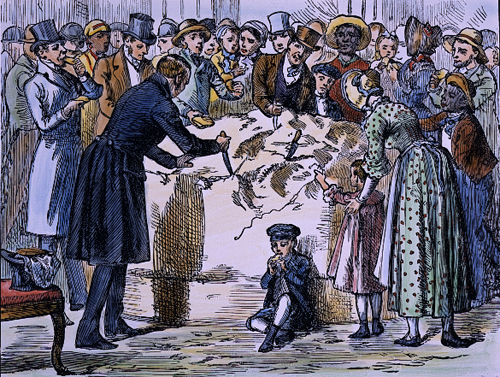
So did you know that in 1836 a New York farmer presented Andrew Jackson with a mammoth wheel of cheddar cheese as a gift? Weighing more than 1,400 pounds, it was four feet in diameter and stood nearly three feet high. Jackson let the gift sit, aging, for more than a year in the vestibule (lobby) of the White House.

A few weeks before leaving office, he invited the public to a reception in honor of George Washington’s birthday. According to eyetwitness accounts, thousands of well-wishers swarmed to the White House, hoping to get a glimpse of the departing president – and a piece of the cheese!

When the last guests finally left, all that remained of the cheese were the pieces that had been ground into the carpet, smudged across the damask walls, and smeared on the silk curtains. Although there wasn't much cheese left for Jackson to enjoy, you can make this tasty recipe for Cheddar Cheese Puffs if you've got a crowd to entertain this weekend!

1 stick butter (8 Tbsp or 4 ounces)
1 cup water
1/2 teaspoon salt
1 cup all purpose flour
4 large eggs
1 cup (4 ounces) grated sharp cheddar cheese
2 teaspoons chopped fresh thyme (or rosemary)
Freshly ground pepper

In a medium sized saucepan, add the water, butter, and salt, and bring to a boil over high heat. Reduce the heat to medium and add the flour all at once. Stir rapidly. The mixture will form a dough ball that will pull away from the sides of the pan. It helps to use a wooden spoon to stir as the dough will be rather thick. Continue to cook for a couple minutes.

Remove the pan from the heat and let cool for a couple of minutes. Stir so that the dough cools more evenly. You want the dough to be warm, just not so hot that when you start adding eggs they cook as they hit the dough. Add the eggs one at a time, stirring after each addition until the eggs are incorporated into the dough. (Do this part in a mixer if you want, or by hand with a wooden spoon.) The dough should become rather creamy. Stir in the grated cheese, thyme, and a few grinds of pepper.

Preheat oven to 425°F. Spoon out small balls (about a heaping tablespoon) of the dough onto a Silpat or parchment lined baking sheet, with at least an inch separating the spoonfuls. Place in oven and cook for 10 minutes at 425°F. Lower heat to 350°F and cook for another 15-20 minutes, until puffed up and lightly golden.
Makes about 2 dozen.

Credit: Jackson's Great Cheese Leeve, painting by Benjamin Poole, 1886