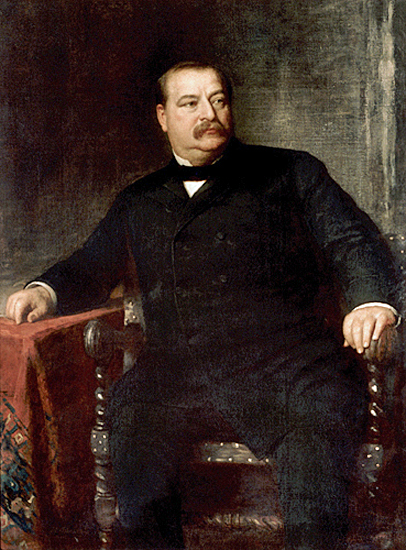
So did you know that Grover Cleveland's name is associated with a long-standing debate over the name of the Baby Ruth bar? Some people say that this popular candy bar was named after Cleveland's infant daughter Ruth, who was endearingly referred to as "Baby Ruth." Others claim that it was named after the great baseball player Babe Ruth, who hit the peak of his fame shortly after the candy bar was introduced in 1920.
According to Babe Ruth Central, this is how the story goes:
Back in 1916, the Curtiss Candy Company was founded in Chicago. The company's first candy bar was called the "Kandy Kake". The product was not overwhelmingly successful, so Curtiss went about refashioning it. And, in 1920, the "Baby Ruth" candy bar was introduced to candy-craving consumers.
That would be a pretty simple story, if it ended there. But, of course, it didn't. Adults and kids back then, just like today, were confused by the name and thought it was a candy bar related to Babe Ruth. After all, even in 1921, Babe already had gained a lot of fame in the baseball world. He had hit 54 home runs in 1920 and 59 during the 1921 season. These were incredible records at the time and he was in newspapers all over the country. So, for many, Baby Ruth was Babe Ruth's candy.
Despite widespread popular opinion that the candy bar was named after the Babe, the Curtiss Candy Company never swayed from its position that it was named in honor of Cleveland's daughter Ruth.
But...as many commentators have observed, Ruth died of diptheria in 1904, seventeen years "before Curtiss combined nougat, chocolate, caramel and peanuts into its chewy Baby Ruth." Moreover, Grover Cleveland left office in 1897, and, by the time the Baby Ruth bar hit the market in 1920, William McKinley, Theodore Roosevelt, and William Howard Taft had all served as president, and Woodrow Wilson was just finishing his second term.
So why would the Curtiss Company name its candy bar after a long-deceased daughter of a former president? Well, some claimed that the company conveniently concocted the story to avoid having to pay royalties to Babe Ruth, which, if true, would have been illegal and unfair.
Whatever the case may be, the story doesn't end there. In 1926, Babe agreed to lend his name to a new candy bar called "Ruth's Home Run Candy Bar" that was manufactured by the fledgling George H. Ruth Candy Company. In response, the Curtiss Company filed a lawsuit to prevent the rival candy bar from being made, claiming that it infringed on their trademark that had been established in 1919.
In 1931, the Court of Customs and Patent Appeals ruled in favor of the Curtiss Company and George Ruth's Home Run Bar was forced off the market. To support its ruling, the court explained that it was evident that George Ruth was trying to capitalize on his nickname at a time when sales of Baby Ruths were reportedly as high as $1 million a month.
Regardless of the legal outcome of the case, the debate over the name of the Baby Ruth bar continues to this day! And so NOW you know how Grover Cleveland's name became associated with the debate over the name of the Baby Ruth bar!
FAST FACT: So did you know that Grover Cleveland is the only American president to serve two non-consecutive terms. His first term was 1885-1889 and his second term was 1893-1897 which means he was the 22nd and 24th president of the United States. So that's why President Biden is the 46th president even though there have only been 45 different presidents to date!
Showing posts with label Woodrow Wilson. Show all posts
Tuesday, October 15, 2024
Tuesday, January 7, 2020
Woodrow Wilson, the Sinking of the Lusitania, and Food Blockades During World War I
On May 7, 1915, a German submarine torpedoed the British passenger liner RMS Lusitania en route from New York City to Liverpool. Attacked without warning off the coast of Ireland, the ship sank in fifteen minutes, killing 1,198 civilians, including 128 Americans.
Woodrow Wilson immediately denounced the sinking of the Lusitania in harsh, threatening terms, demanding that Germany pledge to never launch another attack on citizens of neutral countries, even when traveling on French or British ships. Germany initially acquiesced to Wilson's demand, but only temporarily. In March, 1916, a German U-boat torpedoed the French passenger liner Sussex, causing a heavy loss of life and injuring several Americans.
Two months later, in what's known as the Sussex pledge, Germany announced that they would no longer sink Allied merchant ships without warning but made it clear that it would resume submarine attacks if the Allies refused to respect international law, which, in effect, meant that the Allies had to lift their blockades of food and other raw materials bound for the Central Powers.
Despite further provocations, President Wilson still hoped for a negotiated settlement until February 1, 1917, when Germany resumed submarine warfare against merchant ships, including those of the United States and other neutral countries. In response, Wilson broke off diplomatic relations with Germany.
Then, on Feb. 25, the British intercepted and decoded a telegram from Germany's foreign secretary Arthur Zimmermann to the German ambassador in Mexico. The so-called "Zimmermann telegram" proposed that in the event of war with the United States, Germany and Mexico would form an alliance. In return, Germany promised to regain for Mexico its "lost provinces" of Texas, Arizona, and New Mexico.
The release of the Zimmermann Telegram ignited a public furor that was further enflamed by the loss of three U.S. merchant ships to German submarines. After much thought and introspection, President Wilson appeared before a joint session of Congress on the evening of April 2, 1917 and asked for a declaration of war against Germany.
This is a partial excerpt of what he said:
It is a fearful thing to lead this great peaceful people into war, into the most terrible and disastrous of all wars, civilization itself seeming to be in the balance. But the right is more precious than peace, and we shall fight for the things which we have always carried nearest our hearts - for democracy, for the right of those who submit to authority to have a voice in their own governments, for the rights and liberties of small nations, for a universal dominion of right by such a concert of free peoples as shall bring peace and safety to all nations and make the world itself at last free. To such a task we dedicate our lives and our fortunes...
Wilson was having lunch in the State Dining Room when word came that the Declaration of War had arrived for his signature. Although no one knows what Wilson ate for lunch on that momentous day, we do know that by the time the United States entered the war, German submarines were taking a catastrophic toll on the supplies of food and other provisions being shipped to Britain from abroad.
In response, the British Admiralty established a system of convoys. Under the plan, merchant ships were grouped together in "convoys" and provided with warship escorts through the most dangerous stretches of the North Atlantic.
The convoys had a dramatic effect. By the end of 1917, the tonnage of Allied shipping lost each month to German U-boat attacks plummeted from one million tons in April to 350,000 tons in December. And while many other factors were at play, the increase in food and other necessary provisions helped stiffen the resolve of French and British troops and thwarted Germany’s attempt to force Britain’s surrender.
Tuesday, February 17, 2015
Woodrow Wilson, the Sinking of the Lusitania, and Food Blockades During World War I
On May 7, 1915, a German submarine torpedoed the British passenger liner Lusitania that was en route from New York City to London. Attacked without warning, the ship sank in fifteen minutes, killing 1,198 civilians, including 128 American men, women and children. Woodrow Wilson immediately denounced the sinking of the Lusitania in harsh, threatening terms and demanded that Germany pledge to never launch another attack on citizens of neutral countries, even when traveling on French or British ships. Germany initially acquiesced to Wilson's demand but only temporarily. In March of 1916, a German U-boat torpedoed the French passenger liner Sussex, causing a heavy loss of life and injuring several Americans.
Two months later, in what is known as the Sussex pledge, German officials announced that they would no longer sink Allied merchant ships without warning. At the same time, however, they made it clear that it would resume submarine attacks if the Allies refused to respect international law, which in effect meant that the Allies had to lift their blockades of food and other raw materials bound for the Central powers.
Despite further provocations, President Wilson still hoped for a negotiated settlement until February 1, 1917, when Germany resumed submarine warfare against merchant ships, including those of the United States and other neutral countries. In response, Wilson immediately broke off diplomatic relations with Germany.
Then, on February 25, the British intercepted and decoded a telegram from Germany's foreign secretary Arthur Zimmermann to the German ambassador in Mexico. The so-called "Zimmermann telegram" proposed that in the event of war with the United States, Germany and Mexico would form an alliance. In return, Germany promised to regain for Mexico its "lost provinces" of Texas, Arizona, and New Mexico.
The release of the Zimmermann Telegram ignited a public furor that was further enflamed by the loss of at least three U.S. merchant ships to German submarines. All hope for neutrality was now lost, and, on April 2, 1917, Wilson appeared before a joint session of Congress and asked for a Declaration of War against Germany.
This is a partial excerpt of what he said:
It is a fearful thing to lead this great peaceful people into war, into the most terrible and disastrous of all wars, civilization itself seeming to be in the balance. But the right is more precious than peace, and we shall fight for the things which we have always carried nearest our hearts - for democracy, for the right of those who submit to authority to have a voice in their own governments, for the rights and liberties of small nations, for a universal dominion of right by such a concert of free peoples as shall bring peace and safety to all nations and make the world itself at last free. To such a task we dedicate our lives and our fortunes...
Wilson was having lunch in the State Dining Room of the White House when he received word that the Declaration of War had arrived for his signature. Although no one knows what Wilson ate for lunch on that momentous day, we do know that by the time the United States entered the war, German submarines were taking a devastating toll on the supplies of food and other provisions being shipped to Britain from abroad.
In response, the British admiralty decided to establish a system of convoys. Under the plan, merchant ships were grouped together in "convoys" and provided with warship escorts through the most dangerous stretches of the North Atlantic. The convoys had a dramatic effect. By the end of 1917, the tonnage of Allied shipping lost each month to German U-boat attacks plummeted from one million tons in April to about 350,000 tons in December.
And although many other critical factors were at play, the increase in food and other necessary wartime provisions helped to stiffen the resolve of French and British troops and thwarted Germany’s attempt to force Britain’s surrender.
Thursday, December 11, 2014
Grover Cleveland, Babe Ruth and the Debate over the Name of the Baby Ruth Bar
So did you know that Grover Cleveland's name is associated with a long-standing debate over the name of the Baby Ruth bar? Some people say that this popular candy bar was named after Cleveland's infant daughter Ruth, who was endearingly referred to as "Baby Ruth." Others claim that it was named after the great baseball player Babe Ruth, who hit the peak of his fame shortly after the candy bar was introduced in 1920. According to Babe Ruth Central, this is how the story goes:
Back in 1916, the Curtiss Candy Company was founded in Chicago. The company's first candy bar was called the "Kandy Kake". The product was not overwhelmingly successful, so Curtiss went about refashioning it. And, in 1920, the "Baby Ruth" candy bar was introduced to candy-craving consumers.
That would be a pretty simple story, if it ended there. But, of course, it didn't. Adults and kids back then, just like today, were confused by the name and thought it was a candy bar related to Babe Ruth. After all, even in 1921, Babe already had gained a lot of fame in the baseball world. He had hit 54 home runs in 1920 and 59 during the 1921 season. These were incredible records at the time and he was in newspapers all over the country. So, for many, Baby Ruth was Babe Ruth's candy, whether truth or not.
Despite widespread popular opinion that the candy bar was named after the Babe, the Curtiss Candy Company never swayed from its position that it was named in honor of Cleveland's daughter Ruth.
But...as many commentators have observed, Ruth died of diptheria in 1904, seventeen years "before Curtiss combined nougat, chocolate, caramel and peanuts into its chewy Baby Ruth." Moreover, Grover Cleveland left office in 1897, and, by the time the Baby Ruth bar hit the market in 1920, William McKinley, Theodore Roosevelt, and William Howard Taft had all served as president, and Woodrow Wilson was just finishing his second term.
So why would the Curtiss Company name its candy bar after a long-deceased daughter of a former president? Well, many people believed that the company conveniently concocted the story to avoid having to pay royalties to Babe Ruth.
Whatever the case may be, the story doesn't end there. In 1926, Babe agreed to lend his name to a new candy bar called "Ruth's Home Run Candy Bar" that was manufactured by the fledgling George H. Ruth Candy Company. In response, the Curtiss Company filed a lawsuit to prevent the rival candy bar from being made, claiming that it infringed on their trademark established in 1919.
In 1931, the Court of Customs and Patent Appeals ruled in favor of the Curtiss Company and George Ruth's Home Run Bar was forced off the market. To support its ruling, the court explained that it was evident that George Ruth was trying to capitalize on his nickname at a time when sales of Baby Ruths were reportedly as high as $1 million a month.
Regardless of the legal outcome of the case, the debate over the name of the Baby Ruth bar continues to this day! And so NOW you know how Grover Cleveland's name became associated with the debate over the name of the Baby Ruth bar!
FAST FACT: So did you know that Grover Cleveland is the only American president to serve two non-consecutive terms. His first term was 1885-1889 and his second term was 1893-1897 which means he was the 22nd and 24th president of the United States. So that's why President Obama is the 44th president even though there have only been 43 different presidents to date!
Friday, May 20, 2011
Woodrow Wilson, the Sinking of the Lusitania, and Food Blockades during World War I
On May 7, 1915, a German submarine torpedoed the British passenger liner Lusitania that was en route from New York City to London. Attacked without warning, the ship sank in fifteen minutes, killing 1,198 civilians, including 128 American men, women and children. Woodrow Wilson immediately denounced the sinking of the Lusitania in harsh, threatening terms and demanded that Germany pledge to never launch another attack on citizens of neutral countries, even when traveling on French or British ships. Germany initially acquiesced to Wilson's demand but only temporarily. In March of 1916, a German U-boat torpedoed the French passenger liner Sussex, causing a heavy loss of life and injuring several Americans.
Two months later, in what is known as the Sussex pledge, German officials announced that they would no longer sink Allied merchant ships without warning. At the same time, however, they made it clear that it would resume submarine attacks if the Allies refused to respect international law, which in effect meant that the Allies had to lift their blockades of food and other raw materials bound for the Central powers.
Despite further provocations, President Wilson still hoped for a negotiated settlement until February 1, 1917, when Germany resumed submarine warfare against merchant ships, including those of the United States and other neutral countries. In response, Wilson immediately broke off diplomatic relations with Germany.
Then, on February 25, the British intercepted and decoded a telegram from Germany's foreign secretary Arthur Zimmermann to the German ambassador in Mexico. The so-called "Zimmermann telegram" proposed that in the event of war with the United States, Germany and Mexico would form an alliance. In return, Germany promised to regain for Mexico its "lost provinces" of Texas, Arizona, and New Mexico.
The release of the Zimmermann Telegram ignited a public furor that was further enflamed by the loss of at least three U.S. merchant ships to German submarines. After deep thought and introspection, President Wilson appeared before a joint session of Congress on the evening og April 2, 1917 and asked for a declaration of war against Germany.
This is a partial excerpt of what he said:
It is a fearful thing to lead this great peaceful people into war, into the most terrible and disastrous of all wars, civilization itself seeming to be in the balance. But the right is more precious than peace, and we shall fight for the things which we have always carried nearest our hearts - for democracy, for the right of those who submit to authority to have a voice in their own governments, for the rights and liberties of small nations, for a universal dominion of right by such a concert of free peoples as shall bring peace and safety to all nations and make the world itself at last free. To such a task we dedicate our lives and our fortunes...
Wilson was having lunch in the State Dining Room when he received word that the declaration of war had arrived for his signature. Although no one knows what Wilson ate for lunch on that momentous day, we do know that by the time the United States entered the war, German submarines were taking a catastrophic toll on the supplies of food and other provisions being shipped to Britain from abroad.
In response, the British admiralty decided to establish a system of convoys. Under the plan, merchant ships were grouped together in "convoys" and provided with warship escorts through the most dangerous stretches of the North Atlantic. The convoys had a dramatic effect. By the end of 1917, the tonnage of Allied shipping lost each month to German U-boat attacks plummeted from one million tons in April to about 350,000 tons in December.
And although many other critical factors were at play, the increase in food and other necessary wartime provisions helped to stiffen the resolve of French and British troops and thwarted Germany’s attempt to force Britain’s surrender.
Thanks for stopping by THE HISTORY CHEF! And for a flash sale today for my book click here!
Thursday, September 30, 2010
Woodrow Wilson, Prohibition, and the Boston Molasses Disaster of 1919
At 12:40 p.m. on January 15, 1919, in Boston’s Industrial North End, a fifty-five foot high steel storage tank containing more than two million gallons of molasses exploded, unleashing an immense wave of thick, viscous goo that swept through the city streets as fast as 35 miles per hour. The wave – initially thirty feet high, according to some bystanders – exerted enough force “to break the girders of the adjacent Boston Elevated Railway's Atlantic Avenue structure and lift a train off its tracks.” The force of the blast and the ensuing tsunami also overturned dozens of cars and trucks in its path and "demolished several nearby buildings, including a fire station which was crushed by a huge chunk of the steel tank."
Witnesses later stated that, as the tank collapsed, there was a loud rumbling sound, like a machine gun, and that “the ground shook as if a train were passing by.” In his book, Black Tide, Stephen Puleo described the disaster this way:
Molasses, waist deep, covered the street and swirled and bubbled about the wreckage. Here and there struggled a form — whether it was animal or human being was impossible to tell. Only an upheaval, a thrashing about in the sticky mass, showed where any life was…Horses died like so many flies on sticky fly-paper. The more they struggled, the deeper in the mess they were ensnared. Human beings — men and women — suffered likewise.
The next morning, the Boston Evening Globe ran a front-page story based on eyewitness accounts taken on that terrible day:
Fragments of the great tank were thrown into the air, buildings in the neighborhood began to crumple up as though the underpinnings had been pulled away from under them, and scores of people in the various buildings were buried in the ruins, some dead and others badly injured.
In all, more than 150 people were injured and 21 children and adults were killed, mostly by crushing or asphyxiation. Fueled by the intense anti-immigrant sentiments that swept through the United States during the post-World War I Red Scare, owners of the distillery tried to pin the disaster on Italian anarchists, claiming that they had bombed the tank because they knew that the molasses was intended to be fermented to produce ethyl alcohol, a key component in the manufacturing of munitions at the time.
Although the exact cause of the disaster was never determined, no evidence of sabotage was ever found and experts generally attributed it to unseasonably warm temperatures combined with structural defects and poor maintenance of the tank.
So what does this have to do with President Woodrow Wilson and food? Well, by coincidence, the day after the disaster, Congress ratified the 18th Amendment of the United States Constitution, which prohibited the manufacture, sale, and distribution of intoxicating liquors. With Prohibition looming on the horizon, rumors began to circulate which held that the tank had been overfilled to enable the owners of the distillery to produce as much rum as quickly as possible before the law took effect.
This claim was later proven untrue due to the fact that the distillery didn't make rum and specialized instead in the production of industrial alcohol, which was exempt from the state prohibition laws in effect at the time, and would later be exempted from the Volstead Act, which was passed by Congress on October 27, 1919 over President Wilson's veto.
Regardless of the cause, more than one hundred lawsuits were filed against the owners of the tank, and litigation dragged on for six years, during which 3,000 witnesses testified. In the end, the court ruled for the plaintiffs and ordered the company to pay nearly a million dollars in damages - a "bittersweet victory for survivors of one of the strangest disasters in American history."
FOOD FACT: Molasses was once used in the United States as the primary sweetener in cooking and baking. According to the Oxford Encyclopedia of Food and Drink, New England colonists also used molasses "as an ingredient in brewing birch beer and molasses beer and in distilling rum." In the early 1700s, "rum made in New England became an essential element in a highly profitable Triangular Trade across the Atlantic. The colonists exported rum to West Africa in trade for slaves; the ships brought the slaves from Africa to the French West Indies, trading them for more molasses and sugar; these products were then shipped to New England to make more rum....When the cost of refined sugar dropped at the end of the nineteenth century...molasses lost its role as an important sweetener in the American diet."
Monday, August 9, 2010
Franklin Delano Roosevelt and the Mysterious Origins of Country Captain Chicken
Although they may have become accustomed to elegant State Dinners, many American presidents enjoyed a wide variety of homey dishes prepared with chicken while living in the White House. James Madison was reportedly fond of Chicken and Okra Soup, James Monroe retained a childhood taste for Chicken Pudding with Fried Rice, and it has been said that Woodrow Wilson frequently requested that Chicken Salad be put on the White House luncheon menu during his two terms of office. But that's not all. John F. Kennedy and his wife Jackie were fond of Poulet a l'Estragon (Chicken Tarragon); Richard Nixon reportedly enjoyed his daughter Tricia's homemade Chicken Divan; Bill Clinton was, and perhaps still is, partial to chicken enchildas made with a cheese similar in texture and taste to Velveeta; and one of Franklin Delano Roosevelt's favorite dishes was reportedly Country Captain Chicken, a curried-chicken dish with mysterious origins.
In her nineteenth-century cookbook, Eliza Leslie claimed that the dish got its name from a British officer who brought the recipe back from his station in India. Others maintain that the dish originated in Savannah, Georgia, which was a major shipping port for the spice trade. In Rare Bits: Unusual Origins of Popular Recipes, Paterica Bunning Steven puts forth another other theory about the origins of this slightly spicy chicken dish:
According to an oft-repeated story, a sea-captain sailed into Charleston harbor with a shipload of spices from India. Entertained by the hostesses of a city noted for its graciousness, he repaid their kindness by teaching their capable cooks to make a delicious dish of chicken and curry. Alas for legend! A virtually identical dish is known in England, where it goes by the very same name. The captain, if there ever was one, must have been a British officer stationed in the back country of India. An English writer has noted that "country captain" is also an Anglo-Indian term from the captian of a...ship...from a foreign country. Just how or if that fits into the puzzle would be difficult to say. Another suggestion is that Country Captain may be only a corruption of "country capon."
Although no one knows exactly who created and named this dish, we do know that it has been popular throughout the south for centuries. If you'd like to try it someday, here is a simple and delicious "30-minute Recipe" from the Food Network's ever-peppy Rachel Ray:
2 3/4 cups water
1 tablespoon butter
1 1/2 cups white and wild rice or long grain rice
2/3 cup flour, eyeball it
1 rounded tablespoon sweet paprika
4 pieces, 6 ounces each, boneless, skinless chicken breast
3 boneless, skinless chicken thighs
Salt and freshly ground black pepper
2 tablespoons extra-virgin olive oil, 2 turns of the pan
2 tablespoons butter
1 green bell pepper, seeded and chopped
1 red bell pepper, seeded and chopped
1 medium onion, chopped
2 or 3 large cloves garlic, smashed
1 tablespoon curry powder or mild curry paste
1 cup chicken stock
1 can diced tomatoes in puree or chunky style crushed tomatoes
1/4 cup golden raisins or currants, a couple of handfuls
2 ounces, 1 small pouch, sliced almonds, lightly toasted
3 scallions, chopped, for garnish
Bring water to a boil in a medium saucepan. Add butter and rice and return water to a boil. Reduce heat to low and cover the pot. Cook rice 20 minutes or until tender. Turn off heat and fluff rice with a fork.
Combine flour and paprika in a shallow dish. Season chicken with salt and pepper. Cut each chicken breast and thigh in 1/2 on an angle. Coat chicken pieces in paprika seasoned flour. Wash your hands and chicken work surfaces thoroughly.
Heat a large skillet over medium high heat. Add oil to the pan. Brown chicken pieces, 3 minutes on each side, and remove from the skillet. Add butter to the pan, then stir in peppers, onions and garlic. Season the veggies with salt and pepper and saute them 5 to 7 minutes to soften.
Add curry, stock, tomatoes and raisins. Slide chicken back into the skillet and simmer over moderate heat for 5 minutes to combine flavors and finish cooking the chicken through. Place skillet on a trivet and serve the chicken from the pan. Garnish the Country Captain's chicken with sliced almonds. Transfer rice to a serving dish and garnish with chopped scallions.
FOOD FACT: So now that we know which presidents liked to eat dishes prepared with chicken, it seems only fair that we consider what chickens like and need to eat for their well-being. According to experts, chickens need grains; greens (like grass, green vegetables and weeds); protein (from bugs, worms, milk and meat); calcium (from Oyster shells); as well as Vitamins A and D, and salt. And because a chicken's weight is made up of more than fifty percent water, they need a constant supply of fresh water to "drink."
Credit: Chicks Feeding, oil on canvas by Lucy Ann Leavers
Subscribe to:
Posts (Atom)