Showing posts with label James Monroe. Show all posts

Monday, December 8, 2014

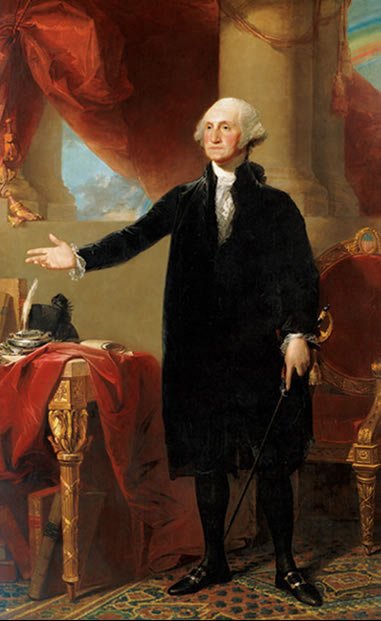
George Washington's Ice House at Mount Vernon

So did you know that one of George Washington’s favorite desserts was ice cream? In fact, he liked this soft, creamy treat so much that he had an ice house constructed near his Mount Vernon home so that he and his family could eat ice cream often.

Historians say that Washington’s icehouse was located on a riverbank about 75 yards from the Potomac. To store ice, Washington’s slaves had to use chisels and axes to pull large chunks of ice from the frozen river during the wintertime and then haul them to the icehouse where they were stacked in layers and stored for use throughout the spring and summer.

Before constructing his ice house, Washington sought advice from his friend and fellow patriot Robert Morris, who had an ice house at his home at 6th & Market Streets in Philadelphia. In a letter to Washington, Morris provided a detailed account of how his ice house had been constructed:

My Ice House is about 18 feet deep and 16 square, the bottom is a Coarse Gravell & the water which drains from the ice soaks into it as fast as the Ice melts, this prevents the necessity of a Drain...the Walls of my Ice House are built of stone without Mortar...On these [walls] the Roof is fixed...I nailed a Ceiling of Boards under the Roof flat from Wall to Wall, and filled the Space between the Ceiling and the Shingling of the Roof with Straw so that the heat of the Sun Cannot possibly have any Effect...

The Door for entering this Ice house faces the north, a Trap Door is made in the middle of the Floor through which the Ice is put in and taken out. I find it best to fill with Ice which as it is put in should be broke into small pieces and pounded down with heavy Clubs or Battons such as Pavers use, if well beat it will after a while consolidate into one solid mass and require to be cut out with a Chizell or Axe. I tried Snow one year and lost it in June. The Ice keeps until October or November and I believe if the Hole was larger so as to hold more it would keep untill Christmas...


Although Morris didn't mention what he stored in his icehouse, we do know that the Washingtons used theirs to preserve meat and butter, chill wine, and make ice cream and other frozen delicacies for their many guests at Mount Vernon.

Of course, George Washington wasn’t the only president who enjoyed ice cream. Accounts of it often appear in letters describing the many elegant dinner parties hosted by James and Dolley Madison, and the dish frequently appears in visitors' accounts of meals with Thomas Jefferson.

One particular guest wrote: "Among other things, ice-creams were produced in the form of balls of the frozen material inclosed in covers of warm pastry, exhibiting a curious contrast, as if the ice had just been taken from the oven." If you'd like to whip up some ice cream contained in warm pastry for your next dinner party, here's a simple recipe to try from puffpastry.com

1/2 of a 17.3-ounce package pastry sheets, 1 sheet, thawed
1 pint chocolate ice cream, softened
1 pint strawberry ice cream, soft
Chocolate fudge topping

Heat the oven to 400°F. Unfold the pastry sheet on a lightly floured surface. Cut the pastry sheet into 3 strips along the fold marks. Place the pastries onto a baking sheet. Bake for 15 minutes or until the pastries are golden brown. Remove the pastries from the baking sheet and let cool on a wire rack for 10 minutes. Split each pastry into 2 layers, making 6 in all.

Reserve 2 top pastry layers. Spread the chocolate ice cream on 2 bottom pastry layers. Freeze for 30 minutes. Top with another pastry layer and spread with the strawberry ice cream. Top with the reserved top pastry layers. Freeze for 30 minutes or until the ice cream is firm. Drizzle with the chocolate topping.

FAST FACT: In 1790, Robert Morris's house at 6th & Market Streets became the Executive Mansion of the United States while Philadelphia served as the temporary capital of the nation. Morris' icehouse was used by President Washington and his household until 1797, and by President John Adams and his family from 1797 to 1800.

Thursday, December 4, 2014

James Monroe, Virginia Spoon Bread, and the Long Winter at Valley Forge

While serving in the Continental Army, James Monroe crossed the Delaware with George Washington, fought at the Battle of Trenton, and endured the long winter at Valley Forge.

Among the soldiers at Valley Forge were Benedict Arnold, Alexander Hamilton, the Marquis de Lafayette, and the future Supreme Court Chief Justice John Marshall. Another soldier encamped there was Dr. Albigence Waldo, a surgeon from Connecticut, whose diary provides perhaps the best account we have of conditions that winter at Valley Forge:

Dec. 21st., Preparations made for hutts. Provision Scarce...sent a Letter to my Wife. Heartily wish myself at home, my Skin & eyes are almost spoiled with continual smoke. A general cry thro' the Camp this Evening among the Soldiers, "No Meat !, No Meat !", the Distant vales Echo'd back the melancholly sound, "No Meat ! No Meat !"…What have you for our Dinners Boys?" Nothing but Fire Cake & Water, Sir." At night, "Gentlemen the Supper is ready." What is your Supper, Lads? " Fire Cake & Water, Sir..."

Dec. 22nd., Lay excessive Cold & uncomfortable last Night, my eyes are started out from their Orbits like a Rabbit's eyes, occation'd by a great Cold, and Smoke. What have you got for Breakfast, Lads ? " Fire Cake & Water, Sir." I am ashamed to say it, but I am tempted to steal Fowls if I could find them, or even a whole Hog, for I feel as if I could eat one…But why do I talk of hunger & hard usage, when so many in the World have not even fire Cake & Water to eat..
.

After the war, Monroe returned to Virginia and studied law under Thomas Jefferson, then served as governor of Virginia and was later appointed as U.S. Minister to France. Like Jefferson, Monroe developed a fondness for fancy French cuisine, but historians say that he retained a boyhood taste for Spoon Bread and other simple foods of his Virginia youth.

Because it has a consistency similar to pudding, Spoon Bread is usually served straight from the baking pan with a large spoon. If you'd like to whip up a batch today, here's a quick and simple recipe to try:

¾ cup cornmeal
1 teaspoon salt
1 cup water
3 tablespoons melted butter
2 eggs
1 cup milk
2 teaspoons baking powder

Combine cornmeal and salt in a mixing bowl. Gradually add boiling water. Stir in melted butter.

In a small mixing bowl, beat eggs and milk. Add egg and milk mixture to the cornmeal mixture. Add baking powder and mix.

Pour into a greased baking dish. Bake at 350° for about 30 minutes, until set and lightly browned. Serve straight from the baking dish with a spoon and enjoy!

FAST FACT: In Emmanuel Luetz’s famous painting “Washington Crossing the Delaware,” James Monroe is depicted directly behind Washington, holding an American flag up against the storm. Measuring 12 feet high and 21 feet long, it's on display at the Metropolitan Museum of Art in New York City.

Monday, September 15, 2014

James Monroe, Mississippi Steamboatin' and "Food Piled High on a Long Linen Cloth"

So did you know that James Monroe was the first president to ride and possibly dine on a steamboat? By the 1820s, steamboats were in use on most of the major rivers, canals, and waterways in the United States.

The steamboat completely revolutionized shipping. For the first time in history, people didn't have to rely on unpredictable currents and winds and could travel to just about any port at any time. Plantation owners in Mississippi, Missouri, and Louisiana, for example, could cheaply and easily ship cargoes of sugar, cotton and other goods upriver on the Mississippi rather than send them around the tip of Florida and up the Eastern seaboard as they had previously done.

Steamboats also provided a luxurious way for wealthy passengers to travel. In Mississippi Steamboatin’, Herbert Quick described the palatial setting and abundance of food served on later steamboats:

The palatial setting of later steamboats attracted pleasure-seekers and wealthy travelers...More comfortable than their 'settin' rooms,' more ornate than their prim and uncomfortable parlors...they saw the steamboat's cabin as a bewilderingly beautiful palace.

The...glistening cut-glass chandeliers; the soft oil paintings on every stateroom door; the thick carpets that transformed walking into a royal march; the steaming foods piled high on the long linen cloth in the dining room, with attentive waiters standing at the traveler's elbow, waiting with more food, and gaily colored desserts in the offing - neither homes nor hotels...were ever like this.


Between 1814 (three years before Monroe took office) and 1834, steamboat arrivals in New Orleans increased from 20 to 1,200 each year. For the next half century, steamboats were the main transporter of American goods, and tiny river towns grew into thriving cities “when steamboats began to make regular stops at their docks.”

FAST FACT: If you've ever watched steam rise from a cup of hot chocolate or coffee, you might think that a steamboat is propelled by steam. That makes sense, but that isn't exactly how a steamboat works. In a steamboat's engine, wood or other fuel is burned to heat water in a boiler, and the steam that rises from the water is forced through small spaces (piston cylinders) to increase the speed at which it escapes, similar to the release of a valve on a pressure-cooker. The concentrated steam then hits and moves a paddlewheel which, in turn, propels the steamboat through water!

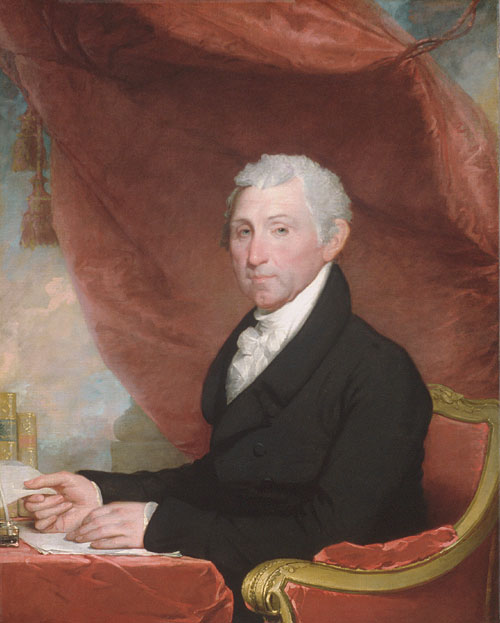
Credit: James Monroe, oil on canvas by Gilbert Stuart (Metropolitan Museum of Art, New York)

Monday, July 8, 2013

James Monroe, the Erie Canal, and "I Eat My Meals with Sal Each Day"

So did you know that during James Monroe’s presidency, many canals were built, mostly in the northeastern states? One of the most famous was the Erie Canal. Originally, it was forty feet wide, four feet deep, and 363 miles long, and stretched from Albany (on the upper Hudson River) to Buffalo (on the eastern shore of Lake Erie).

Teams of horses and mules trotted alongside the canal on a dirt road, called a "tow path," and pulled along flat-bottomed barges and boats called "packets". The opening of the canal in 1825 triggered the first major western migration in the United States, as countless thousands of pioneers and farmers rushed to the fertile lands of Ohio, Illinois, Indiana, and beyond.

Soon, settlers in the Midwest were shipping cargoes of wheat, corn and other foodstuffs to the big cities of the Northeast. On the return trip, farming supplies and other manufactured goods were shipped west. Realizing the great fortunes to be made from shipping the raw materials of the west to the big cities of the east, Americans embarked upon a “canal-building craze" that lasted until the rise of the railroads.

Historians say that the Erie Canal was the transportation marvel of its day. It reduced travel time from the Hudson River to the Great Lakes by more than a half and provided travelers with "a welcome alternative to the rutted, muddy road of the stage coach." In 1836, Thomas S. Woodcock made the trip from Schenectady, New York to Buffalo and described the abudance of food and other luxuries of life provided on a packet:

These boats are about 70 feet long, and with the exception of the Kitchen and bar, is occupied as a Cabin. The forward part being the ladies' Cabin, is separated by a curtain, but at meal times this obstruction is removed, and the table is set the whole length of the boat. The table is supplied with every thing that is necessary and of the best quality with many of the luxuries of life...

The Bridges on the Canal are very low, particularly the old ones. Indeed they are so low as to scarcely allow the baggage to clear, and in some cases actually rubbing against it. Every Bridge makes us bend double if seated on anything, and in many cases you have to lie on your back.

The Man at the helm gives the word to the passengers: 'Bridge,' 'very low Bridge,' 'the lowest in the Canal,' as the case may be. Some serious accidents have happened for want of caution. A young English Woman met with her death a short time since, she having fallen asleep with her head upon a box, had her head crushed to pieces. Such things however do not often occur, and in general it affords amusement to the passengers who soon imitate the cry, and vary it with a command, such as 'All Jackson men bow down.' After such commands we find few aristocrats.


Sadly nostalgic, the classic American folk song "Low Bridge” recalls the years from 1825 to 1880 when mule barges on the Erie Canal "made boomtowns out of Utica, Syracuse, Rochester, and Buffalo, and transformed New York into the Empire State." Maybe you remember the lyrics:

I've got an old mule and her name is Sal
Fifteen years on the Erie Canal
She's a good old worker and a good old pal
Fifteen years on the Erie Canal
We've hauled some barges in our day
Filled with lumber, coal, and hay
And we know every inch of the way
From Albany to Buffalo

Low bridge, everybody down
Low bridge for we're coming to a town
And you'll always know your neighbor
And you'll always know your pal
If you've ever navigated on the Erie Canal…

Don't have to call when I want my Sal
Fifteen miles on the Erie Canal
She trots from her stall like a good old gal
Fifteen miles on the Erie Canal
I eat my meals with Sal each day
I eat beef and she eats hay
And she ain't so slow if you want to know
She put the "Buff" in Buffalo…


Today, this classic old tune is part of American folk history and has been recorded by such popular folk singers as Pete Seeger and The Kingston Trio. Bruce Springsteen also recorded the tune on his 2006 album, "We Shall Overcome: The Seeger Sessions."

A LITTLE BACKGROUND: Shortly after taking office in 1817, James Monroe vetoed a bill to provide federal funds to build the Erie Canal. Like Jefferson and Madison, Monroe encouraged an American system of internal improvements to help the nation grow, but didn't believe that the federal government had the authority under the Constitution to use federal monies to fund state projects like the Erie Canal.

FAST FACT: Ten years after the Erie Canal opened, New York was the busiest port in the nation, moving more agricultural and industrial goods than Boston, Baltimore and New Orleans combined!

Friday, December 9, 2011

James Monroe, the Long Winter at Valley Forge, and Virginia Spoon Bread

So did you know that while serving in the Continental Army, James Monroe crossed the Delaware with George Washington, fought at the Battle of Trenton, and endured the long winter at Valley Forge? Among the patriots encamped there were Benedict Arnold, Alexander Hamilton, the Marquis de Lafayette, and the future Supreme Court Chief Justice John Marshall.

Another soldier there was Dr. Albigence Waldo, a surgeon from Connecticut,

Tuesday, November 29, 2011

Elizabeth Monroe Baked Apple Charlotte

From all accounts, the dinner parties hosted by James and Elizabeth Monroe were very formal affairs. Large dinners had an especially “cold air,” according to novelist James Fenimore Cooper, who was frequently invited to dine at the Monroe White House. Describing a particular dinner, Cooper wrote:

Monday, November 7, 2011

James Monroe, Mississippi Steamboatin' and "Food Piled High on a Long Linen Cloth"

So did you know that James Monroe was the first president to ride and possibly dine on a steamboat? By the 1820s, steamboats were in use on most of the major rivers, canals, and waterways in the United States.

Historians say that the steamboat completely revolutionized shipping. For the first time in history, people "didn't have to rely on unpredictable currents and winds and could travel to any port at any time." Plantation owners in the southern states of Mississippi, Missouri, and Louisiana, for example, could cheaply and easily ship cargoes of sugar, cotton, and other goods upriver on the Mississippi rather than send it around the tip of Florida and up the Eastern seaboard as they had previously done.

Steamboats also provided a luxurious way for wealthy passengers to travel. In Mississippi Steamboatin’, Herbert Quick described the palatial setting and abundance of food served on later steamboats:

The palatial setting of later steamboats attracted pleasure-seekers and wealthy travelers...More comfortable than their 'settin' rooms,' more ornate than their prim and uncomfortable parlors...they saw the steamboat's cabin as a bewilderingly beautiful palace. The...glistening cut-glass chandeliers; the soft oil paintings on every stateroom door; the thick carpets that transformed walking into a royal march; the steaming foods piled high on the long linen cloth in the dining room, with attentive waiters standing at the traveler's elbow, waiting with more food, and gaily colored desserts in the offing - neither homes nor hotels...were ever like this.

Between 1814 (three years before Monroe took office) and 1834, steamboat arrivals in New Orleans increased from 20 to 1,200 each year. For the next half century, steamboats were the main transporter of American goods, and tiny river towns grew into thriving cities “when steamboats began to make regular stops at their docks.”

FAST FACT: If you've ever watched steam rise from a cup of hot chocolate or coffee, you might think that a steamboat is propelled by steam. That makes sense, but that isn't exactly how a steamboat works. In a steamboat's engine, wood or other fuel is burned to heat water in a boiler, and the steam that rises from the water is forced through small spaces (piston cylinders) to increase the speed at which it escapes, similar to the release of a valve on a pressure-cooker. The concentrated steam then hits and moves a paddlewheel which, in turn, propels the steamboat through water!

Credit: James Monroe, oil on canvas by Gilbert Stuart (Metropolitan Museum of Art, New York)

Monday, August 9, 2010

Franklin Delano Roosevelt and the Mysterious Origins of Country Captain Chicken

Although they may have become accustomed to elegant State Dinners, many American presidents enjoyed a wide variety of homey dishes prepared with chicken while living in the White House. James Madison was reportedly fond of Chicken and Okra Soup, James Monroe retained a childhood taste for Chicken Pudding with Fried Rice, and it has been said that Woodrow Wilson frequently requested that Chicken Salad be put on the White House luncheon menu during his two terms of office.

But that's not all. John F. Kennedy and his wife Jackie were fond of Poulet a l'Estragon (Chicken Tarragon); Richard Nixon reportedly enjoyed his daughter Tricia's homemade Chicken Divan; Bill Clinton was, and perhaps still is, partial to chicken enchildas made with a cheese similar in texture and taste to Velveeta; and one of Franklin Delano Roosevelt's favorite dishes was reportedly Country Captain Chicken, a curried-chicken dish with mysterious origins.

In her nineteenth-century cookbook, Eliza Leslie claimed that the dish got its name from a British officer who brought the recipe back from his station in India. Others maintain that the dish originated in Savannah, Georgia, which was a major shipping port for the spice trade. In Rare Bits: Unusual Origins of Popular Recipes, Paterica Bunning Steven puts forth another other theory about the origins of this slightly spicy chicken dish:

According to an oft-repeated story, a sea-captain sailed into Charleston harbor with a shipload of spices from India. Entertained by the hostesses of a city noted for its graciousness, he repaid their kindness by teaching their capable cooks to make a delicious dish of chicken and curry. Alas for legend! A virtually identical dish is known in England, where it goes by the very same name. The captain, if there ever was one, must have been a British officer stationed in the back country of India. An English writer has noted that "country captain" is also an Anglo-Indian term from the captian of a...ship...from a foreign country. Just how or if that fits into the puzzle would be difficult to say. Another suggestion is that Country Captain may be only a corruption of "country capon."

Although no one knows exactly who created and named this dish, we do know that it has been popular throughout the south for centuries. If you'd like to try it someday, here is a simple and delicious "30-minute Recipe" from the Food Network's ever-peppy Rachel Ray:

2 3/4 cups water
1 tablespoon butter
1 1/2 cups white and wild rice or long grain rice
2/3 cup flour, eyeball it
1 rounded tablespoon sweet paprika
4 pieces, 6 ounces each, boneless, skinless chicken breast
3 boneless, skinless chicken thighs
Salt and freshly ground black pepper
2 tablespoons extra-virgin olive oil, 2 turns of the pan
2 tablespoons butter
1 green bell pepper, seeded and chopped
1 red bell pepper, seeded and chopped
1 medium onion, chopped
2 or 3 large cloves garlic, smashed
1 tablespoon curry powder or mild curry paste
1 cup chicken stock
1 can diced tomatoes in puree or chunky style crushed tomatoes
1/4 cup golden raisins or currants, a couple of handfuls
2 ounces, 1 small pouch, sliced almonds, lightly toasted
3 scallions, chopped, for garnish

Bring water to a boil in a medium saucepan. Add butter and rice and return water to a boil. Reduce heat to low and cover the pot. Cook rice 20 minutes or until tender. Turn off heat and fluff rice with a fork.

Combine flour and paprika in a shallow dish. Season chicken with salt and pepper. Cut each chicken breast and thigh in 1/2 on an angle. Coat chicken pieces in paprika seasoned flour. Wash your hands and chicken work surfaces thoroughly.

Heat a large skillet over medium high heat. Add oil to the pan. Brown chicken pieces, 3 minutes on each side, and remove from the skillet. Add butter to the pan, then stir in peppers, onions and garlic. Season the veggies with salt and pepper and saute them 5 to 7 minutes to soften.

Add curry, stock, tomatoes and raisins. Slide chicken back into the skillet and simmer over moderate heat for 5 minutes to combine flavors and finish cooking the chicken through. Place skillet on a trivet and serve the chicken from the pan. Garnish the Country Captain's chicken with sliced almonds. Transfer rice to a serving dish and garnish with chopped scallions.

FOOD FACT: So now that we know which presidents liked to eat dishes prepared with chicken, it seems only fair that we consider what chickens like and need to eat for their well-being. According to experts, chickens need grains; greens (like grass, green vegetables and weeds); protein (from bugs, worms, milk and meat); calcium (from Oyster shells); as well as Vitamins A and D, and salt. And because a chicken's weight is made up of more than fifty percent water, they need a constant supply of fresh water to "drink."

Credit: Chicks Feeding, oil on canvas by Lucy Ann Leavers

Tuesday, November 3, 2009

James Monroe Virginia Spoon Bread

While serving in the Continental Army, James Monroe crossed the Delaware with George Washington, fought at the Battle of Trenton, and endured the harsh winter at Valley Forge.

Among the soldiers at Valley Forge were Benedict Arnold, Alexander Hamilton, the Marquis de Lafayette, and the future Supreme Court Chief Justice John Marshall. Another soldier encamped there was Dr. Albigence Waldo, a surgeon from Connecticut, whose diary provides perhaps the best account we have of conditions that winter at Valley Forge:

Dec. 22nd., Lay excessive Cold & uncomfortable last Night, my eyes are started out from their Orbits like a Rabbit's eyes, occation'd by a great Cold, and Smoke. What have you got for Breakfast, Lads ? " Fire Cake & Water, Sir." I am ashamed to say it, but I am tempted to steal Fowls if I could find them, or even a whole Hog, for I feel as if I could eat one…But why do I talk of hunger & hard usage, when so many in the World have not even fire Cake & Water to eat...

After the war, Monroe returned to Virginia and studied law under Thomas Jefferson. He then served as governor of Virginia and was later appointed U.S. Minister to France. Like Jefferson, Monroe developed a fondness for fancy French cuisine but retained a taste for Virginia Spoon Bread and other simple foods of his youth.

Because it has a consistency similar to pudding, Spoon Bread is usually served straight from the baking pan with a large spoon. If you would like to make some, here is a simple recipe to try:

¾ cup cornmeal
1 teaspoon salt
1 cup water
3 tablespoons melted butter
2 eggs
1 cup milk
2 teaspoons baking powder

Combine cornmeal and salt in a mixing bowl. Gradually add boiling water. Stir in melted butter.

In a small mixing bowl, beat eggs and milk. Add egg and milk mixture to the cornmeal mixture. Add baking powder and mix.

Pour into a greased baking dish. Bake at 350° for about 30 minutes, until set and lightly browned. Serve straight from the baking dish with a spoon and enjoy!

By the way, did you know that in Emmanuel Luetz’s painting “Washington Crossing the Delaware” James Monroe is depicted directly behind Washington, holding an American flag up against the storm? If you would like to see this painting (it measures 12 feet high and 21 feet long), it is on display at the Metropolitan Museum of Art in New York City.