Showing posts with label James Madison. Show all posts

Wednesday, November 30, 2016

Dolley Madison's Wednesday Squeezes


When James Madison and his wife Dolley moved into the President's House, she decided that the place could use some sprucing up and the room that Thomas Jefferson had used as an office soon became the State Dining Room. The adjacent parlor (today’s Red Room) was "redecorated in sunflower yellow, with sofas and chairs to match" and, one room over, the smaller but more formal elliptical salon was "decorated in the Grecian style with elegant cream-colored walls."

Together, these three rooms with their interconnecting doors became the venue for Dolley Madison’s legendary “Drawing Rooms,” or "Wednesday Squeezes," which often attracted as many as three hundreds guests and were the most popular social event in town!

Dressed in brightly colored satins or silks and often donning a feathered headpiece or bejeweled turban, Dolley cheerfully greeted and mingled with guests as they enjoyed a festive evening of refreshments, music, and lively conversation. Mrs. Madison also presided over elaborate dinner parties where she delighted guests with such unusual dessert items as pink pepperment ice cream baked in warm pastries.


The Madisons continued to entertain this way until "their brilliant social whirlwind" went up in flames during the War of 1812. On August 24, 1814, while James was away getting a report on the war, Dolley was supposedly awaiting forty dinner guests. Around three o’clock, word was received that British troops had defeated American forces at nearby Blandensburg and were marching toward the capital.

Before fleeing to safety, Dolley quickly gathered what she could, including important documents of her husband’s and Gilbert Stuart’s famous portrait of George Washington. When British soldiers entered the Executive Mansion later that day, they supposedly devoured the lavish dinner that had been left behind. They then piled up furniture, scattered oil-soaked rags in all of the rooms, and lit the President’s House afire!

Although the British quickly evacuated the capital, the months that followed weren't happy ones for the Madisons as many Americans criticized them for abandoning the President’s House and “allowing the destruction of the most visible symbol of the young republic.”

At their temporary residence, Dolley eventually hosted her Wednesday Squeezes again, but “the spirit was gone.” Then came word of General Andrew Jackson’s brilliant victory over the British in the Battle of New Orleans and the mood of the country was again jubilant. Although a peace treaty had been signed weeks earlier, the Battle of New Orleans transformed “Mr. Madison’s War” (which had been condemned as an unnecessary folly) into “a glorious reaffirmation of American independence."

Wednesday, March 4, 2015

Dolley Madison Fresh Strawberry Ice Cream!

Legend has it that in the early nineteenth century, a freed slave named Sallie Shadd went into her family’s catering business in Wilmington, Delaware. Sallie supposedly achieved fame there for a fabulous new dessert sensation she created with sugar, fruit and frozen cream.

When Dolley Madison heard about this new dessert, she supposedly travelled to Delaware to try it -- and she must have loved it because a magnificent dome of pink ice cream was served at President Madison’s second Inaugural Ball in 1813, and ice cream often appeared as the official dessert on the White House menus during her husband's two terms of office.

If you'd like to whip up some Fresh Strawberry Ice Cream this week, here's a tasty recipe to try from epicurious.com

1 3/4 cups heavy cream
3 (3- by 1-inch) strips fresh lemon zest
1/8 teaspoon salt
2 large eggs
3/4 cup sugar
1 lb strawberries (3 cups), trimmed and quartered
1 tablespoon fresh lemon juice

Special equipment: an ice-cream maker and an instant-read thermometer

Combine cream, zest, and salt in a heavy saucepan and bring just to a boil. Remove from heat and discard zest. Whisk eggs with 1/2 cup sugar in a bowl, then add hot cream in a slow stream, whisking. Pour back into saucepan and cook over moderately low heat, stirring constantly, until slightly thickened and an instant-read thermometer registers 170°F (do not let boil).

Immediately pour custard through a fine sieve into a metal bowl, then cool to room temperature, stirring occasionally. Chill, overed, at least until cold, about 2 hours, and up to 1 day.

While custard is chilling, purée strawberries with remaining 1/4 cup sugar and lemon juice in a blender until smooth, then force through fine sieve (to remove seeds) into chilled custard. Stir purée into custard. Freeze in ice-cream maker, then transfer to an airtight container and put in freezer to harden.

Monday, February 9, 2015

James Madison, the Potomac Oyster Wars, and the Path to the Constitutional Convention

So you probably know that James Madison was one of the drafters of the Constitution and later helped spearhead the drive for the Bill of Rights. But what you might not know is that he also played a major role in negotiating an end to the Potomac Oysters Wars, which helped pave the way to the Constitutional Convention. This is how the story briefly goes:

In the seventeenth century, watermen in Maryland and Virginia battled over ownership rights to the Potomac River. Maryland traced its rights to a 1632 charter from King Charles I which included the river. At the same time, Virginia laid its claims to the river to an earlier charter from King James I and a 1688 patent from King James II, both of which also included the river.

In 1776, after more than a century of conflict, Virginia ceded ownership of the river but reserved the right to “the free navigation and use of the rivers Potowmack and Pocomoke." Maryland rejected this reservation and quickly passed a resolution asserting total control over the Potomac. After the Revolution, battles over the river intensified between watermen from both states.

To resolve this problem, leaders from Maryland and Virginia appointed two groups of commissioners which, at the invitation of George Washington, met at Mount Vernon in May of 1785. James Madison led the Virginia contingent and Samuel Chase led the Maryland delegation. Their discussions led to the Compact of 1785, which allowed oystermen from both states free use the river.

Peace prevailed until the supply of oysters began to dwindle, at which point Maryland re-imposed harvesting restrictions. Virginia retaliated by closing the mouth of the Chesapeake and watermen from both states engaged in bloody gun battles which lasted, with periodic breaks, for more than a century.

Today, these battles are known as the Potomac Oyster Wars. They're important in their own right but they have a larger historical significance because they revealed one of the main weaknesses of the Articles of Confederation, which was that the federal government didn't have the power to control commerce among the states, a setup that was creating constant chaos and conflict.

With this problem in mind, Madison and the others who convened at Mt. Vernon in May of 1785 agreed to meet the following year at Annapolis to discuss the need for a stronger federal government. Not many delegates showed up and so they agreed to convene the following May in Philadelphia, which is, of course, where the Constitution was drafted.

And so NOW you know how James Madison and a little bivalve from the Potomac helped pave the way to the Constitutional Convention!

FAST FACT: Under the Articles of Confederation, the federal government didn't have the power to raise an army, regulate interstate commerce, or coin money for the country. To pass a law, Congress needed the approval of nine out of the 13 states, and in order to amend the Articles it needed the approval of all 13 states, which made it nearly impossible to get anything done! The Articles also didn't provide for an Executive or Federal branch so there was no separation of powers.

Monday, December 22, 2014

Dolley Madison Fresh Raspberry Flummery

So did you know that Dolley Madison had an insatiable sweet tooth and was particularly fond of Macaroons, Cinnamon Cakes, Gingerbread, Cranberry Sherbet and ice cream?

Flummery was another popular ninteeenth century dish that Dolley served at her many festive social gatherings at the White House. According to an article in the New York Times, dictionary writers are not kind to flummery and this innocent pudding is often described by lexicographers as a “bland custard” or “a sort of pap,” while Webster’s asserts that an alternative meaning of flummery is “something insipid or not worth having.”

Food historians say that the modern origins of flummery can be traced to a seventeenth century Welsh specialty prepared with oatmeal and boiled until dense. As this goopy dish lost popularity over the years, cooks gave the name flummery to those puddings that were “firmed up with almonds and gelatin.”

By the time flummery made its way to the United States, it had been transformed into a pure, delicately-set fruit stew. If you’d like to whip up some flummery for your next dinner party or large social gathering, here's a quick and simple recipe to try from the New York Times Magazine:

1 quart fresh raspberries
1 cup sugar
2 tablespoons cornstarch
3 tablespoons cold water or milk
Juice of half a lemon
Heavy cream, for serving

Combine the berries, sugar and ½ cup hot water in a saucepan. Cook over low heat, stirring, until the mixture is liquid. Strain the pulp through a fine sieve. Return the strained liquid to a saucepan. Bring to a boil. Meanwhile, blend the cornstarch with the cold water or milk. Stir this into the boiling berry liquid. Add the lemon juice. Simmer for 1 minute. Serve with heavy cream and enjoy!

FOOD FACT: Famous for hosting elegant dinner parties and receptions, Dolley Madison’s name became associated with fine dining and entertaining. In the early nineteenth century, food companies and advertisers began using her name to suggest that any woman could entertain as well as she did. Some of the food companies named after her were The Dolly Madison Bakery and Dolly Madison Ice Cream. There was even a Dolly Madison Popcorn. And Dolly Madison snacking cakes are still widely available today!

Saturday, October 26, 2013

Dolley Madison's Wednesday Squeezes


When James Madison and his wife Dolley moved into the President's House, the room that Thomas Jefferson had used as an office became the State Dining Room. The adjacent parlor (today’s Red Room) was "redecorated in sunflower yellow, with sofas and chairs to match" and "outfitted with a piano, a guitar, and a portrait of Dolley.” One room over, the smaller but more formal elliptical salon was "decorated in the Grecian style" with cream-colored walls.

Together, these three rooms with their interconnecting doors became the venue for Dolley Madison’s legendary “Drawing Rooms,” or "Wednesday Squeezes," which often attracted as many as three hundreds guests and were the most popular social event in town!

Dressed in brightly colored satins or silks and often donning a feathered headpiece or bejeweled turban, Dolley cheerfully greeted and mingled with guests as they enjoyed a festive evening of refreshments, music, and lively conversation. Mrs. Madison also presided over elaborate dinner parties where she delighted guests with such unusual dessert items as pink pepperment ice cream baked in warm pastries.

The Madisons continued to entertain this way until "their brilliant social whirlwind" went up in flames during the War of 1812. On August 24, 1814, while James was away getting a report on the war, Dolley was supposedly awaiting forty dinner guests. Around three o’clock, word was received that British troops had defeated American forces at nearby Blandensburg and were marching toward the capital.

Before fleeing to safety, Dolley quickly gathered what she could, including important documents of her husband’s and Gilbert Stuart’s famous portrait of George Washington. When British soldiers entered the Executive Mansion later that day, they supposedly devoured the lavish dinner that had been left behind. They then piled up furniture, scattered oil-soaked rags in all of the rooms, and lit the President’s House afire!

Although the British quickly evacuated the capital, the months that followed were not happy ones for the Madisons. Many Americans criticized them for abandoning the President’s House and for “allowing the destruction of the most visible symbol of the young republic.”

At their temporary residence, Dolley started up her Wednesday Squeezes again, but “the spirit was gone.” Then came word of General Andrew Jackson’s victory over the British in the Battle of New Orleans and the mood of the country was again jubilant. Although a peace treaty had been signed weeks earlier, the Battle of New Orleans transformed “Mr. Madison’s War” (which had been condemned until then as an unnecessary folly) into “a glorious reaffirmation of American independence.”

Source: The President's Table: Two Hundred Years of Dining and Diplomacy (NY, Harper Collins: 2007)

Credit: Dolley Madison, oil on canvas, by Gilbert Stuart

Thursday, December 15, 2011

Dolley Madison Fresh Raspberry Flummery

So did you know that Dolley Madison had an insatiable sweet tooth and was particularly fond of such treats as Macaroons, Cinnamon Cakes, Gingerbread, Cranberry Sherbet and ice cream?

Flummery was another popular ninteeenth century dish that Dolley reportedly served at her many festive social gatherings at the White House. According to an article in the New York Times, dictionary writers are not kind to flummery and this “innocent pudding” is often described by lexicographers as a “bland custard” or “a sort of pap,” while Webster’s asserts that an alternative meaning of flummery is “something insipid or not worth having.”

Food historians say that the modern origins of flummery can be traced to a seventeenth century Welsh specialty prepared with oatmeal and boiled until dense. As this "goopy dish" lost popularity over the years, cooks gave the name flummery to those puddings that were “firmed up with almonds and gelatin.”

By the time flummery made its way to the United States, it had been transformed into a "pure, delicately-set fruit stew." If you’d like to whip up some flummery for your next dinner party or large social gathering, here is a simple recipe to try from the New York Times Magazine:

1 quart fresh raspberries
1 cup sugar
2 tablespoons cornstarch
3 tablespoons cold water or milk
Juice of half a lemon
Heavy cream, for serving

Combine the berries, sugar and ½ cup hot water in a saucepan. Cook over low heat, stirring, until the mixture is liquid. Strain the pulp through a fine sieve. Return the strained liquid to a saucepan. Bring to a boil. Meanwhile, blend the cornstarch with the cold water or milk. Stir this into the boiling berry liquid. Add the lemon juice. Simmer for 1 minute. Serve with heavy cream and enjoy!

FOOD FACT: Famous for hosting elegant dinner parties and receptions, Dolley Madison’s name became associated with fine dining and entertaining. In the early nineteenth century, food companies and advertisers began using her name to suggest that any woman could entertain as well as she did. Some of the food companies named after her were The Dolly Madison Bakery and Dolly Madison Ice Cream. There was even a Dolly Madison Popcorn. And Dolly Madison snacking cakes are still widely available today!

Wednesday, November 2, 2011

James Madison, the Potomac Oyster Wars, and the Constitutional Convention

So you probably know that James Madison was one of the drafters of the Constitution and later helped spearhead the drive for the Bill of Rights, but what you might not know is that he also played a major role in negotiating an end to the Potomac Oysters Wars which indirectly helped pave the way to the Constitutional Convention. This is how the story briefly goes:

In the seventeenth century, watermen in Maryland and Virginia battled over ownership rights to the Potomac River. Maryland traced its rights to a 1632 charter from King Charles I which included the river. At the same time, Virginia laid its claims to the river to an earlier charter from King James I and a 1688 patent from King James II, both of which also included the river.

In 1776, after more than a century of conflict, Virginia ceded ownership of the river but reserved the right to “the free navigation and use of the rivers Potowmack and Pocomoke." Maryland rejected this reservation and quickly passed a resolution asserting total control over the Potomac. After the Revolution, battles over the river intensified between watermen from both states.

To resolve this problem, leaders from Maryland and Virginia appointed two groups of commissioners which, at the invitation of George Washington, met at Mount Vernon in May of 1785. James Madison led the Virginia contingent and Samuel Chase led the Maryland delegation. Their discussions led to the Compact of 1785, which allowed oystermen from both states free use the river.

Peace prevailed until the supply of oysters began to dwindle, at which point Maryland re-imposed harvesting restrictions. Virginia retaliated by closing the mouth of the Chesapeake and watermen from both states engaged in bloody gun battles which lasted, with periodic breaks, for more than a century.

Today, these battles are known as the Potomac Oyster Wars. They are important in their own right, but they have a larger historical significance because they revealed one of the main weaknesses of the Articles of Confederation, which was that the federal government didn't have the power to control commerce among the states, a setup that was creating constant chaos and conflict.

With this problem in mind, Madison and the others who convened at Mt. Vernon in May of 1785 agreed to meet the following year at Annapolis to discuss the need for a stronger federal government. Not many delegates showed up and so they agreed to convene the following May in Philadelphia, which is, of course, where the Constitution was drafted.

And so NOW you know how James Madison and a little bivalve from the Potomac helped pave the way to the Constitutional Convention!

FACT: Under the Articles of Confederation, the federal government didn't have the power to raise its own army, regulate commerce between the states, or coin money for the country. To pass a law, Congress needed the approval of nine out of the 13 states, and in order to amend the Articles it needed the approval of all 13 states, which made it nearly impossible to get anything done! The Articles also didn't provide for an Executive or Judicial branch so there was no separation of powers.

Monday, August 9, 2010

Franklin Delano Roosevelt and the Mysterious Origins of Country Captain Chicken

Although they may have become accustomed to elegant State Dinners, many American presidents enjoyed a wide variety of homey dishes prepared with chicken while living in the White House. James Madison was reportedly fond of Chicken and Okra Soup, James Monroe retained a childhood taste for Chicken Pudding with Fried Rice, and it has been said that Woodrow Wilson frequently requested that Chicken Salad be put on the White House luncheon menu during his two terms of office.

But that's not all. John F. Kennedy and his wife Jackie were fond of Poulet a l'Estragon (Chicken Tarragon); Richard Nixon reportedly enjoyed his daughter Tricia's homemade Chicken Divan; Bill Clinton was, and perhaps still is, partial to chicken enchildas made with a cheese similar in texture and taste to Velveeta; and one of Franklin Delano Roosevelt's favorite dishes was reportedly Country Captain Chicken, a curried-chicken dish with mysterious origins.

In her nineteenth-century cookbook, Eliza Leslie claimed that the dish got its name from a British officer who brought the recipe back from his station in India. Others maintain that the dish originated in Savannah, Georgia, which was a major shipping port for the spice trade. In Rare Bits: Unusual Origins of Popular Recipes, Paterica Bunning Steven puts forth another other theory about the origins of this slightly spicy chicken dish:

According to an oft-repeated story, a sea-captain sailed into Charleston harbor with a shipload of spices from India. Entertained by the hostesses of a city noted for its graciousness, he repaid their kindness by teaching their capable cooks to make a delicious dish of chicken and curry. Alas for legend! A virtually identical dish is known in England, where it goes by the very same name. The captain, if there ever was one, must have been a British officer stationed in the back country of India. An English writer has noted that "country captain" is also an Anglo-Indian term from the captian of a...ship...from a foreign country. Just how or if that fits into the puzzle would be difficult to say. Another suggestion is that Country Captain may be only a corruption of "country capon."

Although no one knows exactly who created and named this dish, we do know that it has been popular throughout the south for centuries. If you'd like to try it someday, here is a simple and delicious "30-minute Recipe" from the Food Network's ever-peppy Rachel Ray:

2 3/4 cups water
1 tablespoon butter
1 1/2 cups white and wild rice or long grain rice
2/3 cup flour, eyeball it
1 rounded tablespoon sweet paprika
4 pieces, 6 ounces each, boneless, skinless chicken breast
3 boneless, skinless chicken thighs
Salt and freshly ground black pepper
2 tablespoons extra-virgin olive oil, 2 turns of the pan
2 tablespoons butter
1 green bell pepper, seeded and chopped
1 red bell pepper, seeded and chopped
1 medium onion, chopped
2 or 3 large cloves garlic, smashed
1 tablespoon curry powder or mild curry paste
1 cup chicken stock
1 can diced tomatoes in puree or chunky style crushed tomatoes
1/4 cup golden raisins or currants, a couple of handfuls
2 ounces, 1 small pouch, sliced almonds, lightly toasted
3 scallions, chopped, for garnish

Bring water to a boil in a medium saucepan. Add butter and rice and return water to a boil. Reduce heat to low and cover the pot. Cook rice 20 minutes or until tender. Turn off heat and fluff rice with a fork.

Combine flour and paprika in a shallow dish. Season chicken with salt and pepper. Cut each chicken breast and thigh in 1/2 on an angle. Coat chicken pieces in paprika seasoned flour. Wash your hands and chicken work surfaces thoroughly.

Heat a large skillet over medium high heat. Add oil to the pan. Brown chicken pieces, 3 minutes on each side, and remove from the skillet. Add butter to the pan, then stir in peppers, onions and garlic. Season the veggies with salt and pepper and saute them 5 to 7 minutes to soften.

Add curry, stock, tomatoes and raisins. Slide chicken back into the skillet and simmer over moderate heat for 5 minutes to combine flavors and finish cooking the chicken through. Place skillet on a trivet and serve the chicken from the pan. Garnish the Country Captain's chicken with sliced almonds. Transfer rice to a serving dish and garnish with chopped scallions.

FOOD FACT: So now that we know which presidents liked to eat dishes prepared with chicken, it seems only fair that we consider what chickens like and need to eat for their well-being. According to experts, chickens need grains; greens (like grass, green vegetables and weeds); protein (from bugs, worms, milk and meat); calcium (from Oyster shells); as well as Vitamins A and D, and salt. And because a chicken's weight is made up of more than fifty percent water, they need a constant supply of fresh water to "drink."

Credit: Chicks Feeding, oil on canvas by Lucy Ann Leavers

Tuesday, July 20, 2010

Dolley Madison's Wednesday Squeezes

When James Madison and his wife Dolley moved into the President's House, the room that Thomas Jefferson had used as an office became the State Dining Room. The adjacent parlor (today’s Red Room) was "redecorated in sunflower yellow, with sofas and chairs to match" and "outfitted with a piano, a guitar, and a portrait of Dolley.” One room over, the smaller but more formal elliptical salon was "decorated in the Grecian style" with cream-colored walls.

Together, these three rooms with their interconnecting doors became the venue for Dolley Madison’s legendary “Drawing Rooms,” or "Wednesday Squeezes," which often attracted as many as three hundreds guests and were the most popular social event in town!

Dressed in brightly colored satins or silks and often donning a feathered headpiece or bejeweled turban, Dolley cheerfully greeted and mingled with guests as they enjoyed a festive evening of refreshments, music, and lively conversation. Mrs. Madison also presided over elaborate dinner parties where she delighted guests with such unusual dessert items as pink pepperment ice cream baked in warm pastries.

The Madisons continued to entertain this way until "their brilliant social whirlwind" went up in flames during the War of 1812. On August 24, 1814, while James was away getting a report on the war, Dolley was supposedly awaiting forty dinner guests. Around three o’clock, word was received that British troops had defeated American forces at nearby Blandensburg and were marching toward the capital.

Before fleeing to safety, Dolley quickly gathered what she could, including important documents of her husband’s and Gilbert Stuart’s famous portrait of George Washington. When British soldiers entered the Executive Mansion later that day, they supposedly devoured the lavish dinner that had been left behind. They then piled up furniture, scattered oil-soaked rags in all of the rooms, and lit the President’s House afire!

Although the British quickly evacuated the capital, the months that followed were not happy ones for the Madisons. Many Americans criticized them for abandoning the President’s House and for “allowing the destruction of the most visible symbol of the young republic.”

At their temporary residence, Dolley started up her Wednesday Squeezes again, but “the spirit was gone.” Then came word of General Andrew Jackson’s victory over the British in the Battle of New Orleans and the mood of the country was again jubilant. Although a peace treaty had been signed weeks earlier, the Battle of New Orleans transformed “Mr. Madison’s War” (which had been condemned until then as an unnecessary folly) into “a glorious reaffirmation of American independence.”

Source: Barry Landau, The President's Table: Two Hundred Years of Dining and Diplomacy (NY, Harper Collins: 2007)

Credit: Dolley Madison, oil on canvas, by Gilbert Stuart

Saturday, July 17, 2010

"When Thomas Jefferson Dined Alone"

A scholar, author, architect, scientist and statesman, Thomas Jefferson applied his brilliant mind to many activities. He was elected to the Virginia House of Burgesses when he was only 25, served in the Continental Congress, was governor of Virginia, and a diplomat in France where he helped negotiate the treaties that ended the Revolutionary War.

He also founded the University of Virginia, was fluent in six languages, including Latin, French, Spanish, Italian and Greek, and wrote the Declaration of Independence at the age of 33! He then served as Secretary of State under George Washington, as Vice President under John Adams, and, along with his good pal James Madison, wrote the Virginia and Kentucky Resolutions in defense of states’ rights and the freedom of speech.

During his presidency, Jefferson did many more important things: he repealed the Alien and Sedition Acts, eliminated an unpopular whiskey tax, and sent our navy to fight Barbary pirates who were harassing American ships on the Mediterranean Sea. He also doubled the size of the country by purchasing the Louisiana Territory from Napoleon in 1803 and then commissioned Lewis and Clark to explore western lands which, back then, to most Americans, were totally unknown.

It’s no wonder then that at a Nobel Prize dinner held at the White House in 1962, President John F. Kennedy joked that so many brilliant minds had never been gathered together at the White House "with the possible exception of when Thomas Jefferson dined alone."

Friday, July 16, 2010

James Madison, the Potomac Oyster Wars and the Constitutional Convention

So you probably know that James Madison was one of the drafters of the Constitution and later helped spearhead the drive for the Bill of Rights, but what you might not know is that he also played a major role in negotiating an end to the Potomac Oysters Wars which indirectly helped pave the way to the Constitutional Convention. This is how the story briefly goes:

In the seventeenth century, watermen in Maryland and Virginia battled over ownership rights to the Potomac River. Maryland traced its rights to a 1632 charter from King Charles I which included the river. At the same time, Virginia laid its claims to the river to an earlier charter from King James I and a 1688 patent from King James II, both of which also included the river.

In 1776, after more than a century of conflict, Virginia ceded ownership of the river but reserved the right to “the free navigation and use of the rivers Potowmack and Pocomoke." Maryland rejected this reservation and quickly passed a resolution asserting total control over the Potomac. After the Revolution, battles over the river intensified between watermen from both states.

To resolve this problem, leaders from Maryland and Virginia appointed two groups of commissioners which, at the invitation of George Washington, met at Mount Vernon in May of 1785. James Madison led the Virginia contingent and Samuel Chase led the Maryland delegation. Their discussions led to the Compact of 1785, which allowed oystermen from both states free use the river.

Peace prevailed until the supply of oysters began to dwindle, at which point Maryland re-imposed harvesting restrictions. Virginia retaliated by closing the mouth of the Chesapeake and watermen from both states engaged in bloody gun battles which lasted, with periodic breaks, for more than a century.

Today, these battles are known as the Potomac Oyster Wars. They are important in their own right, but they have a larger historical significance because they revealed one of the main weaknesses of the Articles of Confederation, which was that the federal government didn't have the power to control commerce among the states, a setup that was creating constant chaos and conflict.

With this problem in mind, Madison and the others who convened at Mt. Vernon in May of 1785 agreed to meet the following year at Annapolis to discuss the need for a stronger federal government. Not many delegates showed up and so they agreed to convene the following May in Philadelphia, which is, of course, where the Constitution was drafted.

And so NOW you know how James Madison and a little bivalve from the Potomac helped pave the way to the Constitutional Convention!

FACT: Under the Articles of Confederation, the federal government didn't have the power to raise its own army, regulate commerce or coin money for the country. To pass a law, Congress needed the approval of nine out of the 13 states, and in order to amend the Articles it needed the approval of all 13 states, which made it nearly impossible to get anything done. The Articles also didn't provide for an Executive or Federal branch so there was no separation of powers.

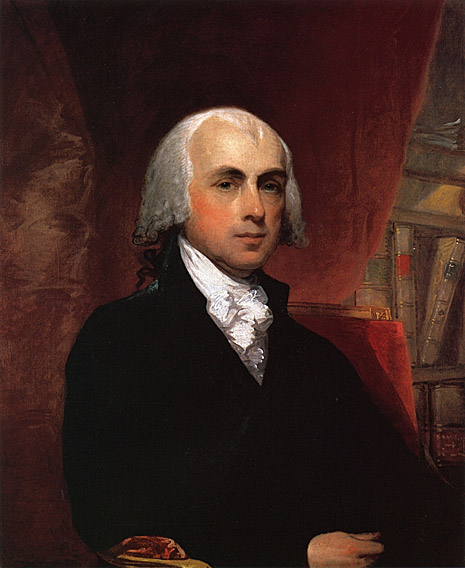
Credit: Portrait of James Madison by Gilbert Stuart

Friday, July 9, 2010

Dolley Madison Fresh Strawberry Ice Cream

Legend has it that in the early nineteenth century, a freed slave named Sallie Shadd went into her family’s catering business in Wilmington, Delaware. Sallie supposedly achieved fame among the free black population there for a new dessert sensation she created with frozen cream, sugar, and fruit.

When Dolley Madison heard about this new dessert, she supposedly travelled to Wilmington to try it. The First Lady must have loved it because a "magnificent dome of pink ice cream" was served at President Madison’s second Inaugural Ball in 1813, and ice cream often appeared as the official dessert on the White House menu during her husband's two terms of office.

This recipe for strawberry ice cream, which may be similar to the one used by the Madison’s chef, is adapted from The White House Cookbook by Hugo Ziemann, a nineteenth century steward of the White House, and Mrs. F. L. Gillette, a celebrated 19th century cookbook author.

1 1/2 cups sugar
4 cups fresh strawberries, sliced
1 quart heavy fresh cream

In a medium bowl, mix 1 cup sugar with strawberries, let stand for three hours, then mash and strain through a coarse towel.

Add 1/2 cup sugar and combine until dissolved. Beat in cream and freeze for at least three hours.

Thanks for stopping by THE HISTORY CHEF! For a free excerpt of my new book from Simon and Schuster click here