Saturday, August 25, 2018

George Bush, Barack Obama, and the Politics of Peanut Butter and Jelly Sandwiches

George Bush's memoir Decision Points has been described by the New York Times as "an autobiography focused around 'the most consequential decisions' of his presidency and his personal life from his decision to give up drinking in 1986 to his decision to invade Iraq in 2003 to his decisions regarding the financial crisis of 2008." According to the Product Description of the book:

President Bush brings readers inside the Texas Governor’s Mansion on the night of the hotly contested 2000 election; aboard Air Force One on 9/11, in the hours after America’s most devastating attack since Pearl Harbor; at the head of the table in the Situation Room in the moments before launching the war in Iraq; and behind the Oval Office desk for his historic and controversial decisions on the financial crisis, Hurricane Katrina, Afghanistan, Iran, and other issues that have shaped the first decade of the 21st century...

With so many momentous issues to review, it's not surprising that Mr. Bush didn't bother to mention his favorite foods, but...in an interview with Oprah Winfrey during the 2000 presidential campaign, he did say that his favorite sandwich is peanut butter and jelly on white bread.
.

Eight years later, during the 2008 presidential campaign, peanut butter and jelly sandwiches once again made national headlines. Responding to charges that his economic policies were socialistic in nature, Barack Obama lightheartedly chided his opponent John McCain for constantly resorting to trivialities and distractions:

Now, because he knows that his economic theories don't work, he's been spending these last few days calling me every name in the book. Lately he's called me a socialist for wanting to roll-back the Bush tax cuts for the wealthiest Americans so we can finally give tax relief to the middle class. I don't know what's next. By the end of the week he'll be accusing me of being a secret communist because I shared my toys in kindergarten. I shared my peanut butter and jelly sandwich.
.

Although neither Bush nor Obama mentioned how they prefer their PB&Js to be made, we do know that John Harvey Kellogg, the cereal pioneer, was the first person to receive a patent for the process of making peanut butter in 1895. According to Andrew Smith's Peanuts: The Illustrious History of the Goober Pea, early peanut butters had several problems:

The first was that peanut oil has a melting point below room temperature. Gravity separated the oil, which then oxidized and turned rancid. Likewise, salt added to the peanut butter separated and crystallized. Grocers received peanut butter in tubs or pails and were advised to use a wooden paddle to stir it frequently...

During the early years of the twentieth century, William Norman, an English chemist, invented a method of saturating unsaturated and polyunsaturated fatty acids, thus preventing them from turning rancid. In 1922, Joseph L. Rosefield...applied these principles to peanut butter [and] developed a process to prevent oil separation and spoilage in peanut butter...The result was a semisolid peanut butter [that]...was thick and creamy and did not stick to the roof of the mouth as much as previous products.


Selecting the name "Skippy" for his product, Rosefield introduced creamy and chunky-style peanut butter in 1932. Three years later, the company inaugurated its first wide-mouth peanut-butter jar, which quickly became the industry standard. And in less than twenty five years, peanut butter had "evolved from a hand ground delicacy to a mass-produced commercial commodity sold in almost every grocery store in America."


FOOD FACT: Florence Cowles' 1928 cookbook Seven Hundred Sandwiches includes dozens of creative recipes for peanut butter sandwiches, including: Peanut Butter and Egg Sandwich, Peanut Butter and Cabbage Sandwich, Peanut Butter and Marshmallow Sandwich, Peanut Butter and Prune Sandwich, Peanut Butter and Cherry Sandwich, Peanut Butter and Cheese Sandwich, and Peanut Butter and Olive Sandwich made with Mayonnaise on Rye. Oh my!

Sunday, July 15, 2018

Warren Harding, Prohibition and Finger Foods

Although kind and well-liked, Warren Harding is often ranked as the worst president in American history and he even admitted that the job was beyond him. Some observers say that his "claim to infamy rests on spectacular ineptitude captured in his own pathetic words: I am not fit for this office and should never have been here.'" Aware of his limitations, Harding appointed some highly intelligent and capable men to his cabinet, including Charles Evans Hughes as Secretary of State and Herbert Hoover as Secretary of Commerce.

Unfortunately, Harding also surrounded himself with an "unpleasant group of dishonest cheats," who came to be known as the Ohio Gang. According to historians at the Miller Center:

Warren’s close friend and political manager, Harry Daugherty, whom he named attorney general, was one of the worst - and one of the slickest. He survived impeachment attempts by Congress and two indictments for defrauding the government in the disposal of alien property confiscated from German nationals. Another schemer, Albert Fall, Secretary of the Interior, secretly allowed private oil companies to tap the Teapot Dome oil reserve in Wyoming and the Elk Hills oil reserve in California in return for $300,000 paid to him in bribes.


Whether Harding was aware of his advisors' crimes beforehand is uncertain. What is certain, however, is that he played card games and drank whiskey with his advisors upstairs at the White House in private defiance of Prohibition.

Describing the scene at one of Harding's card games that she encountered, Alice Roosevelt, daughter of Teddy Roosevelt, wrote: "the air heavy with tobacco smoke, trays with bottles containing every imaginable brand of whiskey, cards and poker chips ready at hand – a general atmosphere of waistcoat unbuttoned, feet on the desk, and spittoons alongside."

Meanwhile, as Harding was downing whiskey with his advisors at the White House, millions of Americans were drinking at secret taverns and bars called speakeasies, a term used to describe an establishment that sold illegal alcoholic beverages. According to The Encyclopedia of American Food and Drink:

In order to gain entrance, you had to speak in a low voice through a small opening in the back door and tell the attendant inside who it was who sent you to the place. The term itself...may derive from the English "Speak-softly-shop," an underworld term for a smuggler's house where one might get liquor cheaply, its usage in this sense having been traced back to 1823.

But with the onset of Prohibition, speakeasies sprang up overnight, sometimes in shabby sections of town, but often in the best neighborhoods, and many of these establishments were actually fine restaurants in their own right. New York's "21" club was a speakeasy during this period and had two bars, a dance floor, an orchestra, and dining rooms on two floors...French diplomat Paul Morande, visiting New York in 1925, reported his experience at a speakeasy: "the food is almost always poor, the service deplorable."


It was during this period (referred to today as the Roaring Twenties) that the custom of throwing cocktail parties at home also became popular. The rise of cocktail parties, in turn, inspired the development of finger foods, which worked well for tipsy guests who jiggled Gin Fizzes, Whiskey Smashes, and other popular cocktails while mingling with others in loud, crowded rooms.

Some popular finger foods of the Roaring Twenties included Lobster Canapés, Crabmeat Cocktails, Stuffed Deviled Eggs, Caviar Rolls, Oyster Toast, and Savory Cheese Balls. For his part, Harding often served Bratwurst Rolls and Mini Frankfurts with Saurkrauet at his raging cocktail parties at the White House.

If you’d like to serve up some Bratwurst Rolls at your next cocktail party, here's a simple and delicious recipe from epicurious.com:

1/4 cup butter
2 medium onions, sliced into thin rings
4 garlic cloves, finely chopped
3 to 4 (12-ounce) cans beer
8 bratwurst links
8 small, crusty hoagie rolls
whole-grain mustard
dill pickle spears

Prepare the grill for a medium-hot fire. Place the butter in a medium disposable foil roasting pan. Place the pan on the grill rack and cook until the butter melts. Add the onions and garlic (if using). Cook until softened, three to five minutes. Add the beer and bring to a simmer. Place the pan on the low heat zone and keep the onion mixture warm.

Place the bratwurst on the grill rack. Grill, turning occasionally, until evenly charred, four to five minutes. Transfer the bratwurst to the onion mixture and let stand until ready to serve. With tongs, place the bratwurst in the rolls. Serve with the onions, mustard, and pickles.

FOOD FACT: Some mass-manufactured foods introduced during the 1920s include the Baby Ruth Bar, Wonder Bread, Reese's Peanut Butter Cups, Hostess Snack Cakes, Kool-Aid, Peter Pan Peanut Butter, and Velveeta!

Tuesday, July 10, 2018

Thomas Jefferson's Vegetable Garden

So did you know that Thomas Jefferson's vegetable garden at Monticello was one thousand feet long and contained more than 250 varieties of more than 75 species of plants from around the world?

Carved into a terraced, slopping hilltop, and tended by elderly slaves, called “veteran aides,” Jefferson’s garden was divided into twenty-four rectangular squares, or growing plots, arranged according to which part of the plant was to be harvested, be it roots (carrots and beets), leaves (lettuce and cabbage) or fruits (tomatoes, peas, and beans).


Among the many exotic new plants grown there were beans and salsify collected by the Lewis and Clark expedition, figs from France, peppers from Mexico, and broccoli and squash imported from Italy. As methodical as a botanist, Jefferson recorded the results of his planting experiments in his Garden Book, noting such events as the dates that seeds were planted, when leaves appeared, and when his favorite vegetables were ready to eat.

Biographers say that Jefferson’s favorite vegetables included tomatoes, turnip greens, corn, and sweet potatoes. He was also particularly fond of the English pea, and, by staggering the time of their planting, he and his many dinner guests were able to enjoy them from mid-May through mid-July.

According to historians at Monticello:

Jefferson might have taken special note of the English pea because of an annual neighborhood contest to see which farmer could bring to table the first peas of spring. The winner would host the other contestants in a dinner that included the peas. Though Jefferson's mountaintop garden, with its southern exposure to warmth and light, should have provided an advantage for the contest, it seems that the contest was almost always won by a neighbor named George Divers.

As Jefferson's grandson recalled: "A wealthy neighbor [Divers], without children, and fond of horticulture, generally triumphed. Mr. Jefferson, on one occasion had them first, and when his family reminded him that it was his right to invite the company, he replied, 'No, say nothing about it, it will be more agreeable to our friend to think that he never fails.'"


If you'd like to whip up a dish of delicious and nutritious sweet English Peas this week, here's a simple recipe to try from recipe doodle.com and this one from epicurious.com

1 spring onion, sliced
2 tablespoons olive oil
2 cups English peas, shelled (about 12 ounces)
6 mint leaves, torn
Salt
Water

Sauté the spring onion in two tablespoons olive oil over medium-high heat. Add the shelled peas, a pinch of salt, and enough water to barely cover. Cook over high heat for 2 minutes, then add the torn mint leaves. Continue cooking until the peas are tender, a few more minutes.

FOOD FACT: When English colonists arrived in America, "pease" were one of the first crops to be planted. This makes sense because peas are nutritious and easy to preserve and ship. They also keep for long periods of time, as reflected in the old  children's rhyming song, "Pease Porridge Hot." Maybe you remember the lyrics: Pease porridge hot/Pease porridge cold/Pease porridge in the pot/Nine days old!

For my submission guidelines at Publishers Marketplace, click here!

Wednesday, June 20, 2018

A Small Dinner Party In Paris and a Brief History of the Statue of Liberty

Although historians don’t typically play the game of What If, it's hard to know if the United States could have won independence from the British without the aid of the French.

At critical times during the Revolutionary War, the French provided munitions, ships, money and men and some Frenchmen, including the Marquis de Lafayette, became high-ranking officers in the Continental Army. It was, as one historian proclaimed, “an alliance of respect and friendship that the French would not forget.”

According to historians at the American Park Network:

One hundred years later, in 1865, after the end of the American Civil War, several French intellectuals, who were opposed to the oppressive regime of Napoleon III, were at a small dinner party. They discussed their admiration for America's success in establishing a democratic government and abolishing slavery at the end of the civil war.

The dinner was hosted by Edouard Rene Lefebvre de Laboulaye...scholar, jurist, abolitionist and a leader of the "liberals," the political group dedicated to establishing a French republican government. During the evening, talk turned to the close historic ties and love of liberty the two nations shared...

As he continued speaking, reflecting on the centennial of American independence only 11 years in the future, Laboulaye commented, "Wouldn't it be wonderful if people in France gave the United States a great monument as a lasting memorial to independence and thereby showed that the French government was also dedicated to the idea of human liberty?"


Laboulaye's proposal intrigued one of his guests, Frédéric-Auguste Bartholdi, a successful 31-year old French sculptor. Years later, recalling the dinner, Bartholdi wrote that Laboulaye's idea 'interested me so deeply that it remained fixed in my memory.'” And so was sown the seed of inspiration that would eventually become the Statue of Liberty!

Once conceived, Bartholdi set out to design and promote the statue. Work began in Paris in the winter of 1875, and, in 1876, the right arm and torch, consisting of 21 separate copper pieces, were completed, assembled, dismantled, packed and shipped to the Philadelphia International Centennial Exhibition, where it was assembled as a feature exhibit.


In 1880, work on the iron framework for the tower began in Paris, and, during the next three years, the inner structure and "outer skin" were assembled, piece by piece, to the statute's full height of 151 feet. Finally, in June, 1884, the statue was completed and then dismantled, packed into 214 crates, and shipped to the United States in early 1885.

The official unveiling of the statue on October 28, 1886 was declared a public holiday, with leaders from both France and the United States in attendance. President Grover Cleveland, formerly the governor of New York, presided over the event. After some introductory speeches, Cleveland addressed the cheering crowd, proclaiming that the statue's "stream of light shall pierce the darkness of ignorance and man's oppression until Liberty enlightens the world."

One hundred years later, on July 4, 1986, the United States threw "a special birthday party" for the Statue of Liberty. With a golden sunset glowing in the background, President Ronald Reagan declared, "We are the keepers of the flame of liberty; we hold it high for the world to see." Later, Reagan pressed a button that sent a laser beam across the water toward the statue. Slowly, dramatically, majestically, a light show unveiled Liberty and her new torch while spectacular fireworks exploded across the sky."

Tuesday, June 12, 2018

Lyndon Johnson's Barbecue Diplomacy and a Brief History of Father's Day


Some historians say that the origins of Father’s Day can be traced to a young woman by the name of Sonora Smart Dodd, who reportedly came up with the idea while listening to a Mother’s Day sermon in Spokane, Washington in 1909. Raised by her widowed father, a Civil War veteran who had lost his wife after the birth of their sixth child, Sonora felt that her father should be honored in the same way that mothers were on Mother’s Day.

Toward that end, a special Father’s Day observance was held on June 19, 1910. Although that celebration was a local affair, the idea of a national Father’s Day picked up steam when it was endorsed by President Calvin Coolidge in 1924, but it would take another thirty years before Father’s Day was recognized by a Joint Resolution of Congress. Then, in 1966, the first presidential proclamation honoring fathers was issued by Lyndon Johnson, who designated the third Sunday in June as Father's Day.

Although it’s hard to say what Johnson ate on that particular day, it’s likely that the Texan native requested a barbecue. Barbecuing, of course, has been used as a tool in American politics since the early nineteenth century, but no politician ever used “the conviviality and informality of cooking and eating outdoors” more than Johnson.


But the most important barbecue ever planned for the LBJ Ranch never took place. This is what happened:

It was scheduled for November 23, 1963, when President Kennedy, Johnson, and their entourages were planning to dine beneath the oaks on the Pedernales. But a few hours before they were to board the choppers from Dallas to Johnson City, on November 22, Kennedy was assassinated two cars in front of Johnson as they drove in a motorcade.

A month later, the Johnson family retreated to the ranch on Christmas Eve. West German Chancellor Ludwig Erhard was scheduled to visit the President to discuss the Soviet threat, the Berlin Wall, and other important matters. Rather than return to Washington for a formal State Dinner, Lyndon invited Erhard on down to what historians claim was the first official Presidential barbecue in history. Yes, Johnson's first state dinner was a barbecue for 300 catered by Walter Jetton on December 29, 1963.

When his staff realized it would be chilly that day, the sit-down part was moved indoors to Stonewall High School gymnasium, about two miles away. Workers did an admirable job of creating an outdoorsy feel with bales of hay, red lanterns, red-checkered table cloths, saddles, lassos, and mariachis. According to Lady Bird's diary, "there were beans (pinto beans, always), delicious barbecued spareribs, cole slaw, followed by fried apricot pies with lots of hot coffee. And plenty of beer."


Although those recipes may have been lost to posterity, some Johnson family favorites included Pedernales River Chili, Chipped Beef with Cream, Beef Stroganoff, Tapioca Pudding, and Lady Bird enjoyed handing out her recipe for Barbecue Sauce. If you’d like to add a little zip to your Father's Day celebrations this weekend, here's a great recipe to try and here's Lady Bird's original recipe:


¼ cup butter
¼ cup vinegar
¼ cup ketchup
¼ cup fresh lemon juice
¼ cup Worcestershire sauce
Salt, pepper, red pepper flakes to taste

Melt butter in a medium sauce pan over medium-high heat. Add other ingredients and bring to a boil. Add Tabasco sauce to taste.

Thursday, May 17, 2018

A Royal State Dinner at the Reagan White House!

The wedding of Prince Charles and Lady Diana Spencer on July 29, 1981 has been aptly described as one of the most celebrated spectacles of the Reagan era. But because of the assassination attempt on President Reagan four months earlier, he couldn't attend, but he encouraged his wife Nancy to “serve as the United States representative at the event.”

Rising to the occasion, Mrs. Reagan traveled to England and spent one week in London, which was the longest amount of time she had been away from her husband in their then-twenty-nine years of marriage. During her stay, the First Lady attended eighteen events on behalf of the nation, including "a ball at Buckingham Palace, a dinner at the American Embassy, tea with the Queen Mother, and lunch with Prime Minister Margaret Thatcher.”


According to the Ronald Reagan Foundation,

Mrs. Reagan was an especially appropriate delegate for the United States to send to the Royal Wedding. The Reagans had met Prince Charles many years earlier, when Ronald Reagan was Governor of California. Also, in March of 1975 Ronald and Nancy had met Margaret Thatcher, and the future president and future prime minister found they shared a special connection even then...

Over the years, the President and Mrs. Reagan expressed their immense respect for their British friends in many ways, saving the first and last state dinners to honor Margaret Thatcher. Her Royal Majesty Queen Elizabeth II attended the first dinner in February 1981, and the Queen returned the honor when she hosted a state dinner for the Reagans’ visit to London when the president addressed Parliament in 1982.


The following year, Queen Elizabeth II and her husband Prince Philip visited Rancho del Cielo, the Reagans’ Santa Barbara ranch, and invited the Reagans aboard the royal yacht Brittania to celebrate an anniversary dinner. But of all the Royal visits to the Reagan White House, none were more memorable than the star-studded State Dinner held in honor of the Prince and Princess of Wales on November 9, 1985. As the BBC reported:

Prince Charles and Princess Diana have ended the first day of their much-vaunted trip to the USA at a gala dinner in Washington, hosted by President Reagan and his wife Nancy. They mixed with movie stars, such as Clint Eastwood, John Travolta, Tom Selleck and the singer Neil Diamond as well as politicians and businessmen.

A small group of anti-British IRA supporters protested outside and there were a few slip-ups during the glamorous event. For a moment President Reagan forgot the Princess of Wales' name during an after-dinner speech to guests. "Permit me to add our congratulations to Prince Charles on his birthday just five days away," he said, "and express also our great happiness that...er...Princess David...Princess Diane (sic) is here on her first trip to the United States."


According to the report, the Princess herself, still suffering from jetlag, momentarily forgot to return the toast. But all that was forgotten when she famously took to the dance floor with John Travolta in her midnight blue velvet dress and sapphire and diamond choker.

Earlier in the evening, an elegant dinner was held in the State Dining room, where ballet great Mikhail Baryshnikov was seated next to Princess Diana, while Prince Charles sat between actress Beverly Sills and the First Lady. In addition to Neal Diamond, Clint Eastwood, Tom Selleck, and Travolta, other well-known personalities who attended the affair included fasion icons Gloria Vanderbilt and Estee Lauder, Olympic figure skater Dorothy Hamill, and architect I.M. Pei.


According to White House chef Henry Haller, the dinner menu that evening "was carefully designed to suit the noble tastes of the Prince and Princess, and to appeal to the varied tastes of their table mates. Since the Prince favors fish and fowl, the meal featured fennel-flavored lobster mousse as the first course and lightly glazed chicken for the entree."

If you'd like to whip up some Lobster Mousse for your next formal gathering, here is a delicious recipe to try from the New York Times:

1/2 pound cooked lobster meat
3/4 cup clam broth
1 tablespoon unflavored gelatin
2 ribs celery, chopped fine
2 tablespoons finely chopped onion
1 1/2 teaspoons Dijon mustard
1/2 cup minced parsley
1/2 cup heavy cream, whipped
3/4 cup mayonnaise
Salt, white pepper to taste
Juice of one lemon
Curly kale

Cut lobster into 1/2-inch pieces. Sprinkle gelatin over broth. Place over low heat; stir until thoroughly dissolved. Cool. Whip cream. Combine celery, onion, mustard, parsley, whipped cream, 1/4 cup mayonnaise, salt and pepper, lobster and cooled broth and mix thoroughly.

Spoon into 1-quart mold and seal tightly with plastic wrap. Refrigerate until firm, at least four hours or overnight. To serve, mix remaining mayonnaise with lemon juice. Unmold mousse and serve on curly kale, with lemon mayonnaise poured over the top. Serve with homemade Melba toast.

For more on my manuscript wish list and submission info click here!

Sunday, April 1, 2018

Lucy Hayes and a Brief History of the Easter Egg Roll at the White House!


Some historians claim that Dolley Madison originally suggested the idea of a public egg roll on White House grounds while others tell stories of informal egg-rolling parties dating back to Abraham Lincoln's administration. What is clear, however, is that, beginning in the 1870s, Washingtonians from all social levels celebrated Easter Monday on the west grounds of the U.S. Capitol where children rolled brilliantly dyed hard-boiled eggs down the terraced lawn.

This practice ended in 1876, however, when lawmakers complained that eggs shells were destroying the grass. To resolve this problem, a group of party-poopers in Congress passed the Turf Protection Act which banned egg rolls from Capital grounds, and President Ulysses S. Grant signed the bill into law later that year. Fortunately, the tradition was revived in 1878 when First Lady Lucy Hayes invited children of all ages to roll Easter eggs on the White House lawn, a tradition that has continued ever since.

According to this article in Time Magazine:

Some 53,000 people attended the egg roll in 1941...though in modern times the number is generally under 20,000. Calvin Coolidge's wife mingled through crowds while holding a pet raccoon named Rebecca, while Mrs. Warren G. Harding put on the uniform of her beloved Girl Scouts for the event.

Showcasing modern technology, Eleanor Roosevelt welcomed crowds and addressed listeners across the country via radio in 1933, while the Clinton administration proudly announced that 1998's egg roll would be the first broadcast on the Internet.


In 2016, the Obamas hosted the 138th annual White House Easter Egg Roll on Monday, March 28, when more than 35,000 people joined them on the South Lawn for games, stories, and, of course, the traditional egg roll.


And while the menu for this year's traditional White House Easter Brunch (if there is one!) hasn't been released, the Chicago Sun-Times reported that menu items in 2008 included Honey Baked Ham with Maple Mustard Sauce, Eggs Benedict, spinach salad, waffles, sauteed asparagus, biscuits and cheese grits.

If you'd like whip up some Eggs Benedict for your Easter brunch this Sunday, here's a simple and simply delicious recipe to try from the Food Network:


1 teaspoon vinegar
4 eggs
4 thin slices Canadian bacon
2 English muffins

Hollandaise sauce:

3 egg yolks
1 tablespoon hot water
1 tablespoon lemon juice
1 stick unsalted butter, melted and hot
Salt and pepper
Paprika and chopped parsley

In large skillet, bring 2 inches of water and vinegar to a boil. Crack one egg into a glass. Reduce water to a simmer and pour egg into water. Add remaining eggs and cook for 4 minutes. Remove eggs with a slotted spoon and drain. In a non-stick skillet heat the bacon until warm. Toast the English muffins until golden.

For sauce: Place yolks, water and lemon juice into blender. Blend for 1 minute. With blender running, pour butter through open hole of lid. Season with salt and pepper. To assemble: Top each muffin with bacon and a poached egg. Pour the warm sauce over and garnish with paprika and the chopped parsley.

FAST FACT: The Easter Egg Roll was held at the White House every year in the 20th century except during World War I, World War II, and the Truman Renovation of the White House, when it was moved to nearby locations or cancelled. Ronald Reagan was the first president to hide autographed eggs for children to find and Richard Nixon and First Lady Pat Nixon were the first to include the Easter Bunny in the festivities. Years earlier, First Lady Grace Coolidge made an appearance at the Easter Egg Roll in the 1920s with her pet racooon Rebecca!

Saturday, February 24, 2018

Dolley Madison Fresh Strawberry Ice Cream


Legend has it that in the early nineteenth century, a freed slave named Sallie Shadd went into her family’s catering business in Wilmington, Delaware. Sallie supposedly achieved fame there for a fabulous new dessert sensation she created with frozen cream, sugar, and fruit.

When Dolley Madison heard about this new dessert, she supposedly traveled to Delaware to try it - and she must have loved it because a "magnificent pink dome of ice cream" was served at President Madison’s second Inaugural Ball in 1813, and ice cream often appeared as a dessert on the White House menu during her husband's two terms of office.


If you'd like to whip up some Fresh Strawberry Ice Cream this week, here's a fabulous recipe to try from epicurious.com:

1 3/4 cups heavy cream
3 (3- by 1-inch) strips fresh lemon zest
1/8 teaspoon salt
2 large eggs
3/4 cup sugar
1 lb strawberries (3 cups), trimmed and quartered
1 tablespoon fresh lemon juice

Special equipment: an ice-cream maker and an instant-read thermometer

Combine cream, zest, and salt in a heavy saucepan and bring just to a boil. Remove from heat and discard zest. Whisk eggs with 1/2 cup sugar in a bowl, then add hot cream in a slow stream, whisking.

Pour back into saucepan and cook over moderately low heat, stirring constantly, until slightly thickened and an instant-read thermometer registers 170°F (do not let boil).

Immediately pour custard through a fine sieve into a metal bowl, then cool to room temperature, stirring occasionally. Chill, overed, at least until cold, about 2 hours, and up to 1 day.


While custard is chilling, purée strawberries with remaining 1/4 cup sugar and lemon juice in a blender until smooth, then force through fine sieve into chilled custard. Stir purée into custard. Freeze in ice-cream maker, then transfer to an airtight container and put in freezer to harden.

Monday, February 19, 2018

George Washington Cherry Cobbler

An early nineteenth century American book peddler, itinerant preacher and author, "Parson" Mason Locke Weems is best known today as the source of some of the most beloved if apocryphal stories about George Washington. The famous story of George and the Cherry Tree is included in Weems' masterpiece, The Life and Memorable Actions of Washington, which was originally published in 1800 (the year after Washington's death) and was an immediate best-seller.

Reprinted in ever more inventive editions over the next 25 years, it contains, according to Edward Lengel, "some of the most beloved lies of American history, including the cherry tree myth" and other exaggerated or invented anecdotes that extolled Washington’s virtues and provided an entertaining and morally instructive tale for the young republic.

In telling his cherry tree story, Weems attributed it to "an aged lady,” who was reportedly a distant relative of George, and who, as a young girl, supposedly spent much time with him. This is how the fable unfolded:

"When George was about six years old, he was made the wealthy master of a hatchet of which, like most little boys, he was immoderately fond, and was constantly going about chopping everything that came in his way. One day, in the garden, where he often amused himself hacking his mother's pea-sticks, he unluckily tried the edge of his hatchet on the body of a beautiful young English cherry-tree, which he barked so terribly, that I don't believe the tree ever got the better of it.


The next morning, [George’s father], finding out what had befallen his tree, which, by the by, was a great favorite, came into the house, and with much warmth asked for the mischievous author, declaring at the same time, that he would not have taken five guineas for his tree.

Nobody could tell him anything about it. Presently George and his hatchet made their appearance. "George," said his father, "do you know who killed that beautiful little cherry-tree yonder in the garden?" This was a tough question; and George staggered under it for a moment; but quickly recovered himself: and looking at his father, with the sweet face of youth brightened with the inexpressible charm of all-conquering truth, he bravely cried out, "I can't tell a lie, Pa; you know I can't tell a lie. I did cut it with my hatchet."

“Run to my arms, you dearest boy,” cried his father in transports, “run to my arms; glad am I, George, that you killed my tree; for you have paid me for it a thousand fold. Such an act of heroism in my son, is more worth than a thousand trees, though blossomed with silver, and their fruits of purest gold.”


Although plausible enough, historians generally agree that this quaint story is almost certainly not true. What is true, however, is that George was particularly fond of cherries, and Martha Washington's Booke of Cookery contains several family “receipts” for preserving this sweet and tangy highly versatile fruit.

Of course, then, as today, sweet and sour cherries can be used in all kinds of pies, tarts, jellies, jams, breads, muffins, and soups, as well as in a fabulously wide array of cobblers, like this recipe for cherry cobbler, which George surely would have loved had he had time to try it during his extraordinarily illustrious life:


Crust: 1 1/4 cups flour
2 tablespoons sugar
2 tablespoons yellow cornmeal
1/2 teaspoon salt
6 tablespoons butter, cut into 1/2-inch pieces and chilled
1 large egg yolk
3 tablespoons cold milk, cream or water

Filling: 2 cups cherry preserves
1/3 cup sliced almonds
Confectioners' sugar, for dusting

In the workbowl of a food processor, combine the flour, sugar, cornmeal and salt. Pulse to combine. Add the butter, toss carefully with your hands to coat the butter cubes in flour. Pulse in the food processor several times until the mixture resembles coarse oatmeal. Add the egg and 2 tablespoons of milk, cream or water, and pulse until the dough begins to come together in a ball. Add the additional tablespoon of liquid if needed until the dough comes together.

Transfer the dough to a lightly floured work surface and knead it briefly to shape it into a disk about 5 inches across. Wrap in plastic and refrigerate at least 1 hour or overnight. Using a lightly floured rolling pin, roll the dough into a shape a ½ inch wider than the tart pan you are using. Loosely fold the dough in half and transfer it to the tart pan.

Line the pan with the dough, being. Trim any excess dough from the rim of the pan, leaving a blunt neat edge. Gather the trimmings into a ball (it should be about the size of a pingpong ball). Wrap the tart and the ball of dough in plastic and refrigerate for 1 hour.

Heat to 375 degrees. Remove tart pan from refrigerator and spread the marmalade evenly over the crust. Grate the chilled ball of pastry onto the filling, and sprinkle the almonds over the top. Bake until the pastry is golden, the filling is bubbly and the almonds are toasted, 40 minutes. Transfer to a wire rack to cool. When the tart is completely cool, dust with confectioners' sugar. Serve at room temperature.

Monday, February 12, 2018

Abraham Lincoln Kentucky Corncakes

Abraham Lincoln and his wife Mary were great animal lovers and allowed their four young sons to keep all sorts of pets on White House grounds. Among other animals, Abe and his family had three cats, a dog named Fido, rabbits, horses, and two rambunctious billygoats named Nanny and Nunko.

Another was a wild turkey named Jack with whom Lincoln’s youngest son Tad played with daily. When it came time for Jack to be sacrificed for a Christmas dinner, Tad supposedly begged his dad to spare the turkey’s life, and, to this day, the White House maintains the tradition of “pardoning” two turkeys each holiday season!


Although it’s a "tad" early to be thinking about preparing your next holiday dinner, you can whip up a batch of Kentucky Corncakes, which are a great side dish at just about any meal and were a Lincoln family favorite. If you’d like to make some Kentucky Corncakes today, here is a simple and simply delicious recipe to try from the Food Network:


FAST FACT: According to the Miller Center, the Lincoln family's routine in the White House reflected "the presence of their sons, the demands of war, and the highly complex and many-sided character of Abraham and Mary. [T]he day went from breakfast together as a family at 8:00 in the morning, reunion again for dinner at 8:00 in the evening, and then bedtime. Until little Willie's death in 1862, the two younger sons demanded a good deal of attention, and both parents gave them ample attention, although Lincoln grew more distant as the war progressed and occupied much of his day."

Monday, February 5, 2018

Lou Henry Hoover and the First Organized Girl Scout Cookie Drive in 1935


So did you know that Herbert Hoover’s wife "Lou" served as president of the Girl Scouts and helped coordinate one of the first Girl Scout Cookie Drives in 1935? Sixty five years later, in April of 2000, the Herbert Hoover Presidential Library and Museum held an exhibit entiitled, American Women! A Celebration of Our History. One exhibit depicted Lou Hoover’s lifelong commitment to the Girl Scouts. This is how the placard read:

A woman nicknamed "Daisy" started the Girl Scouts of the U.S.A. with 18 girls. And a tomboy called "Lou" helped the organization grow into its current membership of over 3.5 million! Lou Henry grew up enjoying the outdoor life, and was the first women to receive a degree in geology from Stanford. She traveled the world with her husband Herbert Hoover, and assisted him with his mining ventures and famine relief activities.

During World War I she met up with Juliette Low [Daisy], and was a Girl Scout for the next 25 years. As First Lady and national leader of the Girl Scouts, Hoover quietly aided people in need during the Depression, and was also the first to desegregate White House social functions.

Lou remained a Scout the rest of her life and led the first Girl Scout cookie drive in 1935. Juliette Low and Lou Henry Hoover brought together girls from the North and South, wealthy and poor, black and white, athletic and handicapped – instilling confidence that all women can develop their potential to be whatever they wish to be.


In the 1920s and 1930s, Girl Scouts all across the country baked their own simple sugar cookies with their mothers. They then packaged their coookies in wax paper bags sealed with a sticker and sold them door-to-door for 25 to 35 cents a dozen.


Today, of course, there is a wide array of commercially baked Girl Scouts cookies to choose from, including such traditional favorites as Samoas, Tagalongs, Trefoils, and Thin Mints! If you'd like to whip up a batch of cookies with your kids today, here's the original recipe for Early Girl Scout Cookies® from The Girl Scouts of the United States of America.


1 cup butter
1 cup sugar plus additional amount for topping (optional)
2 eggs
2 tablespoons milk
1 teaspoon vanilla
2 cups flour
1 teaspoon salt
2 teaspoons baking powder

Cream butter and the cup of sugar; add well-beaten eggs, then milk, vanilla, flour, salt, and baking powder. Refrigerate for at least 1 hour. Roll dough, cut into trefoil shapes, and sprinkle sugar on top, if desired. Bake in a quick oven (375°) for approximately 8 to 10 minutes or until the edges begin to brown. Makes six- to seven-dozen cookies.

For more on my manuscript wish list click here!

Wednesday, December 27, 2017

Andrew Johnson Hoppin John

At the end of the Civil War, the South lay in ruins. Southern plantations and entire cities had been destroyed during the war. Without food, many southerners starved to death, and most of those who survived lost just about everything they owned. As a result, the government had to figure out how to rebuild the South.

As president, Andrew Johnson took charge of the first phase of Reconstruction. But his attempt to quickly readmit the former Confederate states into the union and his vetoes of important civil rights bills outraged Radical Republicans in Congress.

The House of Representatives impeached Johnson in 1868, but he was acquitted by a single vote in the Senate, and historians say that his victory “marked the beginning of an ambitious series of receptions, dinners and children’s parties that would turn the last nine months of his term into an ongoing celebration.”


After leaving office, Johnson returned to his native state of Tennessee where he consumed such traditional foods as Hush Puppies, Benne Wafers, Hoppin’ John and Pine Bark Stew. Still popular in the south, Hoppin' John is often the high point of New Year's Day festivities and is thought to bring good luck and prosperity throughout the coming year.

If you'd like to whip up some Hoppin' John for your New Year's festivities this week, you can't go wrong with this quick and delicious recipe from Emeril Lagasse.


1 tablespoon olive oil
1 large ham hock
1 cup onion, chopped
1/2 cup celery, chopped
1/2 cup green pepper, chopped
1 tablespoon chopped garlic
1 pound black-eyed peas, soaked overnight and rinsed
1 quart chicken stock
1 Bay leaf
1 teaspoon dry thyme leaves
Salt, black pepper, and cayenne
3 tablespoons finely chopped green onion
3 cups steamed white rice

Heat oil in a large pot, add ham hock and sear on all sides for 4 minutes. Add the onion, celery, green pepper, and garlic, and cook for 4 minutes. Add the peas, stock, bay leaves, thyme, and seasonings. Bring to a boil, reduce the heat and simmer for 40 minutes, or until the peas are creamy and tender. If the liquid evaporates, add more water or stock. Adjust seasonings, and garnish with green onions.

Thursday, November 30, 2017

Teddy Roosevelt Teddy Bear Cupcakes


So did you know that the first American teddy bear was created and named in honor of Theodore Roosevelt? It all began when he went on a four-day hunting trip in the Mississippi wilderness in November, 1902. Although Roosevelt was known as an experienced big game hunter, he had not come across a single bear on that particular trip.

According to historians at the National Park Service:

Roosevelt’s assistants, led by Holt Collier, a former slave, cornered and tied an old black bear to a willow tree, then they summoned Roosevelt and suggested that he shoot it. Viewing this as very unsportsmanlike, Roosevelt refused to shoot the bear. News of the president's refusal to shoot a tired old bear spread quickly throughout the United States, but it wasn't just any president - it was Theodore Roosevelt, the big game hunter!

So, that's how Theodore Roosevelt's name became associated with a bear. But the story doesn't end there because when a political cartoonist named Clifford Berryman read reports about the incident, he decided to lightheartedly lampoon it.


Then, when a Brooklyn candy shop owner by the name of Morris Michton saw Berryman’s cartoon in the Washington Post on November 16, 1902, he came up with an idea - and his idea was quite brilliant, indeed.

You see, Morris's wife Rose was a seamstress and made stuffed toys at their shop, so he asked her to make two stuffed toy bears that looked just like the cute little bear in Mr. Berryman's cartoon. So Rose began sewing and as soon as she finished the last stitch on her cute cuddly creations, Morris proudly showcased them in the front window of their shop, along with a sign that read "Teddy's Bears."

After receiving Roosevelt’s permission to use his nickname, Morris began mass producing the toy bears, which became so popular that he launched the Ideal Novelty and Toy Company, and, by 1907, more than a million "Teddy Bears" had been sold in the United States.

And so NOW you know how Teddy Roosevelt, a political cartoonist, a Brooklyn candy shop owner, and a seamstress led to the creation and naming of the first American Teddy Bear!

Now...I'm guessing that you probably don't want to feast on a juicy bear steak like those that Roosevelt and his fellow hunters enjoyed, but you might like these cute Teddy Bear Cupcakes that are fun to make and great to serve at children's birthday parties and play dates.


1 box Betty Crocker® SuperMoist® yellow cake mix
1 cup water
1/2 cup creamy peanut butter
3 eggs
1 container Betty Crocker® Whipped chocolate frosting
1/3 cup miniature semisweet chocolate chips
48 teddy bear-shaped graham snacks

In large bowl, beat cake mix, water, peanut butter and eggs with electric mixer on low speed 30 seconds. Beat on medium speed 2 minutes, scraping bowl occasionally. Divide batter among muffin cups. Bake 13 to 18 minutes or until toothpick inserted in center comes out clean. Cool 10 minutes. Remove from pan to cooling rack. Cool for 30 minutes.

Reserve 1/4 cup of the frosting. Spread remaining frosting over tops of cupcakes. Sprinkle each cupcake with chocolate chips; press gently into frosting. Spread about 1/2 teaspoon reserved frosting on flat sides of 2 graham snacks. Place on cupcakes, pressing candles in place.

Sunday, November 26, 2017

Andrew Jackson Inaugural Orange Whiskey Punch


When John Quincy Adams took the oath of office in 1825, it was under a cloud of controversy. The election of 1824 had been a bitterly contested four-man race between Andrew Jackson, Henry Clay, William Crawford, and Adams.

Since no candidate had won a majority of electoral votes, the election was thrown into the House of Representatives where Clay, as Speaker of the House, quickly threw his support to Adams, even though Jackson won the most popular and electoral votes. Adams then appointed Clay as Secretary of State. Outraged and feeling cheated out of the White House, Jackson called the deal a “Corrupt Bargain to "cheat the will of the people."”


With these accusations hanging over his head, Adams faced problems from the start and his four years in office weren't easy ones. Although his intelligence, family background, and experience could and should have made him a great president, he lacked the charisma needed to create a base of loyal supporters.

Not surprisingly, he lost the election of 1828 in a landslide, and when Andrew Jackson was inaugurated in March, 1829, twenty thousand of his loyal supporters, who believed he had been cheated out of the White House four years earlier, descended "like locusts" upon Washington, eager to celebrate the long-delayed victory of their champion.

According to culinary historian Poppy Cannon, Jackson's inauguration "sparked a celebration that did everything but set fire to the White House." Thousands of rowdy fans crammed into the building and "little thought was given to the delicate French furniture, elegant draperies, and fine china" as ice cream, ices and cakes "were gobbled up as fast they appeared on long serving tables."


In a letter to her sister, Margaret Bayard Smith, a prominent Washington socialite, described the chaos of Jackson's inaugural festivities this way:

But what a scene did we witness! The Majesty of the People had disappeared, and a rabble, a mob, of boys, negros, women, children, scrambling fighting, romping. What a pity, what a pity! No arrangements had been made, no police officers placed on duty, and the whole house had been inundated by the rabble mob...

Cut glass and china to the amount of several thousand dollars had been broken in the struggle to get the refreshments, punch and other articles had been carried out in tubs and buckets, but had it been in hogsheads it would have been insufficient...

Ladies fainted, men were seen with bloody noses, and such a scene of confusion took place as is impossible to describe…This concourse had not been anticipated...Ladies and gentlemen only had been expected at this Levee, not the people en masse. But it was the People's day, and the People's President, and the People would rule!


Another observer described the day's events this way:

Orange-punch by barrels full was inside, but as the waiters opened the door to bring it out, a rush would be made, the glasses broken, the pails of liquor upset, and the most painful confusion prevailed. To such a degree was this carried, that tubs of punch were taken from the lower story into the garden to lead off the crowds from the rooms.

Although no one knows how those waiters prepared the punch that day, you can get some great whiskey tips from eatdrinkfrolic.com and The Wall Street Journal scoured some ninteeenth century cookbooks and provided this adapted recipe for Inaugural Orange Punch that's "easy to make by the bucketful" if you've got a mob to entertain today!


3 parts fresh orange juice
1 part fresh lemon juice
1 part Mulled Orange Syrup*
1 part dark rum
1 part cognac
2 parts soda water

Mulled Orange Syrup: Combine 1 cup sugar with 1 cup water and heat to a boil, stirring to dissolve the sugar. Reduce heat to a low simmer. Add the peel from an orange and mulling spices (a couple of cinnamon sticks, some whole cloves and allspice berries). After 15 minutes, remove from heat and let it sit for several hours. Strain.

Combine Mulled Orange Syrup and all other ingredients in a punch bowl with a large block of ice. Serve in punch cups with a little crushed ice. Add a dash of Angostura bitters to each glass and enjoy!

Friday, November 24, 2017

James Garfield, the Pythagorian Theorem, and the Founding Father of Vegetarianism

As a lawyer, professor, and duly ordained minister, James Garfield is the only president to have discovered a novel proof of the Pythagorean Theorem. The Theorem, of course, is named after Pythagoras, an ancient Greek philosopher and mathematician.

As you might recall from grade school, the theorem says that in a right triangle, the sum of the squares of the two right angle sides will always be the same as the square of the hypotenuse (the longest side).

Translated mathematically, the equation would read: A2 + B2 = C2. Let’s try it quickly here: If Side A is 4 inches long and Side B is 3 inches long, the equation would be: 4 x 4 = 16 and 3 x 3 = 9. Added together, 16 + 9 = 25. Now we simply find the square root of 25 and - voila! - we know that side C is 5 inches long!


So what does the Pythagorean Theorem have to do with food? A lot, if you consider the fact that Pythagoras has been called the Founding Father of Vegetarianism. Until the 19th century, when the term "vegetarian" came into use, people who didn't eat meat were often called “Pythagoreans.”

As a young man, Garfield was a farmer in Ohio and wouldn't have called himself a Pythagorean, but he might have enjoyed this healthy recipe for Ultimate Veggie Burgers from 101 Cookbooks if he tried it!


2 1/2 cups garbanzo beans or canned garbanzos, rinsed
4 large eggs
1/2 teaspoon fine-grain sea salt
1/3 cup chopped fresh cilantro
1 onion, chopped
Grated zest of one lemon
1 cup toasted (whole-grain) bread crumbs
1 tablespoon extra-virgin olive oil

Combine garbanzos, eggs, and salt in a food processor. Puree until the mixture is the consistency of a thick, slightly chunky hummus. Pour into a mixing bowl and stir in the cilantro, onion, and zest.

Add breadcrumbs, stir, and let sit for a couple of minutes. Heat oil in a heavy skillet over medium low, add 4 patties, cover and cook for 7-10 minutes. Flip the patties and cook the second side for 7 minutes, or until golden. Remove from the skillet and cool on a wire rack while you cook the remaining patties.

FAST FACT: Garfield was one of our most intellectual presidents. Before going into politics, he was a professor of ancient languages. He was also ambidextrous and would often show off his knowledge by writing Greek with one hand and Latin with the other. Now THAT'S impressive!

Thursday, November 2, 2017

Golfers-in-Chief: Donald Trump, Tiger Woods and Grilled Rosemary Lamb Chops


While Donald Trump's round of golf with Tiger Woods last year made national headlines, Tiger's round with Barack Obama in 2013 also caused quite a stir. Although scores remain top secret, what's not so secret is that many American presidents have been avid golfers.

According to Don van Natta’s First Off the Tee, 14 of the last 17 presidents have been serious golfers and how they played the game reveals a lot about their character. Dwight Eisenhower played more than 800 times during his eight years in office and had a putting green installed on the South Lawn of the White House.

A member of Augusta National Golf Club, Ike broke 80 on a dozen occasions and the Eisenhower Pine, once located on the 17th hole, was named after him. Ike hit the tree so many times that, at a club meeting in 1956, he proposed that the tree be cut down. Not wanting to offend the president, the club’s chairman adjourned the meeting rather than reject the request.

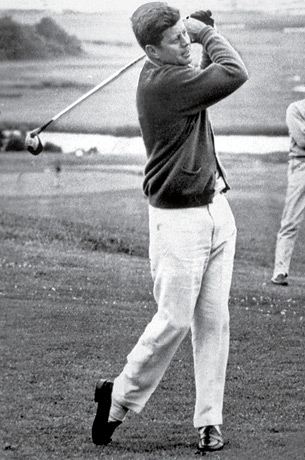
John F. Kennedy was a serious golfer but didn't want to be seen playing because he wanted to contrast his image with Ike’s reputation of “golfing his way through the presidency.” JFK and his aides reportedly made a lot of hay out of Ike's constant playing, and dubbed him "Duffer in Chief.”


As for LBJ, van Natta says that he “really tore it up” on the course and would take 300, sometimes 400 swings, in a round. "He just wanted the feel of one perfect shot," van Natta notes, "and if it took 400 swings to do it, he was going to do it. He was the president and nobody was going to get in his way."

Ronald Reagan only played the game about a dozen times while in office, but he loved putting around the Oval Office and aboard Air Force One.


But nowhere does golf run deeper than in the Bush family bloodline.

George H.W. Bush's maternal grandfather, George Herbert Walker, served as president of the United States Golf Association in 1920. A single-digit handicapper, he donated the Walker Cup, the trophy awarded to the winning team in the biennial matches between leading amateur golfers from the U.S. and Great Britain/Ireland. And 41’s father, Senator Prescott S. Bush, was a scratch golfer who served as president of the USGA in 1935.


As for Clinton, Van Natta says he "followed the rules for about a hole and a half. Then...started taking these do-over shots, gimme putts and, at the end of the 18 holes, it took him about 200 swings to score an 82."

And as for Barack Obama, an article in Time magazine notes that he took up golf “as a relaxing alternative to basketball...but now that his game is out of the closet, it is clear that he duffs in much the same way that he tries to govern.” Wellington Wilson, Obama’s longtime golf buddy, was quoted as saying, “You can really tell a person's personality by the way he plays golf. He just goes with the flow. Not too high. Not too low."


And while it's hard to know if Donald Trump chose to just "go with the flow" with Tiger Woods last year, we do know that Obama attended a Black Caucus Dinner in Washington D.C. after his match with #MacDaddySanta, then flew to California for a fundraiser at the ritzy Fig and Olive restaurant in West Hollywood.

According to obamafoodroma.com, celebrity guests included Jack Black, Jamie Foxx, Danny DeVito, and Quincy Jones. Judd Apatow and Aaron Sorkin were also on hand for the festivities, where guests reportedly shelled out a whopping $17,900 each for dinner.

So what kind of meal comes with such a price tag? Well, one guest revealed that appetizer options included:

jamón ibérico and a fig Gorgonzola tartlet, while entree options included striped bass filet en papillote with zucchini, eggplant, fennel, tomato, thyme, scallion, and saffron served with Arbequina olive oil mashed potato & chives; free range organic chicken breast with grilled zucchini, eggplant, heirloom tomato, cipollini onion, roasted fig, Parmesan polenta, and marinated red bell pepper; and rosemary lamb chops, grilled then smoked a la minute with Herbs de Provence, goat cheese, and chive gnocchi.

Sounds delish, but since most of us don't have a spare $18k to drop on dinner, here's a fabulous and more affordable recipe for Grilled Rosemary Lamb Chops from epicurious.com:


3/4 cup balsamic vinegar
6 tablespoons olive oil
3 tablespoons fresh lemon juice
3 tablespoons minced fresh rosemary or 3 teaspoons dried
6 garlic cloves, minced
1 teaspoon ground black pepper
12 1-inch-thick loin lamb chops, fat trimmed

Mix first 6 ingredients in small bowl. Place lamb chops in single layer in 13x9x2-inch glass dish. Pour marinade over. cover with foil and refrigerate 4 hours, turning lamb chops occasionally.

Prepare barbecue (medium-high heat). When coals turn white, drain chips, if using, and scatter over coals. When chips begin to smoke, season lamb with salt and pepper and place on grill. Cover; grill shops to desired doneness, basting often with marinade, about 4 minutes per side for medium-rare. Transfer to platter and serve.