Showing posts with label FDR. Show all posts

Monday, November 18, 2024

Woodrow Wilson, the Sinking of the Lusitania and Food Blockades During World War I


On May 7, 1915, a German submarine torpedoed the British ocean liner RMS Lusitania en route from New York to England. Attacked without warning off the coast of Ireland, the ship sank in fifteen minutes, killing nearly 2,000 civilians, including 128 Americans.

Woodrow Wilson immediately denounced the sinking of the Lusitania in harsh, threatening terms, demanding that Germany pledge to never launch another attack on citizens of neutral countries, even when traveling on French or British ships. Germany acknowledged Wilson's demand, but only temporarily. In March, 1916, a German U-boat torpedoed the French passenger liner Sussex, causing a heavy loss of life and injuring several Americans.


Two months later, in what's known as the Sussex pledge, Germany announced that they would no longer sink Allied merchant ships without warning but made it clear that it would resume submarine attacks if the Allies refused to respect International Law which meant that the Allies had to lift their blockades of food and other materials bound for the Central Powers.

Despite further provocations, President Wilson still hoped for a negotiated settlement until February 1, 1917, when Germany resumed submarine warfare against merchant ships, including those of the United States and other neutral countries. In response, Wilson broke off diplomatic relations with Germany.

Then, on Feb. 25, the British intercepted and decoded a telegram from Germany's Foreign Secretary Arthur Zimmermann to the German Ambassador in Mexico. The "Zimmermann Telegram" proposed that in the event of war with the United States, Germany and Mexico would form an alliance. In return, Germany promised to regain for Mexico its "lost provinces" of Texas, Arizona, and New Mexico.

The release of the Zimmermann Telegram ignited a public furor that was further enflamed by the loss of three U.S. merchant ships to German submarines. After much thought and introspection, President Wilson appeared before a Joint Session of Congress on the evening of April 2, 1917 and asked for a Declaration of War against Germany.


This is a partial excerpt of what he said:

It is a fearful thing to lead this great peaceful people into war, into the most terrible and disastrous of all wars, civilization itself seeming to be in the balance. But the right is more precious than peace, and we shall fight for the things which we have always carried nearest our hearts - for democracy, for the right of those who submit to authority to have a voice in their own governments, for the rights and liberties of small nations, for a universal dominion of right by such a concert of free peoples as shall bring peace and safety to all nations and make the world itself at last free. To such a task we dedicate our lives and our fortunes...

Wilson was having lunch in the State Dining Room when word came that the Declaration of War had arrived for his signature. Although no one knows what Wilson ate for lunch on that momentous day, we do know that by the time the United States entered the war, German submarines were taking a catastrophic toll on the supplies of food and other provisions being shipped to Britain from abroad.

In response, the British Admiralty established a system of convoys. Under the plan, merchant ships were grouped together in convoy and provided with warship escorts through the most dangerous stretches of the North Atlantic.

The convoys had a dramatic effect. By the end of 1917, the tonnage of Allied shipping lost each month to German U-boat attacks plummeted from one million tons in April to 350,000 tons in December. And while many other factors were at play, the increase in food and other necessary provisions helped stiffen the resolve of French and British troops and thwarted Germany’s attempt to force Britain’s surrender.

Tuesday, November 8, 2022

The Election of 1828 and Andrew Jackson's First Inaugural Orange Whiskey Punch!


When John Quincy Adams took the oath of office in 1825, it was under a dark cloud of controversy. The election of 1824 had been a bitterly contested four-man race between Andrew Jackson, Henry Clay, William Crawford, and Adams.

Since no candidate had won a majority of electoral votes, the election was thrown into the House of Representatives where Clay, as Speaker of the House, threw his support to Adams, even though Jackson won the most popular and electoral votes. Adams then quickly appointed Clay as Secretary of State. Outraged and feeling cheated out of the White House, Jackson called the deal a “Corrupt Bargain" to "cheat the will of the people."”


With these accusations hanging over his head, Adams faced problems from the start and his four years in office weren't easy ones. Although his intelligence, family background, and experience could and should have made him a great president, he lacked the charisma needed to create a base of loyal supporters.

Not surprisingly, he lost the election of 1828 in a landslide, and when Andrew Jackson was inaugurated in 1829, twenty thousand of his loyal supporters, who believed he had been cheated out of the White House four years earlier, descended "like locusts" upon Washington, eager to celebrate the long-delayed victory of their champion.

According to culinary historian Poppy Cannon, Jackson's inauguration "sparked a celebration that did everything but set fire to the White House." Thousands of rowdy fans crammed into the building and "little thought was given to the delicate French furniture, elegant draperies, and fine china" as ice cream, ices and cakes "were gobbled up as fast they appeared on long serving tables."


In a letter to her sister, Margaret Bayard Smith, a prominent Washington socialite, described the chaos of Jackson's inaugural festivities this way:

But what a scene did we witness! The Majesty of the People had disappeared, and a rabble, a mob, of boys, women, children, scrambling fighting, romping. What a pity, what a pity! No arrangements had been made, no police officers placed on duty, and the whole house had been inundated by the rabble mob...

Cut glass and china to the amount of several thousand dollars had been broken in the struggle to get the refreshments, punch and other articles had been carried out in tubs and buckets, but had it been in hogsheads it would have been insufficient...

Ladies fainted, men were seen with bloody noses, and such a scene of confusion took place as is impossible to describe…This concourse had not been anticipated...Ladies and gentlemen only had been expected at this Levee, not the people en masse. But it was the People's day, and the People's President, and the People would rule!


Another observer described the day's events this way:

Orange-punch by barrels full was inside, but as the waiters opened the door to bring it out, a rush would be made, the glasses broken, the pails of liquor upset, and the most painful confusion prevailed. To such a degree was this carried, that tubs of punch were taken from the lower story into the garden to lead off the crowds from the rooms.

Although no one knows how those waiters prepared the punch that day, you can get some great whiskey tips from eatdrinkfrolic.com and The Wall Street Journal scoured some ninteeenth century cookbooks and provided this recipe for Inaugural Orange Punch that's easy to make by the bucketful if you've got a mob to entertain on election day!


3 parts fresh orange juice
1 part fresh lemon juice
1 part Mulled Orange Syrup*
1 part dark rum
1 part cognac
2 parts soda water

Mulled Orange Syrup: Combine 1 cup sugar with 1 cup water and heat to a boil, stirring to dissolve the sugar. Reduce heat to a low simmer. Add the peel from an orange and mulling spices (a couple of cinnamon sticks, some whole cloves and allspice berries). After 15 minutes, remove from heat and let it sit for several hours. Strain.

Combine Mulled Orange Syrup and all other ingredients in a punch bowl with a large block of ice. Serve in punch cups with a little crushed ice. Add a dash of Angostura bitters to each glass and enjoy!

Sunday, January 24, 2016

Bill Clinton Air Force One Tuna Melt on Croissant!

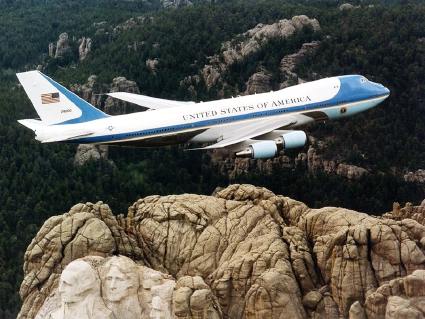
Regardless of where in the world the president travels, if he flies in an Air Force jet, the plane is called Air Force One. According to White House officials, Air Force One is technically the "call sign" of any Air Force aircraft carrying the president. In practice, however, the name "Air Force One" is used to refer to one of two highly customized Boeing 747-200B series aircraft, which carry the tail codes 28000 and 29000.

Emblazoned with the words United States of America and an image of the American flag and Seal of the President of the United States, Air Force One is an undeniable presence wherever it flies. This is how the interior of this amazing, high-tech jet is described on the White House website:

Capable of refueling midair, Air Force One has unlimited range and can carry the President wherever he needs to travel. The onboard electronics are hardened to protect against an electromagnetic pulse, and Air Force One is equipped with advanced secure communications equipment, allowing the aircraft to function as a mobile command center in the event of an attack on the United States.

Inside, the President and his travel companions enjoy 4,000 square feet of floor space on three levels, including an extensive suite for the President that features a large office, lavatory, and conference room. Air Force One includes a medical suite that can function as an operating room, and a doctor is permanently on board. The plane’s two food preparation galleys can feed 100 people at a time.


Although it's difficult to find copies of specific Air Force One menus, The Old Foodie tells us that the following luncheon items were served aboard Air Force One on February 6, 1994:

Assorted Relishes
Vegetable Soup
Tuna Melt on Croissant
Chips
Choice of Beverage
Cookies

Now, this is a surprisingly sparse and ordinary menu to present to a sitting president, don't you think? BUT...that was back in 1994, when Bill Clinton was in office, which leads me to believe that perhaps this particular menu was inspired by his advisors' well-meaning desire to steer the president away from the greasy cheeseburgers and french fries that he once seemed to enjoy so much like and nudge him toward more healthy choices to help trim his then-less-than-slender waistline.


Although that recipe for Tuna Melt on Croissant isn't easily obtainable today, Barack Obama did kindly provide his favorite recipe for Tuna Salad during an interview with "60 Minutes" correspondent Steve Kroft early in the 2008 presidential campaign. If you're in the mood for tuna salad today, here is former President Obama's take on Toasted Tuna Salad Sandwiches:

Tuna
Grey Poupon mustard
Mayonnaise
Chopped gherkins
Toasted Bread

Whatever items might appear on its many in-flight menus, be they simple Tuna Melts on Croissants or crystal-filled dishes of Russian caviar, Air Force One truly is an "undeniable presence" wherever in the world it flies!

FAST FACT: According to the White House website: Air Force One is maintained and operated by the Presidential Airlift Group, part of the White House Military Office. The Airlift Group was founded in 1944 as the Presidential Pilot Office at the direction of President Franklin D. Roosevelt.

For the next 20 years, various propeller driven aircraft served the President. In 1962, President John F. Kennedy became the first President to fly in his own jet aircraft, a modified Boeing 707. Over the years, several other jet aircraft have been used, with the first of the current aircraft being delivered in 1990 during the administration of President George H. W. Bush.

Here's a brief excerpt from my Publishers Marketplace agent profile - and for more on my manuscript wish list and "How to Submit" click here!

Saturday, January 16, 2016

FDR's Beloved Dog "Fala" and the Election of 1944!

On November 10, 1940, a cute black Scottish terrier puppy arrived at the White House as a gift for President Franklin Delano Roosevelt and his family. At first, the dog’s name was "Big Boy," but the president soon renamed him “Murray the Outlaw of Falahill” after a distant Scottish ancestor.

One of the most famous presidential pets, Fala, as he was nicknamed, went just about everywhere with the President and quickly became part of his public image. In her Pulitzer-Prize-winning biography, No Ordinary Time, presidential historian Doris Kearns Goodwin wrote:

Fala accompanied the president everywhere, eating his meals in Roosevelt's study, sleeping in a chair at the foot of his bed. Within a few weeks of his arrival, the puppy was sent to the hospital with a serious intestinal disturbance. He had discovered the White House kitchen, and everyone was feeding him. When he came home, Roosevelt issued a stern order to the entire White House staff: "Not even one crumb will be fed to Fala except by the President." From then on, Fala was in perfect health.

While being pampered at the White House and traveling with Roosevelt, Fala had the good fortune to meet many famous political leaders, including British Prime Minister Winston Churchill and Mexican President Manuel Camacho.


Thrust as he was into the national spotlight, it’s perhaps not surprising that Fala became embroiled in a political controversy during the presidential campaign of 1944. You see, earlier that year, Fala had faithfully accompanied his master on a diplomatic trip to the Aleutian Islands. Shortly after the president returned home, a rumor began circulating that Fala was accidentally left on one of the islands and that the Navy had to send a destroyer back to retrieve him.

Capitalizing on the rumors, Republicans accused Roosevelt of spending millions of taxpayers' dollars in the effort to get his dog back. Responding sharply but light-heartedly to these and other accusations, FDR delivered his famous “Fala Speech” at a campaign dinner in Washington D.C., before the International Brotherhood of Teamsters, Chauffeurs, Warehousemen and Helpers of America. These are some of the remarks that President Roosevelt made that evening:

These Republican leaders have not been content with attacks on me, or my wife, or on my sons. No, not content with that, they now include my little dog, Fala. Well, of course, I don't resent attacks, and my family doesn't resent attacks — but Fala does resent them.

You know, Fala is Scotch, and being a Scottie, as soon as he learned that the Republican fiction writers in Congress and out had concocted a story that I'd left him behind on an Aleutian island and had sent a destroyer back to find him — at a cost to the taxpayers of two or three, or eight or 20 million dollars — his Scotch soul was furious.

He has not been the same dog since. I am accustomed to hearing malicious falsehoods about myself — such as that old, worm-eaten chestnut that I have represented myself as indispensable. But I think I have a right to resent, to object, to libelous statements about my dog.


Sadly, less than a year after he delivered that speech, President Roosevelt died. In her autobiography, Roosevelt's wife Eleanor described her recollections of Fala's reaction to his master's untimley death:

his legs straightened out, his ears pricked up and I knew that he expected to see his master coming down the drive as he had come so many times. Later, when we were living in the cottage, Fala always lay near the dining-room door where he could watch both entrances just as he did when his master was there...Fala accepted me after my husband's death, but I was just someone to put up with until the master should return.


FAST FACT: Fred D. Fair was Roosevelt’s porter on the Ferdinand Magellan, the presidential Pullman rail car. In a Washington Post article, Mr. Fair recalled his memories of the president's beloved dog in a letter titled "Feeding Fala":

I served him his meals, made his bed. We would serve the president highballs before dinner. Before the meal, I would fix Fala's food. He would never go into the dining room until you called him. We'd serve him in there. But you couldn't serve Fala yourself, oh no. You had to hand it to the president, and he'd feed Fala out of his hand. Many times, I remember dignitaries and other important folks waiting for their supper until Mr. Roosevelt finished feeding Fala."

Here's a brief excerpt from my Publishers Marketplace agent profile - and for more on my manuscript wish list and "How to Submit" click here!