How Leonardo da Vinci used rudimentary pigments in 1503 to create such subtle shadows and light on the Mona Lisa has long baffled art historians. Now, French researchers are using X-ray fluorescence spectroscopy to isolate and study each ultra-thin layer of paint and glaze da Vinci used to create the effect he was seeking, according to recent news reports.
By beaming x-rays on the Mona Lisa without removing it from the wall on which it is mounted in Paris' Louvre Museum, scientists found that da Vinci used a Renaissance painting technique known as sfumato, intricately mixing thin layers of pigment, glaze and oil to create the appearance of lifelike shadows and light. Scientists now believe that da Vinci used up to 30 layers of paint on his works.
While this may solve one mystery about the Mona Lisa, others remain, like: who is this enigmatic woman and why does she hold her subtle half-smile? To these questions we can add another: what did this mysterious woman and da Vinci like to eat?
According to one researcher who studied the culinary habits of Renaissance Italy, some favorites included Risi e Bisi, Saffron Risotto with Duck and Mushrooms, and Spinach Soup with Hazelnuts. Although those recipes would be impossible to duplicate today, this one for Mushroom Risotto from the New York Times might give you a sense of how and what Leonardo da Vinci liked to eat!
4 cups beef or chicken stock
1/8 teaspoon ground saffron
3 tablespoons unsalted butter
2 tablespoons olive oil
1/4 cup finely minced scallions
1/4 cup finely minced onions
1 pound fresh wild mushrooms, trimmed
1 1/2 cups Italian Arborio rice
Salt and freshly ground black pepper to taste
3/4 cup freshly grated Parmigiano-Reggiano cheese
Place stock in a saucepan and over medium heat bring to a simmer. Add saffron, stir, and simmer slightly. Meanwhile, in a saucepan over medium heat, melt 1 tablespoon butter in olive oil. When foam subsides, add scallions and onions and cook until softened and yellow but not browned. Add mushrooms and saute, stirring occasionally until liquid has evaporated.
Add rice to mushrooms, and cook, stirring to coat well, with butter and oil. Add approximately 3/4 cup of simmering stock to rice and mushrooms. Stir well and continue to cook, stirring occasionally, until rice has absorbed most of stock. Continue adding stock to rice by half-cupful adding only after rice has absorbed previous addition.
As cooking continues, stir more frequently. After 25 minutes, rice should be tender but still chewy. Remove from heat. Add salt and pepper to taste. Stir in remaining butter and 1/4 cup of Parmigiano-Reggiano. Serve immediately, passing the rest of the cheese.
Showing posts with label recipes. Show all posts
Friday, July 26, 2024
Friday, January 13, 2023
Lou Henry Hoover and the First Organized Girl Scout Cookie Drive in 1935!
So did you know that Herbert Hoover’s wife "Lou" served as president of the Girl Scouts and helped coordinate one of the first Girl Scout Cookie Drives in 1935? Sixty five years later, in April of 2000, the Herbert Hoover Presidential Library and Museum held an exhibit entitled, American Women! A Celebration of Our History. One exhibit depicted Lou Hoover’s lifelong commitment to the Girl Scouts. This is how the placard read:
A woman nicknamed "Daisy" started the Girl Scouts of the U.S.A. with 18 girls. And a tomboy called "Lou" helped the organization grow into its current membership of over 3.5 million! Lou Henry grew up enjoying the outdoor life, and was the first women to receive a degree in geology from Stanford. She traveled the world with her husband Herbert Hoover, and assisted him with his mining ventures and famine relief activities.
During World War I she met up with Juliette Low [Daisy], and was a Girl Scout for the next 25 years. As First Lady and national leader of the Girl Scouts, Hoover quietly aided people in need during the Depression, and was also the first to desegregate White House social functions.
Lou remained a Scout the rest of her life and led the first Girl Scout cookie drive in 1935. Juliette Low and Lou Henry Hoover brought together girls from the North and South, wealthy and poor, black and white, athletic and handicapped – instilling confidence that all women can develop their potential to be whatever they wish to be.
In the 1920s and 1930s, Girl Scouts all across the country baked their own simple sugar cookies with their mothers. They then packaged their coookies in wax paper bags sealed with a sticker and sold them door-to-door for 25 to 35 cents a dozen.
Today, of course, there is a wide array of commercially baked Girl Scouts cookies to choose from, including such traditional favorites as Samoas, Tagalongs, Trefoils, and Thin Mints! If you'd like to whip up a batch of cookies with your kids today, here's the original recipe for Early Girl Scout Cookies® from The Girl Scouts of the United States of America.
1 cup butter
1 cup sugar plus additional amount for topping (optional)
2 eggs
2 tablespoons milk
1 teaspoon vanilla
2 cups flour
1 teaspoon salt
2 teaspoons baking powder
Cream butter and the cup of sugar; add well-beaten eggs, then milk, vanilla, flour, salt, and baking powder. Refrigerate for at least 1 hour. Roll dough, cut into trefoil shapes, and sprinkle sugar on top, if desired. Bake in a quick oven (375°) for approximately 8 to 10 minutes or until the edges begin to brown. Makes six- to seven-dozen cookies.
For more on my manuscript wish list click here!
Monday, July 1, 2019
John and Abigail Adams Gooseberry Fool
As a delegate to the Second Continental Congress, John Adams was one of the fiercest advocates of the Declaration of Independence. Contrary to popular belief, the declaration wasn't signed by all of the delegates on July 4, 1776. Instead, it was initially approved on July 2, 1776. The delegates then continued debating and slightly revised it the following day and formally adopted it on the Fourth of July. Most historians agree that the Declaration wasn’t signed by all the delegates (with a few holdouts) until nearly a month later, on August 2, 1776.
Nevertheless, on July 3, 1776, John Adams wrote a letter to his wife Abigail, describing these momentous events. This, in part, is what he wrote:
The second day of July, 1776, will be the most memorable epoch in the history of America. I am apt to believe that it will be celebrated by succeeding generations as the great anniversary festival...It ought to be solemnized with pomp and parade, with shows, games, sports, guns, bells, bonfires, and illuminations, from one end of this continent to the other, from this time forward forever more.
Although no one knows what the delegates ate on those momentous days, biographers say that Adams was fond of Green Sea Turtle Soup, Indian Pudding and other simple foods of his New England youth. Gooseberry Fool, a traditional eighteenth century British and early American dish, was another Adams family favorite.
As an example of how national foodways change over time, gooseberries were abundant in John's day, but aren't widely available in the United States today. So, if you can't find gooseberries in your local grocery store, you can use blueberries or raspberries. Either way, this delicious, nutritious, and refreshingly sweet little treat would make a great addition to your Fourth of July festivities this week!
If you'd like to whip up some Gooseberry Fool today, here's a simple and simply delicious recipe to try from epicurious.com
3 cups pink or green gooseberries (or blueberries)
1/2 cup granulated sugar
1/2 cup well-chilled heavy cream
1/4 cup crème fraîche
1/4 cup superfine granulated sugar
Pull off tops and tails of gooseberries and halve berries lengthwise. In a heavy skillet cook berries and granulated sugar over moderate heat, stirring occasionally until liquid is thickened, about 5 minutes. Simmer mixture, mashing with a fork to a coarse puree, 2 minutes more. Chill puree, covered, until cold, about 1 hour, and up to 1 day.
In a bowl with an electric mixer beat heavy cream with crème fraîche until it holds soft peaks. Add superfine sugar and beat until mixture just holds stiff peaks. Fold chilled puree into cream mixture until combined well. Fool may be made 3 hours ahead and chilled, covered.
Credit: Declaration of Independence, painting by John Trumball
Saturday, February 25, 2012
Ulysses S. Grant, the Transcontinental Railroad, and Santa Fe Broiled Sage Hen
After the Civil War, peace between the North and South made it possible for the nation’s first Transcontinental Railroad to be completed. In 1863, the Union Pacific began laying track in Omaha, Nebraska, heading west. At the same time, the Central Pacific started laying track in Sacramento, California, heading east. Work in the beginning was slow and difficult, as you can imagine. After less than 25 miles of track had been laid in California, the Central Pacific “faced the daunting task of laying tracks over terrain that rose 7,000 feet in less than a hundred miles.” To conquer the sheer embankments, workers, the vast majority of whom were Chinese immigrants, were lowered by rope from the top of cliffs. While dangling in mid-air, they chipped away at the granite with picks and axes and then planted explosives to blast tunnels through the cliffs.
On October 10, 1865, Leland Stanford, president of the Central Pacific, submitted a progress report to President Andrew Johnson:
A large majority of the white laboring class on the Pacific Coast find more
profitable and congenial employment in mining and agricultural pursuits, than in railroad work. The greater portion of the laborers employed by us are Chinese, who constitute a large element in the population of California. Without them it would be impossible to complete the western portion of this great national enterprise within the time required by the Acts of Congress...
Their wages, which are always paid in coin, at the end of each month, are divided among them by their agents…in proportion to the labor done by each person. These agents…furnish them their supplies of food, the value of which they deduct from their monthly pay. We have assurances from leading Chinese merchants that ...the [company] will be able to procure during the next year not less than 15,000 laborers. With this large force, the Company will be able to push on the work so as not only to complete it within the time required by the Acts of Congress, but so as to meet the public impatience.
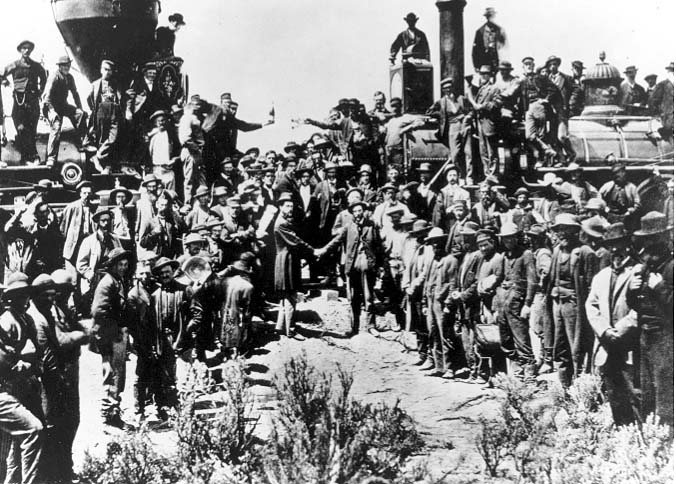
Four and a half years later, the two tracks finally met and the final “Golden Spike” was driven in with great ceremony at Promontory, Utah on May 10, 1869. By the end of the century, four more railways crisscrossed the United States. By then, most trains had luxury dining cars where first class passengers like President Grant dined on superb regional fare. The Baltimore and Ohio, for example, was famous for fresh seafood from the Chesapeake Bay while the Santa Fe was reportedly known for its Prairie Chicken and Broiled Sage Hen.
Although those railway recipes would be difficult to duplicate today, you can try this simple and simply delicious recipe for Lemon Sage Roasted Chicken from Bon Appetit.
4 chicken breast halves with skin and bones
8 very thin lemon slices, seeded
12 fresh sage leaves
Olive oil
4 teaspoons fresh lemon juice
2 large garlic cloves, coarsely chopped
1 cup low-salt chicken broth
Preheat oven to 450°F. Slide fingertips under chicken skin to loosen. Arrange 2 lemon slices and 3 sage leaves under skin on each breast; smooth skin over to enclose. Place chicken on rimmed baking sheet; brush with oil. Drizzle 1 teaspoon lemon juice over each breast; sprinkle with garlic, salt, and pepper. Pour 1/2 cup broth onto sheet around chicken.
Roast chicken until brown and cooked through, basting once or twice with pan juices, about 25 minutes. Transfer chicken to platter. Place baking sheet directly atop 2 burners; add remaining 1/2 cup broth. Using back of fork, mash any garlic on baking sheet into broth and pan juices. Boil over high heat until broth reduces almost to glaze, scraping up browned bits, about 4 minutes. Spoon sauce over chicken and serve.
FAST FACT: For every track of mile laid, railroads were granted a certain sum of money and 20 square miles of free land. The transcontinental railroad brought rapid economic growth to the nation, as farming, cattle-ranching and other agricultural businesses rapidly developed along the main lines..
If you like this, click here for my new book from Simon and Schuster!
Tuesday, July 13, 2010
John and Abigail Adams Indian Pudding
As you can imagine, the celebration was grand! Cookies, custards, and cakes, all baked in the new hearths on either side of the enormous kitchen fireplace, were served, along with all kinds of puddings, pastries, trifles, and tarts. Borrowing court etiquette from European kings and queens she had seen while John was U.S. Ambassador to Britain, Abigail regally greeted guests from a throne-like chair. Standing proudly beside her was her husband, wearing velvet breeches and lace with fashionably powdered hair.
Although that reception was a lavish affair, John and Abigail preferred more basic fare, and a few of their favorite foods, which can be traced to their New England roots, included Green Turtle Soup, Indian Pudding, and Gooseberry Fool. If you would like to make Indian Pudding, this recipe, adapted from simplyrecipes.com is fairly simple to make and tastes simply delicious!
6 cups of milk
1/2 cup (1 stick) butter
1/2 cup yellow cornmeal
1/4 cup flour
1 teaspoon salt
1/2 cup molasses
3 eggs, beaten
1/2 cup of granulated sugar
1 teaspoon of cinnamon
1 teaspoon of nutmeg
Whipped cream or vanilla ice cream
Scald the milk and butter in a large double boiler or heat the milk and butter for about 5 minutes on high heat in the microwave until it is boiling, then carefully transfer it to a medium saucepan on the stove. Keep hot over medium heat.
Preheat oven to 250°F. In a medium bowl, mix cornmeal, flour, and salt, then stir in molasses. Thin the mixture with 1/2 cup of scalded milk, a few tablespoons at a time, then gradually add the mixture back to into the scalded milk. Cook, stirring occasionally, until thickened, about 3-4 minutes.
Slowly add a half cup of the hot milk cornmeal mixture to the 3 beaten eggs, whisking constantly. Then add the egg mixture back in with the cornmeal mixture and stir to combine. Stir in the sugar and spices until smooth. Pour into a 2 1/2 quart shallow casserole dish. Bake for 2 hours at 250°F. Let cool for about an hour, then serve with whipped cream or vanilla ice cream and enjoy!
Thanks for stopping by THE HISTORY CHEF! And for a flash sale today for my book click here!
Andrew Johnson, Presidential Reconstruction, and Southern Hoppin' John
As a result, the government had to figure out how to rebuild the South. As president, Johnson took charge of the first phase of Reconstruction. But his attempt to quickly readmit the former Confederate states into the union and his vetoes of important civil rights bills outraged Radical Republicans in Congress.
The House of Representatives impeached Johnson in 1868, but he was acquitted by a single vote in the Senate. Historians say that Johnson’s victory “marked the beginning of an ambitious series of receptions, dinners and children’s parties that would turn the last nine months of his term into an ongoing celebration.”
After leaving office, Johnson returned to his native state of Tennessee where he probably consumed such traditional southern foods as Hoppin’ John and Pine Bark Stew. Still popular in the south, Hoppin' John is often the high point of New Year's Day festivities and is thought to bring good luck throughout the coming year. If you'd like to whip up some Hoppin' John, you can't go wrong with this quick and simple recipe from Emeril Lagasse.
1 tablespoon olive oil
1 large ham hock
1 cup onion, chopped
1/2 cup celery, chopped
1/2 cup green pepper, chopped
1 tablespoon chopped garlic
1 pound black-eyed peas, soaked overnight and rinsed
1 quart chicken stock
1 Bay leaf
1 teaspoon dry thyme leaves
Salt, black pepper, and cayenne
3 tablespoons finely chopped green onion
3 cups steamed white rice
Heat oil in a large soup pot, add the ham hock and sear on all sides for 4 minutes. Add the onion, celery, green pepper, and garlic, and cook for 4 minutes. Add the black-eyed peas, stock, bay leaves, thyme, and seasonings.
Bring to a boil, reduce the heat and simmer for 40 minutes, or until the peas are creamy and tender, stir occasionally. If the liquid evaporates, add more water or stock. Adjust seasonings, and garnish with green onions. Serve over rice and enjoy!
Subscribe to:
Posts (Atom)