Showing posts with label Presidents. Show all posts

Tuesday, October 15, 2024

Babe Ruth, Grover Cleveland, and the Debate Over the Name of the Baby Ruth Bar

So did you know that Grover Cleveland's name is associated with a long-standing debate over the name of the Baby Ruth bar? Some people say that this popular candy bar was named after Cleveland's infant daughter Ruth, who was endearingly referred to as "Baby Ruth." Others claim that it was named after the great baseball player Babe Ruth, who hit the peak of his fame shortly after the candy bar was introduced in 1920.

According to Babe Ruth Central, this is how the story goes:

Back in 1916, the Curtiss Candy Company was founded in Chicago. The company's first candy bar was called the "Kandy Kake". The product was not overwhelmingly successful, so Curtiss went about refashioning it. And, in 1920, the "Baby Ruth" candy bar was introduced to candy-craving consumers.

That would be a pretty simple story, if it ended there. But, of course, it didn't. Adults and kids back then, just like today, were confused by the name and thought it was a candy bar related to Babe Ruth. After all, even in 1921, Babe already had gained a lot of fame in the baseball world. He had hit 54 home runs in 1920 and 59 during the 1921 season. These were incredible records at the time and he was in newspapers all over the country. So, for many, Baby Ruth was Babe Ruth's candy.


Despite widespread popular opinion that the candy bar was named after the Babe, the Curtiss Candy Company never swayed from its position that it was named in honor of Cleveland's daughter Ruth.

But...as many commentators have observed, Ruth died of diptheria in 1904, seventeen years "before Curtiss combined nougat, chocolate, caramel and peanuts into its chewy Baby Ruth." Moreover, Grover Cleveland left office in 1897, and, by the time the Baby Ruth bar hit the market in 1920, William McKinley, Theodore Roosevelt, and William Howard Taft had all served as president, and Woodrow Wilson was just finishing his second term.

So why would the Curtiss Company name its candy bar after a long-deceased daughter of a former president? Well, some claimed that the company conveniently concocted the story to avoid having to pay royalties to Babe Ruth, which, if true, would have been illegal and unfair.

Whatever the case may be, the story doesn't end there. In 1926, Babe agreed to lend his name to a new candy bar called "Ruth's Home Run Candy Bar" that was manufactured by the fledgling George H. Ruth Candy Company. In response, the Curtiss Company filed a lawsuit to prevent the rival candy bar from being made, claiming that it infringed on their trademark that had been established in 1919.


In 1931, the Court of Customs and Patent Appeals ruled in favor of the Curtiss Company and George Ruth's Home Run Bar was forced off the market. To support its ruling, the court explained that it was evident that George Ruth was trying to capitalize on his nickname at a time when sales of Baby Ruths were reportedly as high as $1 million a month.

Regardless of the legal outcome of the case, the debate over the name of the Baby Ruth bar continues to this day! And so NOW you know how Grover Cleveland's name became associated with the debate over the name of the Baby Ruth bar!

FAST FACT: So did you know that Grover Cleveland is the only American president to serve two non-consecutive terms. His first term was 1885-1889 and his second term was 1893-1897 which means he was the 22nd and 24th president of the United States. So that's why President Biden is the 46th president even though there have only been 45 different presidents to date!

Thursday, May 28, 2020

James Garfield, the Pythagorean Theorem, and the Founding Father of Vegetarianism

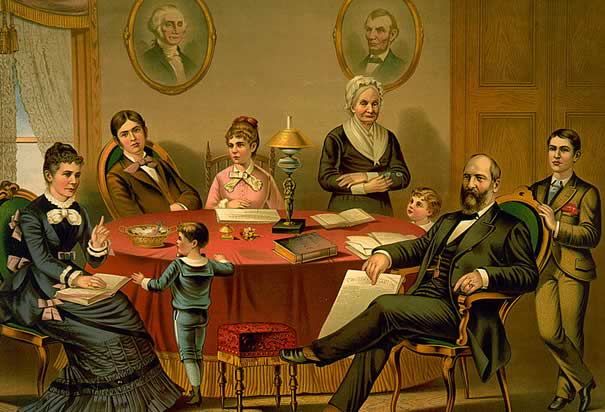
As a lawyer, professor, and duly ordained minister, James Garfield is the only president to have discovered a novel proof of the Pythagorean Theorem. The Theorem, of course, is named after Pythagoras, an ancient Greek philosopher and mathematician.

As you might recall from grade school, the theorem says that in a right triangle, the sum of the squares of the two right angle sides will always be the same as the square of the hypotenuse (the longest side).

Translated mathematically, the equation would read: A2 + B2 = C2. Let’s try it quickly here: If Side A is 4 inches long and Side B is 3 inches long, the equation would be: 4 x 4 = 16 and 3 x 3 = 9. Added together, 16 + 9 = 25. Now we simply find the square root of 25 and - voila! - we know that side C is 5 inches long!


So what does the Pythagorean Theorem have to do with food? A lot, if you consider the fact that Pythagoras has been called the Founding Father of Vegetarianism. Until the 19th century, when the term "vegetarian" came into use, people who didn't eat meat were often called “Pythagoreans.”

As a young man, Garfield was a farmer in Ohio and wouldn't have called himself a Pythagorean, but he might have enjoyed this healthy recipe for Ultimate Veggie Burgers from 101 Cookbooks if he tried it!


2 1/2 cups garbanzo beans or canned garbanzos, rinsed
4 large eggs
1/2 teaspoon fine-grain sea salt
1/3 cup chopped fresh cilantro
1 onion, chopped
Grated zest of one lemon
1 cup toasted (whole-grain) bread crumbs
1 tablespoon extra-virgin olive oil

Combine garbanzos, eggs, and salt in a food processor. Puree until the mixture is the consistency of a thick, slightly chunky hummus. Pour into a mixing bowl and stir in the cilantro, onion, and zest.

Add breadcrumbs, stir, and let sit for a couple of minutes. Heat oil in a heavy skillet over medium low, add 4 patties, cover and cook for 7-10 minutes. Flip the patties and cook the second side for 7 minutes, or until golden. Remove from the skillet and cool on a wire rack while you cook the remaining patties.

FAST FACT: Garfield was one of our most intellectual presidents. Before going into politics, he was a professor of ancient languages. He was also ambidextrous and would often show off his knowledge by writing Greek with one hand and Latin with the other. Now THAT'S impressive!

Monday, December 8, 2014

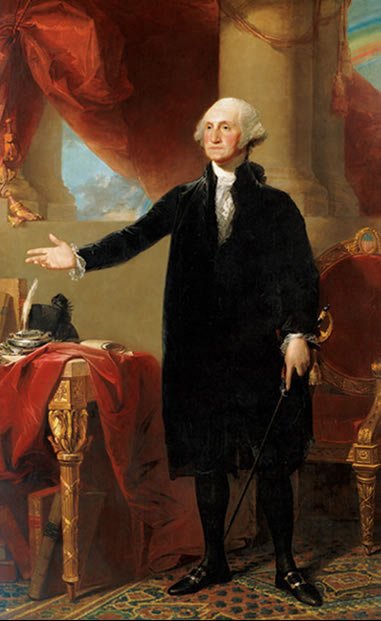
George Washington's Ice House at Mount Vernon

So did you know that one of George Washington’s favorite desserts was ice cream? In fact, he liked this soft, creamy treat so much that he had an ice house constructed near his Mount Vernon home so that he and his family could eat ice cream often.

Historians say that Washington’s icehouse was located on a riverbank about 75 yards from the Potomac. To store ice, Washington’s slaves had to use chisels and axes to pull large chunks of ice from the frozen river during the wintertime and then haul them to the icehouse where they were stacked in layers and stored for use throughout the spring and summer.

Before constructing his ice house, Washington sought advice from his friend and fellow patriot Robert Morris, who had an ice house at his home at 6th & Market Streets in Philadelphia. In a letter to Washington, Morris provided a detailed account of how his ice house had been constructed:

My Ice House is about 18 feet deep and 16 square, the bottom is a Coarse Gravell & the water which drains from the ice soaks into it as fast as the Ice melts, this prevents the necessity of a Drain...the Walls of my Ice House are built of stone without Mortar...On these [walls] the Roof is fixed...I nailed a Ceiling of Boards under the Roof flat from Wall to Wall, and filled the Space between the Ceiling and the Shingling of the Roof with Straw so that the heat of the Sun Cannot possibly have any Effect...

The Door for entering this Ice house faces the north, a Trap Door is made in the middle of the Floor through which the Ice is put in and taken out. I find it best to fill with Ice which as it is put in should be broke into small pieces and pounded down with heavy Clubs or Battons such as Pavers use, if well beat it will after a while consolidate into one solid mass and require to be cut out with a Chizell or Axe. I tried Snow one year and lost it in June. The Ice keeps until October or November and I believe if the Hole was larger so as to hold more it would keep untill Christmas...


Although Morris didn't mention what he stored in his icehouse, we do know that the Washingtons used theirs to preserve meat and butter, chill wine, and make ice cream and other frozen delicacies for their many guests at Mount Vernon.

Of course, George Washington wasn’t the only president who enjoyed ice cream. Accounts of it often appear in letters describing the many elegant dinner parties hosted by James and Dolley Madison, and the dish frequently appears in visitors' accounts of meals with Thomas Jefferson.

One particular guest wrote: "Among other things, ice-creams were produced in the form of balls of the frozen material inclosed in covers of warm pastry, exhibiting a curious contrast, as if the ice had just been taken from the oven." If you'd like to whip up some ice cream contained in warm pastry for your next dinner party, here's a simple recipe to try from puffpastry.com

1/2 of a 17.3-ounce package pastry sheets, 1 sheet, thawed
1 pint chocolate ice cream, softened
1 pint strawberry ice cream, soft
Chocolate fudge topping

Heat the oven to 400°F. Unfold the pastry sheet on a lightly floured surface. Cut the pastry sheet into 3 strips along the fold marks. Place the pastries onto a baking sheet. Bake for 15 minutes or until the pastries are golden brown. Remove the pastries from the baking sheet and let cool on a wire rack for 10 minutes. Split each pastry into 2 layers, making 6 in all.

Reserve 2 top pastry layers. Spread the chocolate ice cream on 2 bottom pastry layers. Freeze for 30 minutes. Top with another pastry layer and spread with the strawberry ice cream. Top with the reserved top pastry layers. Freeze for 30 minutes or until the ice cream is firm. Drizzle with the chocolate topping.

FAST FACT: In 1790, Robert Morris's house at 6th & Market Streets became the Executive Mansion of the United States while Philadelphia served as the temporary capital of the nation. Morris' icehouse was used by President Washington and his household until 1797, and by President John Adams and his family from 1797 to 1800.

Tuesday, July 13, 2010

Andrew Johnson, Presidential Reconstruction, and Southern Hoppin' John

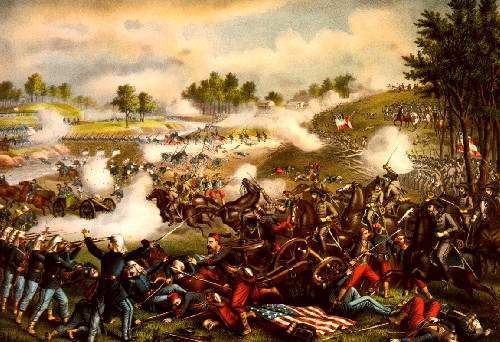
At the end of the Civil War, the South lay in ruins. Southern plantations and entire cities had been destroyed during the war. Without food, many southerners starved to death, and some of those who survived lost everything they owned.

As a result, the government had to figure out how to rebuild the South. As president, Johnson took charge of the first phase of Reconstruction. But his attempt to quickly readmit the former Confederate states into the union and his vetoes of important civil rights bills outraged Radical Republicans in Congress.

The House of Representatives impeached Johnson in 1868, but he was acquitted by a single vote in the Senate. Historians say that Johnson’s victory “marked the beginning of an ambitious series of receptions, dinners and children’s parties that would turn the last nine months of his term into an ongoing celebration.”

After leaving office, Johnson returned to his native state of Tennessee where he probably consumed such traditional southern foods as Hoppin’ John and Pine Bark Stew. Still popular in the south, Hoppin' John is often the high point of New Year's Day festivities and is thought to bring good luck throughout the coming year. If you'd like to whip up some Hoppin' John, you can't go wrong with this quick and simple recipe from Emeril Lagasse.

1 tablespoon olive oil
1 large ham hock
1 cup onion, chopped
1/2 cup celery, chopped
1/2 cup green pepper, chopped
1 tablespoon chopped garlic
1 pound black-eyed peas, soaked overnight and rinsed
1 quart chicken stock
1 Bay leaf
1 teaspoon dry thyme leaves
Salt, black pepper, and cayenne
3 tablespoons finely chopped green onion
3 cups steamed white rice

Heat oil in a large soup pot, add the ham hock and sear on all sides for 4 minutes. Add the onion, celery, green pepper, and garlic, and cook for 4 minutes. Add the black-eyed peas, stock, bay leaves, thyme, and seasonings.

Bring to a boil, reduce the heat and simmer for 40 minutes, or until the peas are creamy and tender, stir occasionally. If the liquid evaporates, add more water or stock. Adjust seasonings, and garnish with green onions. Serve over rice and enjoy!

Friday, July 9, 2010

Dolley Madison Fresh Strawberry Ice Cream

Legend has it that in the early nineteenth century, a freed slave named Sallie Shadd went into her family’s catering business in Wilmington, Delaware. Sallie supposedly achieved fame among the free black population there for a new dessert sensation she created with frozen cream, sugar, and fruit.

When Dolley Madison heard about this new dessert, she supposedly travelled to Wilmington to try it. The First Lady must have loved it because a "magnificent dome of pink ice cream" was served at President Madison’s second Inaugural Ball in 1813, and ice cream often appeared as the official dessert on the White House menu during her husband's two terms of office.

This recipe for strawberry ice cream, which may be similar to the one used by the Madison’s chef, is adapted from The White House Cookbook by Hugo Ziemann, a nineteenth century steward of the White House, and Mrs. F. L. Gillette, a celebrated 19th century cookbook author.

1 1/2 cups sugar
4 cups fresh strawberries, sliced
1 quart heavy fresh cream

In a medium bowl, mix 1 cup sugar with strawberries, let stand for three hours, then mash and strain through a coarse towel.

Add 1/2 cup sugar and combine until dissolved. Beat in cream and freeze for at least three hours.

Thanks for stopping by THE HISTORY CHEF! For a free excerpt of my new book from Simon and Schuster click here