Showing posts with label Ulysses S. Grant. Show all posts

Tuesday, March 22, 2016

Lucy Hayes, the Turf Protection Act and Brief History of the Easter Egg Roll at the White House

According to whitehouse.gov, some historians claim that Dolley Madison originally suggested the idea of a public egg roll on White House grounds while others tell stories of informal egg-rolling parties dating back to Abraham Lincoln's administration. What is clear, however, is that, beginning in the 1870s, Washingtonians from all social levels celebrated Easter Monday on the west grounds of the U.S. Capitol where children rolled brilliantly dyed hard-boiled eggs down the terraced lawn.

This practice ended in 1876, however, when lawmakers complained that eggs shells were destroying the grass. To resolve this problem, a group of party-poopers in Congress passed the Turf Protection Act which banned egg rolls from Capital grounds, and President Ulysses S. Grant signed the bill into law later that year. Fortunately, the tradition was revived in 1878 when First Lady Lucy Hayes invited children of all ages to roll Easter eggs on the White House lawn, a tradition that has continued ever since.

According to this article in Time Magazine:

Some 53,000 people attended the egg roll in 1941...though in modern times the number is generally under 20,000. Calvin Coolidge's wife mingled through crowds while holding a pet raccoon named Rebecca, while Mrs. Warren G. Harding put on the uniform of her beloved Girl Scouts for the event. Showcasing modern technology, Eleanor Roosevelt welcomed crowds and addressed listeners across the country via radio in 1933, while the Clinton administration proudly announced that 1998's egg roll would be the first broadcast on the Internet.

This year, the Obamas will host the 138th annual White House Easter Egg Roll on Monday, March 28, when more than 35,000 people will join them on the South Lawn for games, stories, and, of course, the traditional egg roll.


And while the menu for this year's White House Easter Brunch hasn't been released, the Chicago Sun-Times reported that menu items in 2008 included Honey Baked Ham with Maple Mustard Sauce, Eggs Benedict, spinach salad, waffles, sauteed asparagus, biscuits and cheese grits. If you'd like whip up some Eggs Benedict for your Easter brunch this Sunday, here's a simple and simply delicious recipe to try from the Food Network:


1 teaspoon vinegar
4 eggs
4 thin slices Canadian bacon
2 English muffins

Hollandaise sauce:

3 egg yolks
1 tablespoon hot water
1 tablespoon lemon juice
1 stick unsalted butter, melted and hot
Salt and pepper
Paprika and chopped parsley

In large skillet, bring 2 inches of water and vinegar to a boil. Crack one egg into a glass. Reduce water to a simmer and pour egg into water. Add remaining eggs and cook for 4 minutes. Remove eggs with a slotted spoon and drain. In a non-stick skillet heat the bacon until warm. Toast the English muffins until golden.

For sauce: Place yolks, water and lemon juice into blender. Blend for 1 minute. With blender running, pour butter through open hole of lid. Season with salt and pepper. To assemble: Top each muffin with bacon and a poached egg. Pour the warm sauce over and garnish with paprika and the chopped parsley.

FAST FACT: The Easter Egg Roll was held at the White House every year in the 20th century except during World War I, World War II, and the Truman Renovation of the White House, when it was moved to nearby locations or cancelled. Ronald Reagan was the first president to hide autographed eggs for children to find and Richard Nixon and First Lady Pat Nixon were the first to include the Easter Bunny in the festivities. Years earlier, First Lady Grace Coolidge made an appearance at the Easter Egg Roll in the 1920s with her famous pet racooon Rebecca!

For more on my manuscript wish list and submission info click here!

Friday, November 20, 2015

Franklin D. Roosevelt, the Great Depression and the Thanksgiving Day Date-Change Fiasco

So did you know that in 1939 President Franklin D. Roosevelt decided to move Thanksgiving Day forward by a week? Rather than allow the holiday to fall on its traditional date, the last Thursday of November, Roosevelt issued a proclamation declaring that the holiday would instead be celebrated a week earlier.

Why did he make such a seemingly random decision in the midst of the Great Depression? Well, his reason was economic and intended to extend the Christmas shopping season. According to the Wall Street Journal:

There were five Thursdays in November that year, which meant that Thanksgiving would fall on the 30th. That left just 20 shopping days till Christmas. By moving the holiday up a week to Nov. 23, the president hoped to give the economy a lift by allowing shoppers more time to make their purchases and—so his theory went—spend more money...

In an informal news conference in August announcing his decision, FDR offered a little tutorial on the history of the holiday. Thanksgiving was not a national holiday, he noted, meaning that it was not set by federal law. According to custom, it was up to the president to pick the date every year.

It was not until 1863, when Abraham Lincoln ordered Thanksgiving to be celebrated on the last Thursday in November, that that date became generally accepted, Roosevelt explained. To make sure that reporters got his point, he added that there was nothing sacred about the date...


Just as he had done with his controversial "Court Packing" plan of 1937, Roosevelt badly misjudged public opinion. Outraged protests began in Plymouth, Massachussetts, the place of the "first Thanksgiving" in 1621, but quickly spread to other circles.

PRESIDENT SHOCKS FOOTBALL COACHES: Many Games are Upset by Thanksgiving Plan, read a banner headline in the New York Times. And even in the staunchly Democratic state of Arkansas, the football coach of Little Ouachita College threatened: 'We'll vote the Republican ticket if he interferes with our football.'"


Of course, some collegiate coaches and athletic directors were more diplomatic. In a letter to the president's secretary, Philip Badger, Chairman of the University Board of Athletic Control at New York University wrote:

My dear Mr. Secretary:

I am wondering if you are at liberty at this time to supply me with any information over and above what has appeared in the public press to date regarding the plan of the President to proclaim November 23 as Thanksgiving Day this year instead of November 30.

Over a period of years it has been customary for my institution to play its annual football game with Fordham University at the Yankee Stadium here at New York University on Thanksgiving Day...As you probably know, it has become necessary to frame football schedules three to five years in advance, and for both 1939 and 1940 we had arranged to play our annual football game with Fordham on Thanksgiving Day, with the belief that such day would fall upon the fourth Thursday in November.

Please understand that all of us interested in the administration of intercollegiate athletics realize that there are considerations and problems before the country for solution which are far more important than the schedule problems of intercollegiate athletics. However, some of us are confronted with the problem of readjusting the date of any football contest affected by the President's proposal.


Outside of the collegiate football arena, public sentiments also ran heavily against Roosevelt's plan, as evidenced by a national Gallup poll which found "that 62% of Americans surveyed disapproved of the date change." And, as opposition grew, some state governors "took matters into their own hands and defied the Presidential Proclamation."

According to the Franklin D. Roosevelt Presidential Library and Museum:

Some governors declared November 30th as Thanksgiving. And so, depending upon where one lived, Thanksgiving was celebrated on the 23rd and the 30th. This was worse than changing the date in the first place because families that lived in states such as New York did not have the same day off as family members in states such as Connecticut! [And so] family and friends were unable to celebrate the holiday together.

By 1941, most retailers also disapproved of Roosevelt's plan, and even the federal government conceded that the date change had not resulted in any boost in sales. And so, on December 26, 1941, President Roosevelt signed Joint Resolution 41 making Thanksgiving a national holiday and mandating that it be observed on the fourth Thursday in November of each year.

FAST FACT: According to the Library of Congress, when "Abraham Lincoln was president in 1863, he proclaimed the last Thursday of November to be our national Thanksgiving Day. In 1865, Thanksgiving was celebrated the first Thursday of November, because of a proclamation by President Andrew Johnson, and, in 1869, President Ulysses S. Grant chose the third Thursday for Thanksgiving Day. In all other years, until 1939, Thanksgiving was celebrated as Lincoln had designated, the last Thursday in November."

Thursday, September 10, 2015

Ulysses S. Grant, the Transcontinental Railroad, and Santa Fe Broiled Sage Hen

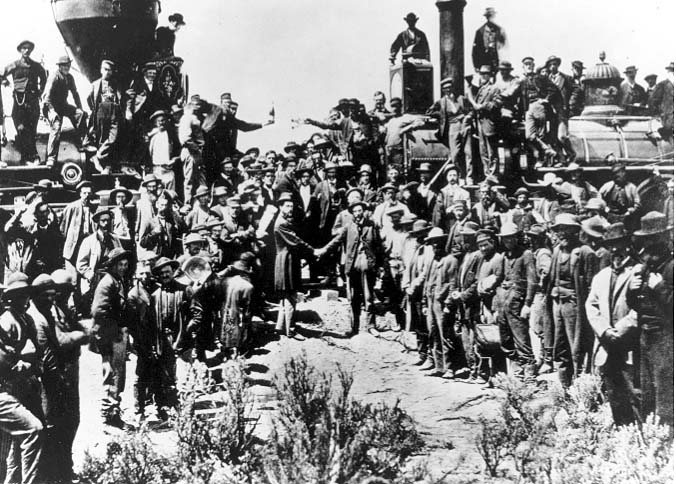
After the Civil War, peace between the North and South made it possible for the nation’s first Transcontinental Railroad to be completed. In 1863, the Union Pacific began laying track in Omaha, Nebraska, heading west. At the same time, the Central Pacific started laying track in Sacramento, California, heading east.

Work in the beginning was slow and difficult, as you can imagine. After less than 25 miles of track had been laid in California, the Central Pacific “faced the daunting task of laying tracks over terrain that rose 7,000 feet in less than a hundred miles.” To conquer the sheer embankments, workers, the vast majority of whom were Chinese immigrants, were lowered by rope from the top of cliffs. While dangling in mid-air, they chipped away at the granite with picks and axes and then planted explosives to blast tunnels through the cliffs.

On October 10, 1865, Leland Stanford, president of the Central Pacific, submitted a progress report to President Ulysses S. Grant:

A large majority of the white laboring class on the Pacific Coast find more
profitable and congenial employment in mining and agricultural pursuits, than in railroad work. The greater portion of the laborers employed by us are Chinese, who constitute a large element in the population of California. Without them it would be impossible to complete the western portion of this great national enterprise within the time required by the Acts of Congress...

Their wages, which are always paid in coin, at the end of each month, are divided among them by their agents…in proportion to the labor done by each person. These agents…furnish them their supplies of food, the value of which they deduct from their monthly pay. We have assurances from leading Chinese merchants that ...the [company] will be able to procure during the next year not less than 15,000 laborers. With this large force, the Company will be able to push on the work so as not only to complete it within the time required by the Acts of Congress, but so as to meet the public impatience.


Four and a half years later, the two tracks finally met and the final “Golden Spike” was driven in with great ceremony at Promontory, Utah on May 10, 1869. By the end of the century, four more railways crisscrossed the United States. By then, most trains had luxury dining cars where first class passengers like President Grant dined on superb regional fare. The Baltimore and Ohio, for example, was famous for fresh seafood from the Chesapeake Bay while the Santa Fe was reportedly known for its Prairie Chicken and Broiled Sage Hen.

Although those railway recipes would be difficult to duplicate today, you can try this simple and simply delicious recipe for Lemon Sage Roasted Chicken from Bon Appetit.

4 chicken breast halves with skin and bones
8 very thin lemon slices, seeded
12 fresh sage leaves
Olive oil
4 teaspoons fresh lemon juice
2 large garlic cloves, coarsely chopped
1 cup low-salt chicken broth

Preheat oven to 450°F. Slide fingertips under chicken skin to loosen. Arrange 2 lemon slices and 3 sage leaves under skin on each breast; smooth skin over to enclose. Place chicken on rimmed baking sheet; brush with oil. Drizzle 1 teaspoon lemon juice over each breast; sprinkle with garlic, salt, and pepper. Pour 1/2 cup broth onto sheet around chicken.

Roast chicken until brown and cooked through, basting once or twice with pan juices, about 25 minutes. Transfer chicken to platter. Place baking sheet directly atop 2 burners; add remaining 1/2 cup broth. Using back of fork, mash any garlic on baking sheet into broth and pan juices. Boil over high heat until broth reduces almost to glaze, scraping up browned bits, about 4 minutes. Spoon sauce over chicken and serve.

FAST FACT: For every track of mile laid, railroads were granted a certain sum of money and 20 square miles of free land. The transcontinental railroad brought rapid economic growth to the nation, as farming, cattle-ranching and other agricultural businesses rapidly developed along the main lines.

Friday, January 30, 2015

Ulysses S. Grant, the Transcontinental Railroad, and Santa Fe Broiled Sage Hen

After the Civil War, peace between the North and South made it possible for the nation’s first Transcontinental Railroad to be completed. In 1863, the Union Pacific began laying track in Omaha, Nebraska, heading west. At the same time, the Central Pacific started laying track in Sacramento, California, heading east.

Work in the beginning was slow and difficult, as you can imagine. After less than 25 miles of track had been laid in California, the Central Pacific faced the daunting task of laying tracks over terrain that rose 7,000 feet in less than a hundred miles. To conquer the sheer embankments, workers, the vast majority of whom were Chinese immigrants, were lowered by rope from the top of cliffs. While dangling in mid-air, they chipped away at the granite with picks and axes and then planted explosives to blast tunnels through the cliffs.

On October 10, 1865, Leland Stanford, president of the Central Pacific, submitted a progress report to President Ulysses S. Grant:

A large majority of the white laboring class on the Pacific Coast find more
profitable and congenial employment in mining and agricultural pursuits, than in railroad work. The greater portion of the laborers employed by us are Chinese, who constitute a large element in the population of California. Without them it would be impossible to complete the western portion of this great national enterprise within the time required by the Acts of Congress...

Their wages, which are always paid in coin, at the end of each month, are divided among them by their agents…in proportion to the labor done by each person. These agents…furnish them their supplies of food, the value of which they deduct from their monthly pay. We have assurances from leading Chinese merchants that ...the [company] will be able to procure during the next year not less than 15,000 laborers. With this large force, the Company will be able to push on the work so as not only to complete it within the time required by the Acts of Congress, but so as to meet the public impatience.


Four and a half years later, the two tracks finally met and the final “Golden Spike” was driven in with great ceremony at Promontory, Utah on May 10, 1869. By the end of the century, four more railways crisscrossed the United States. By then, most trains had luxury dining cars where first class passengers like President Grant dined on superb regional fare. The Baltimore and Ohio, for example, was famous for fresh seafood from the Chesapeake Bay while the Santa Fe was known for its Barbecued Prairie Spring Chicken and Broiled Sage Hen.

Although those railway recipes might be mighty difficult to find today, you can try this one for Lemon Sage Roasted Chicken from Bon Appetit.

4 chicken breast halves with skin and bones
8 very thin lemon slices, seeded
12 fresh sage leaves
Olive oil
4 teaspoons fresh lemon juice
2 large garlic cloves, coarsely chopped
1 cup low-salt chicken broth

Preheat oven to 450°F. Slide fingertips under chicken skin to loosen. Arrange 2 lemon slices and 3 sage leaves under skin on each breast; smooth skin over to enclose. Place chicken on rimmed baking sheet; brush with oil. Drizzle 1 teaspoon lemon juice over each breast; sprinkle with garlic, salt, and pepper. Pour 1/2 cup broth onto sheet around chicken.

Roast chicken until brown and cooked through, basting once or twice with pan juices, about 25 minutes. Transfer chicken to platter. Place baking sheet directly atop 2 burners; add remaining 1/2 cup broth. Using back of fork, mash any garlic on baking sheet into broth and pan juices. Boil over high heat until broth reduces almost to glaze, scraping up browned bits, about 4 minutes. Spoon sauce over chicken and serve.

FAST FACT: For every track of mile laid, railroads were granted a certain sum of money and 20 square miles of free land. The transcontinental railroad brought rapid economic growth to the nation, as farming, cattle-ranching and other agricultural businesses rapidly developed along the main lines.

Monday, December 2, 2013

Ulysses S. Grant's Second Inaugural Ball

The menu for Ulysses S. Grant’s second Inaugural Ball reflects the opulence of the Gilded Age. A New York Times article dated March 5, 1873 contains a mind-boggling list of dishes and provisions served, including:

10,000 fried oysters; 8,000 scalloped oysters; 8,000 pickled oysters; 63 boned turkeys; 75 roast turkeys; 150 roast capons stuffed with truffles; 15 saddles of mutton; 200 dozen quails; 300 tongues ornamented with jelly; 200 hams; 30 baked salmon; 100 roasted chickens; 400 partridges; 25 stuufed boar’s heads; 2,000 head-cheese sandwiches; 3,000 ham sandwiches; 3,000 beef-tongue sandwiches; 1,600 bunches celery; 30 barrels of salad; 350 boiled chickens; 6,000 boiled eggs; 2,000 pounds of lobster; 2,500 loaves of bread; 8,000 rolls and 1,000 pounds of butter.

Dessert items inclued 300 charlotte russes; 200 moulds of wine jelly; 200 moulds of blanc mange; 300 gallons of assorted ice-cream; 400 pounds of mixed cakes; 25 barrels of Malaga grapes; 400 pounds of mixed candies; 200 pounds of shelled almonds; 200 gallons coffee; 200 gallons of tea and 100 gallons of hot chocolate.

But the best laid plans can go awry, even for a president. The weather that evening was freezing and the temporary ballroom had no heat. Guests danced in their hats and overcoats, they ran out of hot chocolate and coffee, and perhaps most tragically, most of the decorative caged canaries (which were supposed to be happily chirping) froze!

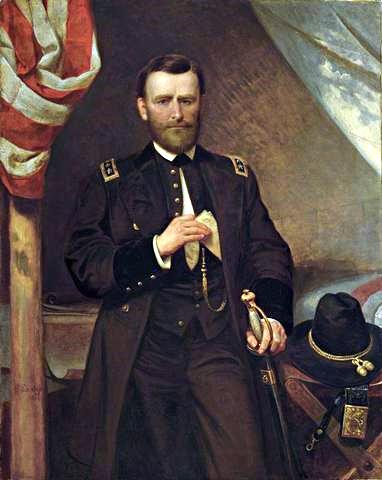
Credit: Portrait of Ulysses S. Grant by Emanuel Gottlieb Leutze

Thanks for stopping by THE HISTORY CHEF! And for a flash sale today for my book click here!

Saturday, February 25, 2012

Ulysses S. Grant, the Transcontinental Railroad, and Santa Fe Broiled Sage Hen

After the Civil War, peace between the North and South made it possible for the nation’s first Transcontinental Railroad to be completed. In 1863, the Union Pacific began laying track in Omaha, Nebraska, heading west. At the same time, the Central Pacific started laying track in Sacramento, California, heading east.

Work in the beginning was slow and difficult, as you can imagine. After less than 25 miles of track had been laid in California, the Central Pacific “faced the daunting task of laying tracks over terrain that rose 7,000 feet in less than a hundred miles.” To conquer the sheer embankments, workers, the vast majority of whom were Chinese immigrants, were lowered by rope from the top of cliffs. While dangling in mid-air, they chipped away at the granite with picks and axes and then planted explosives to blast tunnels through the cliffs.

On October 10, 1865, Leland Stanford, president of the Central Pacific, submitted a progress report to President Andrew Johnson:

A large majority of the white laboring class on the Pacific Coast find more
profitable and congenial employment in mining and agricultural pursuits, than in railroad work. The greater portion of the laborers employed by us are Chinese, who constitute a large element in the population of California. Without them it would be impossible to complete the western portion of this great national enterprise within the time required by the Acts of Congress...

Their wages, which are always paid in coin, at the end of each month, are divided among them by their agents…in proportion to the labor done by each person. These agents…furnish them their supplies of food, the value of which they deduct from their monthly pay. We have assurances from leading Chinese merchants that ...the [company] will be able to procure during the next year not less than 15,000 laborers. With this large force, the Company will be able to push on the work so as not only to complete it within the time required by the Acts of Congress, but so as to meet the public impatience.


Four and a half years later, the two tracks finally met and the final “Golden Spike” was driven in with great ceremony at Promontory, Utah on May 10, 1869. By the end of the century, four more railways crisscrossed the United States. By then, most trains had luxury dining cars where first class passengers like President Grant dined on superb regional fare. The Baltimore and Ohio, for example, was famous for fresh seafood from the Chesapeake Bay while the Santa Fe was reportedly known for its Prairie Chicken and Broiled Sage Hen.

Although those railway recipes would be difficult to duplicate today, you can try this simple and simply delicious recipe for Lemon Sage Roasted Chicken from Bon Appetit.

4 chicken breast halves with skin and bones
8 very thin lemon slices, seeded
12 fresh sage leaves
Olive oil
4 teaspoons fresh lemon juice
2 large garlic cloves, coarsely chopped
1 cup low-salt chicken broth

Preheat oven to 450°F. Slide fingertips under chicken skin to loosen. Arrange 2 lemon slices and 3 sage leaves under skin on each breast; smooth skin over to enclose. Place chicken on rimmed baking sheet; brush with oil. Drizzle 1 teaspoon lemon juice over each breast; sprinkle with garlic, salt, and pepper. Pour 1/2 cup broth onto sheet around chicken.

Roast chicken until brown and cooked through, basting once or twice with pan juices, about 25 minutes. Transfer chicken to platter. Place baking sheet directly atop 2 burners; add remaining 1/2 cup broth. Using back of fork, mash any garlic on baking sheet into broth and pan juices. Boil over high heat until broth reduces almost to glaze, scraping up browned bits, about 4 minutes. Spoon sauce over chicken and serve.

FAST FACT: For every track of mile laid, railroads were granted a certain sum of money and 20 square miles of free land. The transcontinental railroad brought rapid economic growth to the nation, as farming, cattle-ranching and other agricultural businesses rapidly developed along the main lines..

If you like this, click here for my new book from Simon and Schuster!

Monday, March 21, 2011

Ulysses S. Grant, the Transcontinental Railroad, and "Santa Fe Sage Broiled Hen"

After the Civil War, peace between the North and South made it possible for the nation’s first Transcontinental Railroad to be completed. In 1863, the Union Pacific began laying track in Omaha, Nebraska, heading west. At the same time, the Central Pacific started laying track in Sacramento, California, heading east.

Work in the beginning was slow and difficult, as you can imagine. After less than 25 miles of track had been laid in California, the Central Pacific “faced the daunting task of laying tracks over terrain that rose 7,000 feet in less than a hundred miles.” To conquer the sheer embankments, workers, the vast majority of whom were Chinese immigrants, were lowered by rope from the top of cliffs. While dangling in mid-air, they chipped away at the granite with picks and axes and then planted explosives to blast tunnels through the cliffs.

On October 10, 1865, Leland Stanford, president of the Central Pacific, submitted a progress report to President Ulysses S. Grant:

A large majority of the white laboring class on the Pacific Coast find more
profitable and congenial employment in mining and agricultural pursuits, than in railroad work. The greater portion of the laborers employed by us are Chinese, who constitute a large element in the population of California. Without them it would be impossible to complete the western portion of this great national enterprise within the time required by the Acts of Congress...

Their wages, which are always paid in coin, at the end of each month, are divided among them by their agents…in proportion to the labor done by each person. These agents…furnish them their supplies of food, the value of which they deduct from their monthly pay. We have assurances from leading Chinese merchants that ...the [company] will be able to procure during the next year not less than 15,000 laborers. With this large force, the Company will be able to push on the work so as not only to complete it within the time required by the Acts of Congress, but so as to meet the public impatience.


Four and a half years later, the two tracks finally met and the final “Golden Spike” was driven in with great ceremony at Promontory, Utah on May 10, 1869. By the end of the century, four more railways crisscrossed the United States. By then, most trains had luxury dining cars where first class passengers like President Grant dined on superb regional fare. The Baltimore and Ohio, for example, was famous for fresh seafood from the Chesapeake Bay while the Santa Fe was known for its Broiled Sage Hen and Prairie Chicken.

Although those railway recipes would be difficult to duplicate today, you can try this simple recipe for Lemon Sage Roasted Chicken from Bon Appetit.

4 chicken breast halves with skin and bones
8 very thin lemon slices, seeded
12 fresh sage leaves
Olive oil
4 teaspoons fresh lemon juice
2 large garlic cloves, coarsely chopped
1 cup low-salt chicken broth

Preheat oven to 450°F. Slide fingertips under chicken skin to loosen. Arrange 2 lemon slices and 3 sage leaves under skin on each breast; smooth skin over to enclose. Place chicken on rimmed baking sheet; brush with oil. Drizzle 1 teaspoon lemon juice over each breast; sprinkle with garlic, salt, and pepper. Pour 1/2 cup broth onto sheet around chicken.

Roast chicken until brown and cooked through, basting once or twice with pan juices, about 25 minutes. Transfer chicken to platter. Place baking sheet directly atop 2 burners; add remaining 1/2 cup broth. Using back of fork, mash any garlic on baking sheet into broth and pan juices. Boil over high heat until broth reduces almost to glaze, scraping up browned bits, about 4 minutes. Spoon sauce over chicken and serve.

FAST FACT: For every track of mile laid, railroads were granted a certain sum of money and 20 square miles of free land. The transcontinental railroad brought rapid economic growth to the nation, as farming, cattle-ranching and other agricultural businesses rapidly developed along the main lines.

Wednesday, July 14, 2010

Ulysses S. Grant's Second Inaugural Ball

The menu for Ulysses S. Grant’s second Inaugural Ball reflects the opulence of the Gilded Age. A New York Times article dated March 5, 1873 contains a mind-boggling list of dishes and provisions served, including:

10,000 fried oysters; 8,000 scalloped oysters; 8,000 pickled oysters; 63 boned turkeys; 75 roast turkeys; 150 roast capons stuffed with truffles; 15 saddles of mutton; 200 dozen quails; 300 tongues ornamented with jelly; 200 hams; 30 baked salmon; 100 roasted chickens; 400 partridges; 25 stuufed boar’s heads; 2,000 head-cheese sandwiches; 3,000 ham sandwiches; 3,000 beef-tongue sandwiches; 1,600 bunches celery; 30 barrels of salad; 350 boiled chickens; 6,000 boiled eggs; 2,000 pounds of lobster; 2,500 loaves of bread; 8,000 rolls and 1,000 pounds of butter.

Dessert items inclued 300 charlotte russes; 200 moulds of wine jelly; 200 moulds of blanc mange; 300 gallons of assorted ice-cream; 400 pounds of mixed cakes; 25 barrels of Malaga grapes; 400 pounds of mixed candies; 200 pounds of shelled almonds; 200 gallons coffee; 200 gallons of tea and 100 gallons of hot chocolate.

But the best laid plans can go awry, even for a president. The weather that evening was freezing and the temporary ballroom had no heat. Guests danced in their hats and overcoats, they ran out of hot chocolate and coffee, and perhaps most tragically, most of the decorative caged canaries (which were supposed to be happily chirping) froze!

Credit: Portrait of Ulysses S. Grant by Emanuel Gottlieb Leutze