Showing posts with label Thomas Jefferson. Show all posts
Monday, July 1, 2019
John and Abigail Adams Gooseberry Fool
As a delegate to the Second Continental Congress, John Adams was one of the fiercest advocates of the Declaration of Independence. Contrary to popular belief, the declaration wasn't signed by all of the delegates on July 4, 1776. Instead, it was initially approved on July 2, 1776. The delegates then continued debating and slightly revised it the following day and formally adopted it on the Fourth of July. Most historians agree that the Declaration wasn’t signed by all the delegates (with a few holdouts) until nearly a month later, on August 2, 1776.
Nevertheless, on July 3, 1776, John Adams wrote a letter to his wife Abigail, describing these momentous events. This, in part, is what he wrote:
The second day of July, 1776, will be the most memorable epoch in the history of America. I am apt to believe that it will be celebrated by succeeding generations as the great anniversary festival...It ought to be solemnized with pomp and parade, with shows, games, sports, guns, bells, bonfires, and illuminations, from one end of this continent to the other, from this time forward forever more.
Although no one knows what the delegates ate on those momentous days, biographers say that Adams was fond of Green Sea Turtle Soup, Indian Pudding and other simple foods of his New England youth. Gooseberry Fool, a traditional eighteenth century British and early American dish, was another Adams family favorite.
As an example of how national foodways change over time, gooseberries were abundant in John's day, but aren't widely available in the United States today. So, if you can't find gooseberries in your local grocery store, you can use blueberries or raspberries. Either way, this delicious, nutritious, and refreshingly sweet little treat would make a great addition to your Fourth of July festivities this week!
If you'd like to whip up some Gooseberry Fool today, here's a simple and simply delicious recipe to try from epicurious.com
3 cups pink or green gooseberries (or blueberries)
1/2 cup granulated sugar
1/2 cup well-chilled heavy cream
1/4 cup crème fraîche
1/4 cup superfine granulated sugar
Pull off tops and tails of gooseberries and halve berries lengthwise. In a heavy skillet cook berries and granulated sugar over moderate heat, stirring occasionally until liquid is thickened, about 5 minutes. Simmer mixture, mashing with a fork to a coarse puree, 2 minutes more. Chill puree, covered, until cold, about 1 hour, and up to 1 day.
In a bowl with an electric mixer beat heavy cream with crème fraîche until it holds soft peaks. Add superfine sugar and beat until mixture just holds stiff peaks. Fold chilled puree into cream mixture until combined well. Fool may be made 3 hours ahead and chilled, covered.
Credit: Declaration of Independence, painting by John Trumball
Tuesday, December 1, 2015
George Washington's Ice House at Mount Vernon
Historians say that Washington’s icehouse was located on a riverbank about 75 yards from the Potomac. To store ice, Washington’s slaves had to use chisels and axes to pull large chunks of ice from the frozen river during the wintertime and then haul them to the icehouse where they were stacked in layers and stored for use throughout the spring and summer.
Before constructing his ice house, Washington sought advice from his friend and fellow patriot Robert Morris, who had an ice house at his home at 6th & Market Streets in Philadelphia. In a letter to Washington, Morris provided a detailed account of how his ice house had been constructed:
My Ice House is about 18 feet deep and 16 square, the bottom is a Coarse Gravell & the water which drains from the ice soaks into it as fast as the Ice melts, this prevents the necessity of a Drain...the Walls of my Ice House are built of stone without Mortar...On these [walls] the Roof is fixed...I nailed a Ceiling of Boards under the Roof flat from Wall to Wall, and filled the Space between the Ceiling and the Shingling of the Roof with Straw so that the heat of the Sun Cannot possibly have any Effect...
The Door for entering this Ice house faces the north, a Trap Door is made in the middle of the Floor through which the Ice is put in and taken out. I find it best to fill with Ice which as it is put in should be broke into small pieces and pounded down with heavy Clubs or Battons such as Pavers use, if well beat it will after a while consolidate into one solid mass and require to be cut out with a Chizell or Axe. I tried Snow one year and lost it in June. The Ice keeps until October or November and I believe if the Hole was larger so as to hold more it would keep untill Christmas...
Although Morris didn't mention what he stored in his icehouse, we do know that the Washingtons used theirs to preserve meat and butter, chill wine, and make ice cream and other frozen delicacies for their many guests at Mount Vernon.
Of course, George Washington wasn’t the only president who enjoyed ice cream. Accounts of it often appear in letters describing the many elegant dinner parties hosted by James and Dolley Madison, and the dish frequently appears in visitors' accounts of meals with Thomas Jefferson.
One particular guest wrote: "Among other things, ice-creams were produced in the form of balls of the frozen material inclosed in covers of warm pastry, exhibiting a curious contrast, as if the ice had just been taken from the oven." If you'd like to whip up some ice cream contained in warm pastry for your next dinner party, here is a simple and delicious recipe to try from puffpastry.com
1/2 of a 17.3-ounce package pastry sheets, 1 sheet, thawed
1 pint chocolate ice cream, softened
1 pint strawberry ice cream, soft
Chocolate fudge topping
Heat the oven to 400°F. Unfold the pastry sheet on a lightly floured surface. Cut the pastry sheet into 3 strips along the fold marks. Place the pastries onto a baking sheet. Bake for 15 minutes or until the pastries are golden brown. Remove the pastries from the baking sheet and let cool on a wire rack for 10 minutes. Split each pastry into 2 layers, making 6 in all.
Reserve 2 top pastry layers. Spread the chocolate ice cream on 2 bottom pastry layers. Freeze for 30 minutes. Top with another pastry layer and spread with the strawberry ice cream. Top with the reserved top pastry layers. Freeze for 30 minutes or until the ice cream is firm. Drizzle with the chocolate topping.
FAST FACT: In 1790, Robert Morris's house at 6th & Market Streets became the Executive Mansion of the United States while Philadelphia served as the temporary capital of the nation. Morris' icehouse was used by President Washington and his household until 1797, and by President John Adams and his family from 1797 to 1800.
For my new literary agent profile and submission guidelines, click here
Wednesday, May 13, 2015
Thomas Jefferson's Favorite Pet
Of all the feathered friends that Jefferson purchased, his favorite was a little mockingbird named Dick. In The First Forty Years of Washington Society, Margaret Bayard Smith, a prominent Washington socialite who was frequently invited to dine at the President's House, noted that Jefferson "cherished this bird with peculiar fondness, not only for its melodious powers, but for its uncommon intelligence and affectionate disposition, of which qualities he gave surprising instances."
According to Mrs. Smith, this unsually intelligent little bird
was the constant companion of [Jefferson's] solitary and studious hours. Whenever he was alone he opened the cage and let the bird fly about the room. After flitting for a while from one object to another, it would alight on his table and regale him with its sweetest notes...Often when he retired to his chamber, it would hop up the stairs after him, and while he took his siesta, would sit on his couch and pour forth its melodious strains.
So what in the world does this have to do with presidential history and food? Well, not a whole lot, except that Jefferson was so fond of Dick that he would often let him "perch on his shoulder and take its food from his lips!"
Although Jefferson didn't record the types of food he fed to his little feathered friend, experts say that mockingbirds generally feed on insects, wild fruit, weeds, and seeds. During the spring and summer, caterpillars, grasshoppers, ants, bees, and other insects make up most of their diet, and, during winter, they primarily eat vegetable matter. Because of their insect-eating habits, most people consider mockingbirds more helpful than harmful, and no one can dispute the fact that these birds "truly sing for their supper," something that Jefferson took great delight in throughout most of his extraordinary life!
Tuesday, April 21, 2015
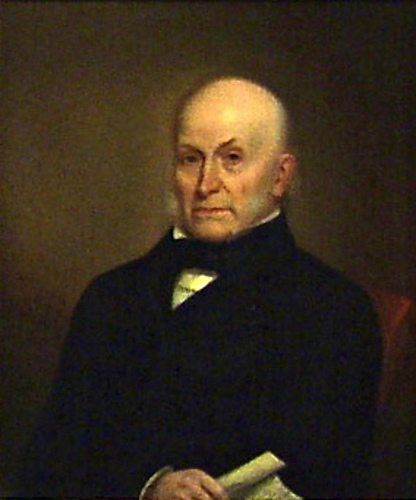
John Quincy Adams, the Corrupt Bargain, and the Art of Dinner Conversation
When John Quincy Adams took the oath of office in 1825, it was under a cloud of controversy. The election of 1824 had been a bitterly contested four-man race between Andrew Jackson, Henry Clay, William Crawford, and Adams.
Since no candidate had won a majority of electoral votes, the election was thrown into the House of Representatives where Clay, as Speaker of the House, threw his support to Adams, even though Jackson had won the most popular and electoral votes. Adams then quickly appointed Clay as Secretary of State. Outraged and feeling cheated out of the White House, Jackson and his supporters called the deal a “Corrupt Bargain to "cheat the will of the people."”
With these accusations hanging over his head, Adams faced problems from the start. Aware of the fact that “two-thirds of the whole people” did not want him to be president, Adams promised in his Inaugural Address to make up for his lack of support with “a heart devoted to the welfare of our country.”
But his four years in office weren't easy ones. Although his intelligence, family background and experience should have made him a great president, John lacked the charisma needed to create a base of loyal supporters.
Nevertheless, he and his wife Louisa hosted many dinner parties at the White House, as required. But his cold personality had a chilling effect on others and guests seated near the president at dinner often said that he had a hard time engaging in casual conversation. Aware of his inability to make small talk, John wrote this in his diary:
I went out this evening in search of conversation, an art of which I never had an adequate idea. Long as I have lived in the world, I never have thought of conversation as a school in which something was to be learned. I never knew how to make, control, or to change it.
I am by nature a silent animal, and my dear mother’s constant lesson in childhood, that children should be seen and not heard, confirmed me irrevocably in what I now deem a bad habit. Conversation is an art of the highest importance, a school in which, for the business of life, more may perhaps be learnt than from books. It…consists more in making others talk than in talking. Therein has been, and ever will be, my deficiency – the talent of starting the game.
Like his father, John Quincy Adams was a very intelligent man, but he lacked personal warmth and his critics called him “a chip off the old iceberg!”
FAST FACT: Adams’ policies favoring a strong federal government angered many southern slave holders who feared that that any expansion of federal power might interfere with slavery. His Indian policies also cost him supporters. Like Jefferson and Monroe, Adams wanted to remove Native Americans west of the Mississippi River, but believed that the government should honor and uphold Indian treaties and purchase (rather than forcibly or fraudulently take) Indian lands.
Here's a brief excerpt from my Publishers Marketplace agent profile - and for more on my manuscript wish list and "How to Submit" click here!
Since no candidate had won a majority of electoral votes, the election was thrown into the House of Representatives where Clay, as Speaker of the House, threw his support to Adams, even though Jackson had won the most popular and electoral votes. Adams then quickly appointed Clay as Secretary of State. Outraged and feeling cheated out of the White House, Jackson and his supporters called the deal a “Corrupt Bargain to "cheat the will of the people."”
With these accusations hanging over his head, Adams faced problems from the start. Aware of the fact that “two-thirds of the whole people” did not want him to be president, Adams promised in his Inaugural Address to make up for his lack of support with “a heart devoted to the welfare of our country.”
But his four years in office weren't easy ones. Although his intelligence, family background and experience should have made him a great president, John lacked the charisma needed to create a base of loyal supporters.
Nevertheless, he and his wife Louisa hosted many dinner parties at the White House, as required. But his cold personality had a chilling effect on others and guests seated near the president at dinner often said that he had a hard time engaging in casual conversation. Aware of his inability to make small talk, John wrote this in his diary:
I went out this evening in search of conversation, an art of which I never had an adequate idea. Long as I have lived in the world, I never have thought of conversation as a school in which something was to be learned. I never knew how to make, control, or to change it.
I am by nature a silent animal, and my dear mother’s constant lesson in childhood, that children should be seen and not heard, confirmed me irrevocably in what I now deem a bad habit. Conversation is an art of the highest importance, a school in which, for the business of life, more may perhaps be learnt than from books. It…consists more in making others talk than in talking. Therein has been, and ever will be, my deficiency – the talent of starting the game.
Like his father, John Quincy Adams was a very intelligent man, but he lacked personal warmth and his critics called him “a chip off the old iceberg!”
FAST FACT: Adams’ policies favoring a strong federal government angered many southern slave holders who feared that that any expansion of federal power might interfere with slavery. His Indian policies also cost him supporters. Like Jefferson and Monroe, Adams wanted to remove Native Americans west of the Mississippi River, but believed that the government should honor and uphold Indian treaties and purchase (rather than forcibly or fraudulently take) Indian lands.
Here's a brief excerpt from my Publishers Marketplace agent profile - and for more on my manuscript wish list and "How to Submit" click here!
Monday, December 8, 2014
George Washington's Ice House at Mount Vernon
Historians say that Washington’s icehouse was located on a riverbank about 75 yards from the Potomac. To store ice, Washington’s slaves had to use chisels and axes to pull large chunks of ice from the frozen river during the wintertime and then haul them to the icehouse where they were stacked in layers and stored for use throughout the spring and summer.
Before constructing his ice house, Washington sought advice from his friend and fellow patriot Robert Morris, who had an ice house at his home at 6th & Market Streets in Philadelphia. In a letter to Washington, Morris provided a detailed account of how his ice house had been constructed:
My Ice House is about 18 feet deep and 16 square, the bottom is a Coarse Gravell & the water which drains from the ice soaks into it as fast as the Ice melts, this prevents the necessity of a Drain...the Walls of my Ice House are built of stone without Mortar...On these [walls] the Roof is fixed...I nailed a Ceiling of Boards under the Roof flat from Wall to Wall, and filled the Space between the Ceiling and the Shingling of the Roof with Straw so that the heat of the Sun Cannot possibly have any Effect...
The Door for entering this Ice house faces the north, a Trap Door is made in the middle of the Floor through which the Ice is put in and taken out. I find it best to fill with Ice which as it is put in should be broke into small pieces and pounded down with heavy Clubs or Battons such as Pavers use, if well beat it will after a while consolidate into one solid mass and require to be cut out with a Chizell or Axe. I tried Snow one year and lost it in June. The Ice keeps until October or November and I believe if the Hole was larger so as to hold more it would keep untill Christmas...
Although Morris didn't mention what he stored in his icehouse, we do know that the Washingtons used theirs to preserve meat and butter, chill wine, and make ice cream and other frozen delicacies for their many guests at Mount Vernon.
Of course, George Washington wasn’t the only president who enjoyed ice cream. Accounts of it often appear in letters describing the many elegant dinner parties hosted by James and Dolley Madison, and the dish frequently appears in visitors' accounts of meals with Thomas Jefferson.
One particular guest wrote: "Among other things, ice-creams were produced in the form of balls of the frozen material inclosed in covers of warm pastry, exhibiting a curious contrast, as if the ice had just been taken from the oven." If you'd like to whip up some ice cream contained in warm pastry for your next dinner party, here's a simple recipe to try from puffpastry.com
1/2 of a 17.3-ounce package pastry sheets, 1 sheet, thawed
1 pint chocolate ice cream, softened
1 pint strawberry ice cream, soft
Chocolate fudge topping
Heat the oven to 400°F. Unfold the pastry sheet on a lightly floured surface. Cut the pastry sheet into 3 strips along the fold marks. Place the pastries onto a baking sheet. Bake for 15 minutes or until the pastries are golden brown. Remove the pastries from the baking sheet and let cool on a wire rack for 10 minutes. Split each pastry into 2 layers, making 6 in all.
Reserve 2 top pastry layers. Spread the chocolate ice cream on 2 bottom pastry layers. Freeze for 30 minutes. Top with another pastry layer and spread with the strawberry ice cream. Top with the reserved top pastry layers. Freeze for 30 minutes or until the ice cream is firm. Drizzle with the chocolate topping.
FAST FACT: In 1790, Robert Morris's house at 6th & Market Streets became the Executive Mansion of the United States while Philadelphia served as the temporary capital of the nation. Morris' icehouse was used by President Washington and his household until 1797, and by President John Adams and his family from 1797 to 1800.
Thursday, December 4, 2014
James Monroe, Virginia Spoon Bread, and the Long Winter at Valley Forge
Among the soldiers at Valley Forge were Benedict Arnold, Alexander Hamilton, the Marquis de Lafayette, and the future Supreme Court Chief Justice John Marshall. Another soldier encamped there was Dr. Albigence Waldo, a surgeon from Connecticut, whose diary provides perhaps the best account we have of conditions that winter at Valley Forge:
Dec. 21st., Preparations made for hutts. Provision Scarce...sent a Letter to my Wife. Heartily wish myself at home, my Skin & eyes are almost spoiled with continual smoke. A general cry thro' the Camp this Evening among the Soldiers, "No Meat !, No Meat !", the Distant vales Echo'd back the melancholly sound, "No Meat ! No Meat !"…What have you for our Dinners Boys?" Nothing but Fire Cake & Water, Sir." At night, "Gentlemen the Supper is ready." What is your Supper, Lads? " Fire Cake & Water, Sir..."
Dec. 22nd., Lay excessive Cold & uncomfortable last Night, my eyes are started out from their Orbits like a Rabbit's eyes, occation'd by a great Cold, and Smoke. What have you got for Breakfast, Lads ? " Fire Cake & Water, Sir." I am ashamed to say it, but I am tempted to steal Fowls if I could find them, or even a whole Hog, for I feel as if I could eat one…But why do I talk of hunger & hard usage, when so many in the World have not even fire Cake & Water to eat...
After the war, Monroe returned to Virginia and studied law under Thomas Jefferson, then served as governor of Virginia and was later appointed as U.S. Minister to France. Like Jefferson, Monroe developed a fondness for fancy French cuisine, but historians say that he retained a boyhood taste for Spoon Bread and other simple foods of his Virginia youth.
Because it has a consistency similar to pudding, Spoon Bread is usually served straight from the baking pan with a large spoon. If you'd like to whip up a batch today, here's a quick and simple recipe to try:
¾ cup cornmeal
1 teaspoon salt
1 cup water
3 tablespoons melted butter
2 eggs
1 cup milk
2 teaspoons baking powder
Combine cornmeal and salt in a mixing bowl. Gradually add boiling water. Stir in melted butter.
In a small mixing bowl, beat eggs and milk. Add egg and milk mixture to the cornmeal mixture. Add baking powder and mix.
Pour into a greased baking dish. Bake at 350° for about 30 minutes, until set and lightly browned. Serve straight from the baking dish with a spoon and enjoy!
FAST FACT: In Emmanuel Luetz’s famous painting “Washington Crossing the Delaware,” James Monroe is depicted directly behind Washington, holding an American flag up against the storm. Measuring 12 feet high and 21 feet long, it's on display at the Metropolitan Museum of Art in New York City.
Monday, December 12, 2011
George Washington's Ice House at Mount Vernon and Strawberry Ice Cream Baked in Warm Pastry
Historians say that Washington’s icehouse was located on a riverbank about 75 yards from the Potomac. To store ice, Washington’s slaves had to use chisels and axes to pull large chunks of ice from the frozen river during the wintertime and then haul them to the icehouse where they were stacked in layers and stored for use throughout the spring and summer.
Before constructing his ice house, Washington sought advice from his friend and fellow patriot Robert Morris, who had an ice house at his home at 6th & Market Streets in Philadelphia. In a letter to Washington, Morris provided a
Wednesday, November 2, 2011
James Madison, the Potomac Oyster Wars, and the Constitutional Convention
In the seventeenth century, watermen in Maryland and Virginia battled over ownership rights to the Potomac River. Maryland traced its rights to a 1632 charter from King Charles I which included the river. At the same time, Virginia laid its claims to the river to an earlier charter from King James I and a 1688 patent from King James II, both of which also included the river.
In 1776, after more than a century of conflict, Virginia ceded ownership of the river but reserved the right to “the free navigation and use of the rivers Potowmack and Pocomoke." Maryland rejected this reservation and quickly passed a resolution asserting total control over the Potomac. After the Revolution, battles over the river intensified between watermen from both states.
To resolve this problem, leaders from Maryland and Virginia appointed two groups of commissioners which, at the invitation of George Washington, met at Mount Vernon in May of 1785. James Madison led the Virginia contingent and Samuel Chase led the Maryland delegation. Their discussions led to the Compact of 1785, which allowed oystermen from both states free use the river.
Peace prevailed until the supply of oysters began to dwindle, at which point Maryland re-imposed harvesting restrictions. Virginia retaliated by closing the mouth of the Chesapeake and watermen from both states engaged in bloody gun battles which lasted, with periodic breaks, for more than a century.
Today, these battles are known as the Potomac Oyster Wars. They are important in their own right, but they have a larger historical significance because they revealed one of the main weaknesses of the Articles of Confederation, which was that the federal government didn't have the power to control commerce among the states, a setup that was creating constant chaos and conflict.
With this problem in mind, Madison and the others who convened at Mt. Vernon in May of 1785 agreed to meet the following year at Annapolis to discuss the need for a stronger federal government. Not many delegates showed up and so they agreed to convene the following May in Philadelphia, which is, of course, where the Constitution was drafted.
And so NOW you know how James Madison and a little bivalve from the Potomac helped pave the way to the Constitutional Convention!
FACT: Under the Articles of Confederation, the federal government didn't have the power to raise its own army, regulate commerce between the states, or coin money for the country. To pass a law, Congress needed the approval of nine out of the 13 states, and in order to amend the Articles it needed the approval of all 13 states, which made it nearly impossible to get anything done! The Articles also didn't provide for an Executive or Judicial branch so there was no separation of powers.
Saturday, July 17, 2010
"When Thomas Jefferson Dined Alone"
He also founded the University of Virginia, was fluent in six languages, including Latin, French, Spanish, Italian and Greek, and wrote the Declaration of Independence at the age of 33! He then served as Secretary of State under George Washington, as Vice President under John Adams, and, along with his good pal James Madison, wrote the Virginia and Kentucky Resolutions in defense of states’ rights and the freedom of speech.
During his presidency, Jefferson did many more important things: he repealed the Alien and Sedition Acts, eliminated an unpopular whiskey tax, and sent our navy to fight Barbary pirates who were harassing American ships on the Mediterranean Sea. He also doubled the size of the country by purchasing the Louisiana Territory from Napoleon in 1803 and then commissioned Lewis and Clark to explore western lands which, back then, to most Americans, were totally unknown.
It’s no wonder then that at a Nobel Prize dinner held at the White House in 1962, President John F. Kennedy joked that so many brilliant minds had never been gathered together at the White House "with the possible exception of when Thomas Jefferson dined alone."
Monday, July 12, 2010
Monticello Tomato Soup with Garlic and Herbs
Thomas Jefferson’s first written reference to "tomatas" is in his Notes on the State of Virginia: “The gardens yield muskmelons, watermelons, tomatas, okra, pomegranates, figs, and the esculent plants of Europe.” Although there no references in his writings to the commonly held eigteenth century belief that tomatoes were poisonous, one story holds that during a visit to Lynchburg, Jefferson “terrified one of the locals when he paused to snack on a tomato on the steps of the Miller-Claytor house.”
Whether this incident actually happened is uncertain. What is certain, however, is that Jefferson’s daughter Martha Jefferson Randolph and her daughters recorded numerous recipes for preparing tomatoes in their family cookbooks, including recipes for Cayenne Tomato Soup, Green Tomato Pickles, Tomato Gumbo, Tomato Preserves and Tomato Omelette.
It has been said that tomato soup with fresh herbs was another Jefferson family favorite. If you try this delicious recipe for Tomato Soup with Garlic and Herbs from seriouseats.com, it might just become one of your favorites, too!
1 tablespoon olive oil
1 large onion, diced
2 ribs celery, diced
1 can (28-ounce) Muir Glen Fire-Roasted diced tomatoes
1 can (28-ounce) Muir Glen Fire-Roasted crushed tomatoes
3 cups vegetable or chicken broth
2 teaspoons dried oregano
2 teaspoons dried basil
1/4 teaspoon cayenne (or to taste)
8 cloves roasted garlic (instructions here)
2 tablespoons minced parsley
Salt and pepper to taste
1 or 2 tablespoons sugar (optional)
4 tablespoons plain yogurt (optional)
Croutons (optional)
Sauté onion and celery in olive oil in a Dutch oven over medium heat. When onion is translucent (about 7 minutes), add the tomatoes, broth, oregano, basil, and cayenne. Bring to a boil, then simmer on low heat for 10 minutes.
Transfer half of the soup to the blender, add the roasted garlic, and purée until fairly smooth. If you'd like a chunky soup, add the blended half back to the pot. For a smoother soup, blend the rest of the soup and return it to the pot. Add the parsley and salt and pepper to taste, and simmer for about 10 minutes to allow the flavors to blend. Taste the soup, and if it is too acidic, add sugar, just enough to take the edge off. If desired, serve with croutons or a tablespoon of yogurt stirred into each bowl.
Credit: Still Life with Tomatoes, a Bowl of Aubergines, and Onions, painting by Louis Meléndez (c. 1771-1774)
Friday, July 9, 2010
James Hemings: Thomas Jefferson's Head Chef
Between 1785 and 1789, James apprenticed under famous French chefs and pastry cooks and became chef de cuisine in Jefferson’s residence on the Champs-Élysées, earning roughly $48 a year. Of course, these were the tumultuous years leading up to the French Revolution and there was no slavery in France at that time, and so James could have claimed his freedom at any time, but for reasons that remain unexplained, he chose not to do so.
Instead, he returned to the United States and later became head chef at Monticello. When James petitioned for his freedom in 1793, Jefferson agreed upon the following condition:“if the said James shall go with me to Monticello…and shall continue there until he shall have taught such persons as I shall place under him for the purpose to be a good cook…he shall be thereupon made free.”
To fulfill the terms of this manumission agreement, James taught his brother Peter all the cooking techniques he had learned in France. Three years later, James became a free man.
No one knows exactly what became of James after that, but we do know one thing: After Jefferson was elected president in 1800, he asked James to be his head chef in Washington, D.C. James declined this post, however, and a Frenchman by the name of Honoré Julien was head chef at the President’s House during most of Jefferson’s administration.
FAST FACT: Manumission is a fancy legal term for the freeing of a slave. In the United States, manumission of slaves was achieved by a variety of means, including state-ordered manumission and through private manumission agreements, like the agreement between Thomas and James.
Friday, July 2, 2010
Thomas Jefferson Grilled Peaches with Honey
While George Washington recorded only two varieties of peaches in his Mount Vernon orchard, Thomas Jefferson cultivated 38 varieties in his Fruit Gardens at Monticello. Jefferson was particularly fond of dried peaches and also used the fruit to make mobby, a peach brandy popular in Virginia.
Mary Randolph's popular 1824 cookbook The Virginia Housewife contains six recipes for peaches, including peach marmalade, peach chips, and peaches in brandy. This recipe for grilled peaches is a snap to make and is great to serve at summer barbecues and other large social gatherings.
4 large ripe peaches, halved and pitted
1 pint French vanilla ice cream
4 teaspoons honey
Heat a grill set to medium. Place peaches on the grill, cut-side down, and cook until grill marks appear, about 3 minutes. Turn over with a metal spatula and grill for another 4 minutes, or until the skin starts to shrivel and the peach softens.
Remove from grill and place 2 halves in 4 separate bowls. Top with the vanilla ice cream, drizzle with the honey and enjoy!
Credit: View of the West Front of Monticello and Garden, painting by Jane Braddick Peticolas
Thanks for stopping by THE HISTORY CHEF! For a free excerpt of my new book from Simon and Schuster click here.
Subscribe to:
Posts (Atom)