Tuesday, April 18, 2017

James Polk and Food on the Range

So did you know that in 1848 James Polk signed the Treaty of Guadalupe Hidalgo which ended the Mexican-American War and gave most of present-day Texas, New Mexico, Arizona, Colorado, California, Wyoming, and Utah to the United States?

With the addition of these vast tracts of land, more and more cowboys headed to the southwest, where they herded cattle north to market and sold them for beef. As they galloped along, cowboys would sing songs about food like "Trouble for the Range Cook" and "Starving to Death on My Government Claim."

"Git Along Little Dogies" is another classic cowboy tune. In it, a cowboy tells the dogies (the calves in the herd) that it’s their misfortune (and none of his own) that they will soon be sold at market. Maybe you remember the lyrics:

As I walked out this morning for pleasure,
I met a cowpuncher a jogging along;
his hat was throwed back and his spurs was a jingling,
and as he advanced he was singing this song.

Yippee ti yi yo, get along little dogies
It's your misfortune and none of my own
Yippee ti yi yo get along little dogies
For you know that Wyoming will soon be your home...


It's early in spring that we round up the dogies,
And mark 'em and brand 'em and bob off their tails;
We round up our horses and load the chuckwagon,
And then throw them dogies out onto the trail.

Whoopee ti yi yo, git along, little dogies,
It's your misfortune And none of my own;
Whoopee ti yi yo, Git along, little dogies,
You know that Wyoming will be your new home.


As cowboys drove cattle north, cooks drove Chuck Wagons (which carried all of the food and supplies for meals) ahead of the herds to set up camp for the night. Meals on the range typically consisted of beef, hash, beans, chili peppers, coffee, biscuits, sugar, and dried fruit.


Like cowboys, cooks would sing snappy tunes about food while working hard on the range. In “Punchin’ Dough” am exhausted, overworked cook tells some bothersome and ungrateful cowboys that cooking is just as demanding as herding cattle (you can listen to it here ):

Come, all you young waddies, I'II sing you a song
Stand back from the wagon, stay where you belong
I've heard you complaining' I'm fussy and slow,
While you're punchin' the cattle and I'm punchin' dough.

Now I reckon your stomach would grow to your back
If it was'n't for the cook that keeps fillin' the slack
With the beans in the box and the pork in the tub
I'm a-wonderin' now, who would fill you with grub?

When you're cuttin' stock, then I'm cuttin' a steak,
When you're wranglin' hosses, I'm wranglin' a cake.
When you're hazin' the dogies and battin' your eyes,
I'm hazin' dried apples that aim to be pies…


Meanwhile, as cowboys were devouring biscuits and beans on the range, Polk was dining on Continental cuisine at the White House. But Polk was no stranger to grub. As a boy growing up on the frontier, he reportedly ate Black Bear Steak and Barbecued Deer. Like other frontier folk, basic country fare, like Tenesseee Ham and Corn Pone, was what pleased Polk the most!


If you'd like to wrangle up some corn pone, here's a simple recipe to try:

1 tablespoon of shortening
3/4 cup of boiling water
1 cup yellow corn meal
1 teaspoon of salt

Melt shortening in 8 or 9-inch skillet. Heat water to boiling point and pour immediately over corn meal and salt. Add melted shortening; stir to blend well. As soon as mixture has cooled enough to handle, divide into four equal portions. Shape each portion into a pone about 3/4 inch thick by patting between the hands. Place in pan and bake at 450°F for about 50 minutes or until golden brown. Serve warm and enjoy!

For more on my submission info click here!

Tuesday, April 11, 2017

Lucy Hayes, the Turf Protection Act, and a Brief History of the Easter Egg Roll at the White House


Some historians claim that Dolley Madison originally suggested the idea of a public egg roll on White House grounds while others tell stories of informal egg-rolling parties dating back to Abraham Lincoln's administration. What is clear, however, is that, beginning in the 1870s, Washingtonians from all social levels celebrated Easter Monday on the west grounds of the U.S. Capitol where children rolled brilliantly dyed hard-boiled eggs down the terraced lawn.

This practice ended in 1876, however, when lawmakers complained that eggs shells were destroying the grass. To resolve this problem, a group of party-poopers in Congress passed the Turf Protection Act which banned egg rolls from Capital grounds, and President Ulysses S. Grant signed the bill into law later that year. Fortunately, the tradition was revived in 1878 when First Lady Lucy Hayes invited children of all ages to roll Easter eggs on the White House lawn, a tradition that has continued ever since.

According to this article in Time Magazine:

Some 53,000 people attended the egg roll in 1941...though in modern times the number is generally under 20,000. Calvin Coolidge's wife mingled through crowds while holding a pet raccoon named Rebecca, while Mrs. Warren G. Harding put on the uniform of her beloved Girl Scouts for the event.

Showcasing modern technology, Eleanor Roosevelt welcomed crowds and addressed listeners across the country via radio in 1933, while the Clinton administration proudly announced that 1998's egg roll would be the first broadcast on the Internet.


Last year, the Obamas hosted the 138th annual White House Easter Egg Roll on Monday, March 28, when more than 35,000 people joined them on the South Lawn for games, stories, and, of course, the traditional egg roll.


And while the menu for this year's traditional White House Easter Brunch (if there is one!) hasn't been released, the Chicago Sun-Times reported that menu items in 2008 included Honey Baked Ham with Maple Mustard Sauce, Eggs Benedict, spinach salad, waffles, sauteed asparagus, biscuits and cheese grits.

If you'd like whip up some Eggs Benedict for your Easter brunch this Sunday, here's a simple and simply delicious recipe to try from the Food Network:


1 teaspoon vinegar
4 eggs
4 thin slices Canadian bacon
2 English muffins

Hollandaise sauce:

3 egg yolks
1 tablespoon hot water
1 tablespoon lemon juice
1 stick unsalted butter, melted and hot
Salt and pepper
Paprika and chopped parsley

In large skillet, bring 2 inches of water and vinegar to a boil. Crack one egg into a glass. Reduce water to a simmer and pour egg into water. Add remaining eggs and cook for 4 minutes. Remove eggs with a slotted spoon and drain. In a non-stick skillet heat the bacon until warm. Toast the English muffins until golden.

For sauce: Place yolks, water and lemon juice into blender. Blend for 1 minute. With blender running, pour butter through open hole of lid. Season with salt and pepper. To assemble: Top each muffin with bacon and a poached egg. Pour the warm sauce over and garnish with paprika and the chopped parsley.

FAST FACT: The Easter Egg Roll was held at the White House every year in the 20th century except during World War I, World War II, and the Truman Renovation of the White House, when it was moved to nearby locations or cancelled. Ronald Reagan was the first president to hide autographed eggs for children to find and Richard Nixon and First Lady Pat Nixon were the first to include the Easter Bunny in the festivities. Years earlier, First Lady Grace Coolidge made an appearance at the Easter Egg Roll in the 1920s with her pet racooon Rebecca!

Saturday, April 8, 2017

The Last Dinner on the Titanic

On April 10, 1912, the RMS Titanic set sail from Southampton England on her maiden voyage to New York. Known as the largest, most luxurious ocean liner ever built, its passengers were a mix of the world's wealthiest basking in opulent, first-class accommodations and poor immigrants packed into steerage.

Four days into her journey, at 11:40 p.m. on April 14th, the Titanic struck an iceberg in the icy waters of the North Atlantic. One crew member later compared the sound of the collision to "the tearing of calico, nothing more." But the force of the impact tore apart faulty rivets along the hull, filling the ship's interior with some 39,000 tons of seawater before its sinking.

As the bow plunged deeper into the water, passengers frantically scrambled to the stern. Seventeen-year-old Jack Thayer witnessed the sinking from an overturned lifeboat. "We could see groups of the almost fifteen hundred people still aboard," he recalled, "clinging in clusters or bunches, like swarming bees; only to fall in masses, pairs or singly, as the great after part of the ship, two hundred and fifty feet of it, rose into the sky, till it reached a sixty-five or seventy degree angle." Two hours and forty minutes after striking the iceberg, the last of the Titanic slid slowly beneath the dark surface of the water.


Of course, the sinking of the Titanic is the most famous maritime disaster in modern history and has been chronicled in countless books, novels, plays, TV shows, and movies. What isn't so well-known, however, is that the Titanic carried some of the most advanced culinary facilities afloat, with elegant dining saloons, outdoor cafes, and luxurious first-class dining rooms that rivaled the ritziest restaurants in Paris, London,and New York.

Although a huge staff worked round the clock to serve more than 6,000 meals each day, only two menus were recovered from the Titanic for the final night of its doomed voyage. One of them - the first-class menu - tells us that the meal began as it did every night, with hors d’ouevers and oysters, followed by Consommé Olga, Cream of Barley Soup and Poached Salmon garnished with cucumbers and Mousseline Sauce.

After this came Filet Mignons Lili, Saute of Chicken Lyonnaise, Lamb with Mint Sauce, Roast Duckling, and Sirloin of Beef with Chateau Potatoes, Creamed Carrots, Boiled Rice and Parmentier Potatoes. Then came Punch Romaine with Roast Squab and Cress followed by Cold Asparagus Vinaigrette, Pate de Foie Gras and Celery. If passengers had any room left for dessert, they could choose from such items as Waldorf Pudding, Peaches in Chartreuse Jelly, Chocolate and Vanilla Eclairs, and French Ice Cream.


Although it might be a bit macabre, some Titanic enthusiasts enjoy recreating the last meals on the ship, and Rick Archbold's The Last Dinner on the Titanic presents 50 recipes based on the dishes that appeared on its menus. One of the most delicious items from a first-class dinner menu is Chicken Lyonnaise. If you'd like to get a taste of what some first-class passengers ate on that fateful night, here's the recipe to try:

1/3 cup all-purpose flour
2 tbsp chopped fresh thyme (or 1 tbsp dried)
1/2 tsp each salt and pepper
6 boneless chicken breasts
1 egg, beaten
3 tbsp vegetable oil
2 onions, thinly sliced
1 clove garlic, minced
1/3 cup white wine
1 cup chicken stock
2 tsp tomato paste
Pinch granulated sugar

In sturdy plastic bag, shake together flour, 1 tbsp of the thyme (or 1 1/2
tsp if using dried), salt, and pepper. One at a time, dip chicken breasts
into egg, and then shake in flour mixture. In large deep skillet, heat 2 tbsp of the vegetable oil over medium-high heat. Place chicken in pan, skin side down. Cook, turning once, for 10 minutes or until golden brown. Remove from skillet and place in 225-degree F oven.

Reduce heat to medium; add remaining oil. Stir in onions, garlic and remaining thyme; cook, stirring often, for 5 minutes or until onions are translucent. Increase heat to medium-high and continue to cook onions, stirring often, for 5 minutes or until golden brown. Add wine to pan; cook, stirring to scrape up any brown bits, for about 1 minute of until reduced by half. Stir in stock, tomato paste, and sugar. Boil for 2 minutes or until beginning to thicken. Return chicken to pan, turning to coat, and cook for 5 minutes or until juices from chicken run clear.

FAST FACT: In the wake of the disaster, King George sent a cablegram to President William Howard Taft, which read: "The Queen and I are anxious to assure you and the American nation of the great sorrow which we experienced at the terrible loss of life that has occurred among the American citizens, as well as among my own subjects, by the foundering of the Titanic. Our two countries are so intimately allied by ties of friendship and brotherhood that any mis fortunes which affect the one must necessarily affect the other, and on the present terrible occasion they are both equally sufferers."

In response, Taft sadly wrote, "In the presence of the appalling disaster to the Titanic the people of the two countries are brought into community of grief through their common bereavement. The American people share in the sorrow of their kinsmen beyond the sea. On behalf of my countrymen I thank you for your sympathetic message. "WILLIAM H. TAFT."

Monday, March 20, 2017

Barack Obama Healthy Oatmeal Raisin Cookies


The private Family Theater at the White House is occasionally used by presidents to rehearse major speeches such as the State of the Union Address each January, but more often it's where the First Family can watch just about any movie they please, often sent direct from Hollywood before its release.

According to this article in the Guardian Unlimited, many presidents have enjoyed private screenings of their favorite films in this luxurious, state-of-the-art theatre that features four comfortable arm chairs and forty red upholstered seats. So, what are some of the presidents' favorite flicks? According to the article:

Starting with All the President's Men — about the Watergate scandal that ultimately brought him to office — Jimmy Carter held 480 screenings at the White House over four years...The devout Baptist started off insisting that only family films be shown, but eventually relented and became the first president to watch an X-rated film at the family theatre: Midnight Cowboy.

Bill Clinton enjoyed High Noon, but his taste in movies mirrored the style of his presidency. It ranged from the earnest and complex — Schindler's List and American Beauty were among his favorites — to simple and earthy, like the Naked Gun movies.

George Bush is a fan of the Austin Powers series and has been known to raise his little finger to his lips in imitation of the characters Dr Evil and Mini-Me. Since the September 11 attacks, however, his viewing has become more somber.

In early 2002, after the worst of the fighting was over in Afghanistan and plans were being hatched to invade Iraq, President Bush watched more war movies, like We Were Soldiers, about Vietnam, and Ridley Scott's soldier's-eye view of Mogadishu in 1993, Black Hawk Down.


Like his predecessors, President Obama rehearsed speeches in the theatre and enjoyed star-studded, pre-release screenings of such blockbusters as Julie & Julia with stars Meryl Streep and Stanley Tucci in attendance) and Slumdog Millionaire, as well as the HBO miniseries "The Pacific," with executive producers Steven Spielberg and Tom Hanks in attendance.

And, in Dec. 2015, two stormtroopers and R2-D2 surprised reporters with an appearance in the White House briefing room while President Obama rushed to finish a press conference so he could watch the latest Star Wars film. A private, pre-release screening of Star Wars: The Force Awakens was held for Gold Star Families, an organization for those who lost family members in the Iraq War.


An avid sports fan, Obama also hosted a Super Bowl party in 2009 in the White House Theatre, where he and his guests tried out special 3D effects as they watched the Pittsburgh Steelers narrowly defeat the Arizona Cardinals by a score of 27-23. And when it came time for some Super Bowl snacks, the president rolled up his sleeves and personally served Oatmeal Raisin cookies to his guests.

Although that particular recipe might be difficult to find, you can try this one from Martha Stewart if you'd like to whip up a batch of Healthy Oatmeal Raisin Cookies at your Super Bowl party this Sunday:


1/2 cup whole-wheat flour
1/2 cup all-purpose flour
1 teaspoon baking powder
1/3 cup vegetable oil
2/3 cup packed dark-brown sugar
1 large egg
1 teaspoon pure vanilla extract
1/2 cup rolled oats (not quick-cooking)
1/2 cup dried currants or raisins

Preheat oven to 350 degrees. In a medium bowl, whisk together flours and baking powder; set aside. In a large bowl, whisk together oil, sugar, egg, and vanilla. Add flour mixture, and stir to combine; mix in oats and currants.

Using two tablespoons of dough per cookie, roll into balls; place on two baking sheets lined with parchment paper, 1 1/2 inches apart. Bake until lightly browned, 15to 17 minutes, rotating sheets halfway through. Cool 5 minutes on sheets, then transfer cookies to a wire rack to cool completely. Store in an airtight container at room temperature.

FAST FACT: According to the White House Museum website, the Family Theatre was converted in 1942 from a long cloakroom when the current East Wing building was constructed. Since then, some presidents have considered it to be the greatest perk of living in the White House, including Bill Clinton, who remarked, "The best perk out in the White House is not Air Force One or Camp David or anything else. It’s the wonderful movie theater I get here, because people send me these movies all the time.”

Sunday, March 12, 2017

The Traditional Easter Egg Roll at the White House

According to whitehouse.gov, some historians claim that Dolley Madison originally suggested the idea of a public egg roll on White House grounds while others tell stories of informal egg-rolling parties dating back to Abraham Lincoln's administration. What is clear, however, is that, beginning in the 1870s, Washingtonians from all social levels celebrated Easter Monday on the west grounds of the U.S. Capitol where children rolled brilliantly dyed hard-boiled eggs down the terraced lawn.

This practice ended in 1876, however, when lawmakers complained that eggs shells were destroying the grass. To resolve this problem, a group of party-poopers in Congress passed the Turf Protection Act which banned egg rolls from Capital grounds, and President Ulysses S. Grant signed the bill into law later that year. Fortunately, the tradition was revived in 1878 when First Lady Lucy Hayes invited children of all ages to roll Easter eggs on the White House lawn, a tradition that has continued ever since.

According to this article in Time Magazine:

Some 53,000 people attended the egg roll in 1941...though in modern times the number is generally under 20,000. Calvin Coolidge's wife mingled through crowds while holding a pet raccoon named Rebecca, while Mrs. Warren G. Harding put on the uniform of her beloved Girl Scouts for the event. Showcasing modern technology, Eleanor Roosevelt welcomed crowds and addressed listeners across the country via radio in 1933, while the Clinton administration proudly announced that 1998's egg roll would be the first broadcast on the Internet.

Last year, the Obamas hosted the 138th annual White House Easter Egg Roll on Monday, March 28, when more than 35,000 people joined them on the South Lawn for games, stories, and, of course, the traditional egg roll.


And while the menu for this year's traditional White House Easter Brunch (if there is one!) hasn't been released, the Chicago Sun-Times reported that menu items in 2008 included Honey Baked Ham with Maple Mustard Sauce, Eggs Benedict, spinach salad, waffles, sauteed asparagus, biscuits and cheese grits. If you'd like whip up some Eggs Benedict for your Easter brunch this Sunday, here's a simple and simply delicious recipe to try from the Food Network:


1 teaspoon vinegar
4 eggs
4 thin slices Canadian bacon
2 English muffins

Hollandaise sauce:

3 egg yolks
1 tablespoon hot water
1 tablespoon lemon juice
1 stick unsalted butter, melted and hot
Salt and pepper
Paprika and chopped parsley

In large skillet, bring 2 inches of water and vinegar to a boil. Crack one egg into a glass. Reduce water to a simmer and pour egg into water. Add remaining eggs and cook for 4 minutes. Remove eggs with a slotted spoon and drain. In a non-stick skillet heat the bacon until warm. Toast the English muffins until golden.

For sauce: Place yolks, water and lemon juice into blender. Blend for 1 minute. With blender running, pour butter through open hole of lid. Season with salt and pepper. To assemble: Top each muffin with bacon and a poached egg. Pour the warm sauce over and garnish with paprika and the chopped parsley.

FAST FACT: The Easter Egg Roll was held at the White House every year in the 20th century except during World War I, World War II, and the Truman Renovation of the White House, when it was moved to nearby locations or cancelled. Ronald Reagan was the first president to hide autographed eggs for children to find and Richard Nixon and First Lady Pat Nixon were the first to include the Easter Bunny in the festivities. Years earlier, First Lady Grace Coolidge made an appearance at the Easter Egg Roll in the 1920s with her famous pet racooon Rebecca!

Friday, March 10, 2017

Bill Clinton Healthy Chicken Enchiladas


According to an article in the Dining & Wine section of the New York Times, Bill Clinton has somehow become "an arbiter of international fine dining, conferring a sort of informal Michelin star just by showing up." And, if you travel enough, "you will eventually hear a tip that goes something like: 'When you’re in Madrid, try Casa Lucio. Bill Clinton ate there with the King of Spain.' Or “Check out Le Pont de la Tour in London. Bill Clinton loves it.'"

So how did Bill Clinton, whose name still conjures up memories of Saturday Night Live skits with Big Macs and french fries become known as “earth's No. 1 restaurant maven” overseas? 


Well...New York Times reporter David Segal explained it this way:

It’s widely (and correctly) assumed that he has good connections everywhere he visits, so he’s unlikely to wind up at a dud. More than most celebrities, he seems like a person who appreciates good food, and before he had heart surgery, he was known for his wide-ranging appetite.

And when Mr. Clinton visits a restaurant, everybody in the room knows it. Douglas Band, an aide who frequently travels with Mr. Clinton...says his boss introduces himself to every diner, as well as every waiter and every kitchen staff member. He will always pose for photographs and sign guest books [and someone] from his staff will send a thank-you note a few days later...

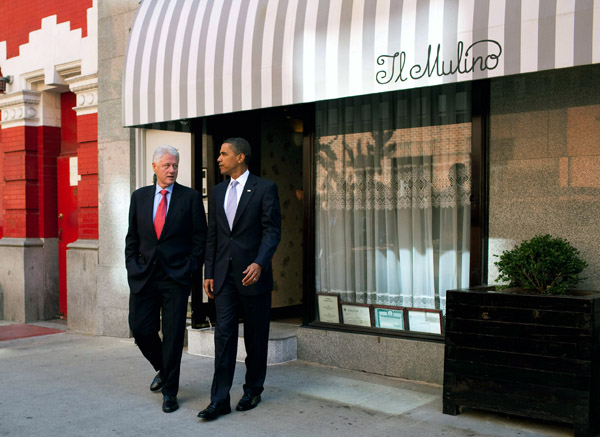
It’s also true that Mr. Clinton’s patronage in the United States has provided P.R. boosts for places like Il Mulino in Manhattan and Georgia Brown’s in Washington...But when it comes to Bill Clinton and overseas restaurants, the upside is on a far greater scale. Managers and owners from Beijing to Iceland and points between say an appearance by Mr. Clinton can be transformational, launching an obscure restaurant to fame...


Mr. Clinton follows a mostly vegan diet these days, and during his travels on behalf of Democratic candidates in recent years, he reportedly dined on such vegan menu items as Miso Barley Soup, Black Bean Burritos, and Cauliflower Potato Curry. The 42nd president also explained to aarp.org "how we can -- and for our health must -- learn to love eating vegetables, too.


It has also been reported that Clinton is particularly fond of chicken enchiladas so it's not surprising that a healthful recipe for this dish appears in The Clinton Presidential Center Cookbook. If you'd like to whip up some of Bill Clinton's favorite healthy chicken enchiladas for dinner this week, here's a great recipe to try from the Daily Beast:


2 (4 oz) cans chopped green chillies, drained
1 garlic clove, minced
cooking oil
1 (28 oz) can tomatoes
2 cups chopped onion
2 tsps salt, divided
tsp oregano
3 cups shredded, cooked chicken
2 cups sour cream
2 cups shredded cheddar cheese
cup cooking oil
15 corn or flour tortillas

In a large skillet over a medium-high heat, sauté the chillies and garlic in a small amount of oil. Drain the tomatoes, reserving cup of liquid. Break up tomatoes and add to skillet. Add the onion, 1 tsp salt, oregano, and reserved liquid. Simmer, uncovered, until thickened (about 30 minutes).

Remove from heat, transfer to a bowl and set aside. In a large bowl, combine chicken, sour cream, cheese, and remaining salt. In the same skillet over a medium heat, heat cup oil. Dip tortillas in the oil until they become limp and drain well on paper towels. Fill tortillas with chicken mixture; roll up and arrange side by side, seam side down, in a 9x13x2-inch baking dish. Pour tomato mixture over the enchiladas. Bake at 350°F for 20 minutes.

FOOD FACT: The Clinton Presidential Center Cookbook contains 250 recipes from the former president's lifelong friends, family members, celebrities, and White House staff and cabinet members. Some of the tasty and homey regional recipes include Muhammad Ali's Favorite Bread Pudding, Bono's Black Velvet, Sophia Loren's Penne Alla Puttanesca, James Carville’s Jambalaya, Mary Steenburgen’s Garlic Cheese Grits and Barbara Streisand’s Southern Lemon Icebox Pie!

For my manuscript wish list and submission info click here!

Wednesday, February 8, 2017

John Quincy Adams, the Corrupt Bargain, and the Art of Dinner Conversation


When John Quincy Adams took the oath of office in 1825, it was under a cloud of controversy. The election of 1824 had been a bitterly contested four-man race between Andrew Jackson, Henry Clay, William Crawford, and Adams. Since no candidate won a majority of electoral votes, the election was thrown into the House of Representatives where Clay, as Speaker of the House, threw his support to Adams, even though Jackson won the most popular and electoral votes.

Adams then quickly appointed Clay as Secretary of State. Outraged and feeling cheated out of the White House, Jackson and his supporters called the deal a “Corrupt Bargain to "cheat the will of the people."”

With these accusations hanging over his head, Adams faced problems from the start. Aware of the fact that “two-thirds of the whole people” did not want him to be president, Adams promised in his Inaugural Address to make up for his lack of support with “a heart devoted to the welfare of our country.”

But his four years in office weren't easy ones. Although his intelligence, family background and experience should have made him a great president, John lacked the charisma needed to create a base of loyal supporters.


Nevertheless, he and his wife Louisa hosted many dinner parties at the White House, as required. But his cold personality had a chilling effect on others and guests seated near the president at dinner often said that he had a hard time engaging in casual conversation. Aware of his inability to make small talk, John wrote this in his diary:

I went out this evening in search of conversation, an art of which I never had an adequate idea. Long as I have lived in the world, I never have thought of conversation as a school in which something was to be learned. I never knew how to make, control, or to change it.

I am by nature a silent animal, and my dear mother’s constant lesson in childhood, that children should be seen and not heard, confirmed me irrevocably in what I now deem a bad habit. Conversation is an art of the highest importance, a school in which, for the business of life, more may perhaps be learnt than from books. It…consists more in making others talk than in talking. Therein has been, and ever will be, my deficiency – the talent of starting the game.


Like his dad, John Quincy was a very intelligent man, but he lacked personal warmth and his critics called him “a chip off the old iceberg!”

FAST FACT: Adams’ policies favoring a strong federal government angered many southern slave holders who feared that that any expansion of federal power might interfere with slavery. His Indian policies also cost him supporters. Like Jefferson and Monroe, Adams wanted to remove Native Americans west of the Mississippi River, but believed that the government should honor and uphold Indian treaties and purchase (rather than forcibly or fraudulently take) Indian lands.

Thursday, February 2, 2017

Lou Henry Hoover and the First Organized Girl Scout Cookie Drive in 1935


So did you know that Herbert Hoover’s wife "Lou" served as president of the Girl Scouts and helped coordinate one of the first Girl Scout Cookie Drives in 1935? Sixty five years later, in April of 2000, the Herbert Hoover Presidential Library and Museum held an exhibit entiitled, American Women! A Celebration of Our History. One exhibit depicted Lou Hoover’s lifelong commitment to the Girl Scouts. This is how the placard read:

A woman nicknamed "Daisy" started the Girl Scouts of the U.S.A. with 18 girls. And a tomboy called "Lou" helped the organization grow into its current membership of over 3.5 million! Lou Henry grew up enjoying the outdoor life, and was the first women to receive a degree in geology from Stanford. She traveled the world with her husband Herbert Hoover, and assisted him with his mining ventures and famine relief activities.

During World War I she met up with Juliette Low [Daisy], and was a Girl Scout for the next 25 years. As First Lady and national leader of the Girl Scouts, Hoover quietly aided people in need during the Depression, and was also the first to desegregate White House social functions.

Lou remained a Scout the rest of her life and led the first Girl Scout cookie drive in 1935. Juliette Low and Lou Henry Hoover brought together girls from the North and South, wealthy and poor, black and white, athletic and handicapped – instilling confidence that all women can develop their potential to be whatever they wish to be.


In the 1920s and 1930s, Girl Scouts all across the country baked their own simple sugar cookies with their mothers. They then packaged their coookies in wax paper bags sealed with a sticker and sold them door-to-door for 25 to 35 cents a dozen.


Today, of course, there is a wide array of commercially baked Girl Scouts cookies to choose from, including such traditional favorites as Samoas, Tagalongs, Trefoils, and Thin Mints! If you'd like to whip up a batch of cookies with your kids today, here's the original recipe for Early Girl Scout Cookies® from The Girl Scouts of the United States of America.


1 cup butter
1 cup sugar plus additional amount for topping (optional)
2 eggs
2 tablespoons milk
1 teaspoon vanilla
2 cups flour
1 teaspoon salt
2 teaspoons baking powder

Cream butter and the cup of sugar; add well-beaten eggs, then milk, vanilla, flour, salt, and baking powder. Refrigerate for at least 1 hour. Roll dough, cut into trefoil shapes, and sprinkle sugar on top, if desired. Bake in a quick oven (375°) for approximately 8 to 10 minutes or until the edges begin to brown. Makes six- to seven-dozen cookies.

For more on my manuscript wish list click here!

Saturday, January 21, 2017

George Bush, Barack Obama, and the Politics of Peanut Butter and Jelly Sandwiches

George Bush's memoir Decision Points has been described by the New York Times as "an autobiography focused around 'the most consequential decisions' of his presidency and his personal life from his decision to give up drinking in 1986 to his decision to invade Iraq in 2003 to his decisions regarding the financial crisis of 2008." According to the Product Description of the book:

President Bush brings readers inside the Texas Governor’s Mansion on the night of the hotly contested 2000 election; aboard Air Force One on 9/11, in the hours after America’s most devastating attack since Pearl Harbor; at the head of the table in the Situation Room in the moments before launching the war in Iraq; and behind the Oval Office desk for his historic and controversial decisions on the financial crisis, Hurricane Katrina, Afghanistan, Iran, and other issues that have shaped the first decade of the 21st century...

With so many momentous issues to review, it's not surprising that Mr. Bush didn't bother to mention his favorite foods, but...in an interview with Oprah Winfrey during the 2000 presidential campaign, he did say that his favorite sandwich is peanut butter and jelly on white bread.
.

Eight years later, during the 2008 presidential campaign, peanut butter and jelly sandwiches once again made national headlines. Responding to charges that his economic policies were socialistic in nature, Barack Obama ridiculed his opponent John McCain for constantly resorting to trivialities and distractions:

Now, because he knows that his economic theories don't work, he's been spending these last few days calling me every name in the book. Lately he's called me a socialist for wanting to roll-back the Bush tax cuts for the wealthiest Americans so we can finally give tax relief to the middle class. I don't know what's next. By the end of the week he'll be accusing me of being a secret communist because I shared my toys in kindergarten. I shared my peanut butter and jelly sandwich.
.

Although neither Bush nor Obama mentioned how they prefer their PB&Js to be made, we do know that John Harvey Kellogg, the cereal pioneer, was the first person to receive a patent for the process of making peanut butter in 1895. According to Andrew Smith's Peanuts: The Illustrious History of the Goober Pea, early peanut butters had several problems:

The first was that peanut oil has a melting point below room temperature. Gravity separated the oil, which then oxidized and turned rancid. Likewise, salt added to the peanut butter separated and crystallized. Grocers received peanut butter in tubs or pails and were advised to use a wooden paddle to stir it frequently...

During the early years of the twentieth century, William Norman, an English chemist, invented a method of saturating unsaturated and polyunsaturated fatty acids, thus preventing them from turning rancid. In 1922, Joseph L. Rosefield...applied these principles to peanut butter [and] developed a process to prevent oil separation and spoilage in peanut butter...The result was a semisolid peanut butter [that]...was thick and creamy and did not stick to the roof of the mouth as much as previous products.


Selecting the name "Skippy" for his product, Rosefield introduced creamy and chunky-style peanut butter in 1932. Three years later, the company inaugurated its first wide-mouth peanut-butter jar, which quickly became the industry standard. And in less than twenty five years, peanut butter had "evolved from a hand ground delicacy to a mass-produced commercial commodity sold in almost every grocery store in America."


FOOD FACT: Florence Cowles' 1928 cookbook Seven Hundred Sandwiches includes dozens of creative recipes for peanut butter sandwiches, including: Peanut Butter and Egg Sandwich, Peanut Butter and Cabbage Sandwich, Peanut Butter and Marshmallow Sandwich, Peanut Butter and Prune Sandwich, Peanut Butter and Cherry Sandwich, Peanut Butter and Cheese Sandwich, and Peanut Butter and Olive Sandwich made with Mayonnaise on Rye. Oh my!

Wednesday, January 18, 2017

John F. Kennedy's Inaugural Luncheon

In November, 1960, John F. Kennedy defeated Richard Nixon in one of the closest and most dramatic presidential elections in American history. Two and a half months later, on January 20, 1961, Kennedy was sworn in as the first Roman Catholic president of the United States and delivered his Inaugural Address on the terrace of the East Portico of the U.S. Capital.

Near the end of his address, he famously said

Let every nation know, whether it wishes us well or ill, that we shall pay any price, bear any burden, meet any hardship, support any friend, oppose any foe, to assure the survival and the success of liberty.

This much we pledge – and more.

And so, my fellow Americans: ask not what your country can do for you - ask what you can do for your country. My fellow citizens of the world: ask not what America will do for you, but what together we can do for the freedom of man...


After delivering his address, Kennedy and his wife Jacqueline were escorted to the Old Supreme Court Chamber in the U.S. Capitol for the traditional inaugural luncheon. According to Senate historians, Menu Items included Cream of Tomato Soup with Crushed Popcorn; Deviled Crab Meat Imperial; New England Boiled Stuffed Lobster with Drawn Butter; Prime Texas Ribs of Beef au jus; String Beans Amandine and Broiled Tomatoes with Grapefruit and Avocado sections with Poppyseed Dressing.


Although the traditional Inaugural Luncheon at the Capital dates back to 1897, when the Senate Committee on Arrangements hosted an official luncheon for President William McKinley and other guests, it didn't begin in its current form until 1953, when President Eisenhower, his wife Mamie, and fifty other guests dined on Creamed Chicken, Baked Ham, and Potato Puffs in the Old Senate Chamber.

Since then, the Joint Congressional Committee on Inaugural Ceremonies has organized a luncheon celebration at many presidential inaugurations. Often featuring cuisine reflecting the home states of the new president and vice president, as well as the theme of the Inauguration, the luncheon program includes speeches, gift presentations, and toasts to the new administration.


FOOD FACT: According to the John F. Kennedy Library and Museum,  Kennedy preferred orange juice, poached eggs on toast, crisp broiled bacon, milk and coffee at breakfast. For lunch, he enjoyed all kinds of soup, especially New England Fish Chowder. At dinner, there were no particular favorites, although he did like lamb chops, steak, turkey, baked beans and mashed potatoes. He also enjoyed corn muffins, and, for dessert, if he had any, it would "likely be something prepared with chocolate." Kennedy was a "food-as-fuel" kind of guy and often had to be reminded to eat because "politics always took preference over food."

For more on presidential inaugurations, click here!

Tuesday, January 10, 2017

George Washington's Thursday Dinners


When George Washington was inaugurated in March, 1789, some of the most pressing questions facing the new nation involved social manners and etiquette. This may seem trivial today, but back then, George and his fellow patriots had just fought a long war against the British Crown and they wanted to be sure that the American people would never mistake their president for a king.

How much pageantry should surround the office of the presidency? How elaborate should presidential dinners be? And how should the new president be addressed? As “His Excellency” or “His Mightiness”? These were questions of great importance when George Washington took the Oath of Office on the balcony of Federal Hall in New York City on April 30, 1789.


Immediately after taking office, Washington distributed questionnaires to his advisors, soliciting their opinions regarding the basis of “a tenable system of etiquette.” After much discussion, it was decided that George would be addressed as President Washington or simply Mr. President.

It was also decided that “levees” (receptions) would be held each Tuesday afternoon for "foreign ambassadors and other strangers of distinction” and that congressional dinners would be held each Thursday. Friday nights were chosen for Martha Washington’s “Drawing Rooms” and the remaining days were reserved for state banquets and personal entertaining.

Despite his desire to avoid the trappings of monarchy, George's Thursday dinners were truly fit for a king. "Dinners would begin promptly at four o’clock," according to culinary historian Poppy Cannon, and would often consist of three "bountiful" courses, the first two of which typically consisted of fifteen or twenty different dishes – all brought to the table at once!

A menu from Martha Washington’s family cookbook reveals just how elaborate these dinners could be. For a first course, she suggested serving Boiled Turkey, Baked Salmon, Shoulder of Mutton, Chicken Patties, Baked Ham, Stewed Cabbage, Scotch Collops, Pork Cutlets and Sauce Robert with Mashed Potatoes, Maids of Honors, Dressed Greens, French Beans, Oyster Loaves and Celery Sauce.


This course would be followed by Asparagus a la Petit Poi, Crayfish in Sauce, Fruit in Jelly, Lamb Tails, Partridges, Poached Salmon, Wild Duck, Roasted Hare, Sweetbreads, Plovers, Prawns, and Chardoons with Fricassed Birds, Rhenish Cream and custard.

After this course, the table cloth was removed and fresh glasses and decanters of wine were placed on the table with all kinds of fruits and nuts. If Martha and other ladies were present, they would excuse themselves at this point and the men would settle down (with very full bellies!) to talk about politics and other important affairs of the day.

Although Martha's dishes might be difficult to duplicate today, you can try this fabulous recipe for Poached Salmon with Creamy Dill Sauce or this one for Poached Salmon with Dill from simplyrecipes.com.


1 to 1½ pounds salmon fillets
½ cup dry white wine (a good Sauvignon Blanc)
½ cup water
A few thin slices of yellow onion and/or 1 shallot, peeled and sliced thin
Several sprigs of fresh dill or sprinkle of dried dill
A sprig of fresh parsley

Put wine, water, dill, parsley and onions in a saute pan, and bring to a simmer on medium heat. Place salmon, skin-side down on the pan. Cover and cook for 5 minutes. Season with freshly ground black pepper and enjoy.

FOOD FACT: If you visit Mount Vernon someday, be sure to stop by the Mount Vernon Inn Restaurant which serves such authentic colonial appetizers as Peanut and Chestnut Soup, Colonial Hoe Cakes, and Fried Brie with Strawberry Sauce. Dinner menu items include Filet Mignon wrapped in Virginia Pepper Bacon;  Roast Duckling with “George Washington’s favorite Apricot Sauce,” and Stuffed Pork Loin with Opium Sauce!

Monday, January 9, 2017

Richard Nixon Inaugural Grapefruit Avocado Salad

As devout Quakers, Richard Nixon’s parents taught their four sons patience, courage, and determination, traits that Nixon said he  drew strength from during trying times in his life. He later recalled that he "gained his first taste for politics during debates around the family dinner table" and described “friendly pillow fights with his three brothers in the small upstairs bedroom they shared.”

Growing up on a small citrus farm in Yorba Linda, California, Nixon might have enjoyed  grapefruit often, and Grapefruit-Avocado Salad was among the official menu items served at his second Inaugural Luncheon on January 20, 1973. If you'd like to whip up  a refreshingly colorful, slightly tangy Grapefruit Avocado Salad in honor of Richard Nixon's birthday today, here's a simple and simply delicious recipe to try from Ina Garten:      


1 tablespoon Dijon mustard
1/4 cup freshly squeezed lemon juice
1 1/2 teaspoons kosher salt
3/4 teaspoon freshly ground black pepper
1/2 cup olive oil
3 or 4 ripe Hass avocados
2 large red grapefruits

Place the mustard, lemon juice, salt, and pepper in a small bowl. Slowly whisk in the olive oil until the vinaigrette is emulsified.

Before serving, cut the avocados in 1/2, remove the seeds, and carefully peel off the skin. Cut each half into 4 thick slices. Toss the avocado slices in the vinaigrette to prevent them from turning brown. Use a large, sharp knife to slice the peel off the grapefruits (be sure to remove all the white pith), then cut between the membranes to release the grapefruit segments.

Arrange the avocado slices around the edge of a large platter. Arrange the grapefruit...and enjoy! 

Sunday, January 8, 2017

Andrew Jackson Inaugural Orange Whiskey Punch


When John Quincy Adams took the oath of office in 1825, it was under a cloud of controversy. The election of 1824 had been a bitterly contested four-man race between Andrew Jackson, Henry Clay, William Crawford, and Adams.

Since no candidate had won a majority of electoral votes, the election was thrown into the House of Representatives where Clay, as Speaker of the House, quickly threw his support to Adams, even though Jackson won the most popular and electoral votes. Adams then appointed Clay as Secretary of State. Outraged and feeling cheated out of the White House, Jackson called the deal a “Corrupt Bargain to "cheat the will of the people."”


With these accusations hanging over his head, Adams faced problems from the start and his four years in office weren't easy ones. Although his intelligence, family background, and experience could and should have made him a great president, he lacked the charisma needed to create a base of loyal supporters.

Not surprisingly, he lost the election of 1828 in a landslide, and when Andrew Jackson was inaugurated in March, 1829, twenty thousand of his loyal supporters, who believed he had been cheated out of the White House four years earlier, descended "like locusts" upon Washington, eager to celebrate the long-delayed victory of their champion.

According to culinary historian Poppy Cannon, Jackson's inauguration "sparked a celebration that did everything but set fire to the White House." Thousands of rowdy fans crammed into the building and "little thought was given to the delicate French furniture, elegant draperies, and fine china" as ice cream, punch, ices and cakes "were gobbled up as fast they appeared on long serving tables."


In a letter to her sister, Margaret Bayard Smith, a prominent Washington socialite, described the chaos of Jackson's inaugural festivities this way:

But what a scene did we witness! The Majesty of the People had disappeared, and a rabble, a mob, of boys, negros, women, children, scrambling fighting, romping. What a pity, what a pity! No arrangements had been made, no police officers placed on duty, and the whole house had been inundated by the rabble mob...

Cut glass and china to the amount of several thousand dollars had been broken in the struggle to get the refreshments, punch and other articles had been carried out in tubs and buckets, but had it been in hogsheads it would have been insufficient...

Ladies fainted, men were seen with bloody noses, and such a scene of confusion took place as is impossible to describe…This concourse had not been anticipated...Ladies and gentlemen only had been expected at this Levee, not the people en masse. But it was the People's day, and the People's President, and the People would rule!


Another observer described the day's events this way:

Orange-punch by barrels full was inside, but as the waiters opened the door to bring it out, a rush would be made, the glasses broken, the pails of liquor upset, and the most painful confusion prevailed. To such a degree was this carried, that tubs of punch were taken from the lower story into the garden to lead off the crowds from the rooms.

Although no one knows how those waiters prepared the punch that day, you can get some great whiskey tips from eatdrinkfrolic.com and The Wall Street Journal scoured some ninteeenth century cookbooks and provided this adapted recipe for Inaugural Orange Punch that's "easy to make by the bucketful" if you've got a mob to entertain today!


3 parts fresh orange juice
1 part fresh lemon juice
1 part Mulled Orange Syrup*
1 part dark rum
1 part cognac
2 parts soda water

Mulled Orange Syrup: Combine 1 cup sugar with 1 cup water and heat to a boil, stirring to dissolve the sugar. Reduce heat to a low simmer. Add the peel from an orange and mulling spices (a couple of cinnamon sticks, some whole cloves and allspice berries). After 15 minutes, remove from heat and let it sit for several hours. Strain.

Combine Mulled Orange Syrup and all other ingredients in a punch bowl with a large block of ice. Serve in punch cups with a little crushed ice. Add a dash of Angostura bitters to each glass and enjoy!

For 5 Wild & Crazy Presidential Elections and Inaugurations, click here!

Tuesday, December 27, 2016

Andrew Johnson Hoppin' John

At the end of the Civil War, the South lay in ruins. Southern plantations and entire cities had been destroyed during the war. Without food, many southerners starved to death, and some of those who survived lost everything they owned.

As a result, the government had to figure out how to rebuild the South. As president, Johnson took charge of the first phase of Reconstruction. But his attempt to quickly readmit the former Confederate states into the union and his vetoes of important civil rights bills outraged Radical Republicans in Congress.

The House of Representatives impeached Johnson in 1868, but he was acquitted by a single vote in the Senate, and historians say that his victory “marked the beginning of an ambitious series of receptions, dinners and children’s parties that would turn the last nine months of his term into an ongoing celebration.”


After leaving office, Johnson returned to his native state of Tennessee where he probably consumed such traditional southern foods as Hush Puppies, Benne Wafers, Hoppin’ John and Pine Bark Stew. Still popular in the south, Hoppin' John is often the high point of New Year's Day festivities and is thought to bring good luck and prosperity throughout the coming year.

If you'd like to whip up some Hoppin' John for your New Year's festivities this week, you can't go wrong with this quick and delicious recipe from Emeril Lagasse.


1 tablespoon olive oil
1 large ham hock
1 cup onion, chopped
1/2 cup celery, chopped
1/2 cup green pepper, chopped
1 tablespoon chopped garlic
1 pound black-eyed peas, soaked overnight and rinsed
1 quart chicken stock
1 Bay leaf
1 teaspoon dry thyme leaves
Salt, black pepper, and cayenne
3 tablespoons finely chopped green onion
3 cups steamed white rice

Heat oil in a large soup pot, add the ham hock and sear on all sides for 4 minutes. Add the onion, celery, green pepper, and garlic, and cook for 4 minutes. Add the black-eyed peas, stock, bay leaves, thyme, and seasonings.

Bring to a boil, reduce the heat and simmer for 40 minutes, or until the peas are creamy and tender, stir occasionally. If the liquid evaporates, add more water or stock. Adjust seasonings, and garnish with green onions. Serve over rice and enjoy!