Friday, October 25, 2019
Dolley Madison Fresh Strawberry Ice Cream
Legend has it that in the early nineteenth century, a freed slave named Sallie Shadd went into her family’s catering business in Wilmington, Delaware. Sallie supposedly achieved fame there for a fabulous new dessert sensation she created with frozen cream, sugar, and fruit.
When Dolley Madison heard about this new dessert, she supposedly traveled to Delaware to try it - and she must have loved it because a "magnificent pink dome of ice cream" was served at President Madison’s second Inaugural Ball in 1813, and ice cream often appeared as a dessert on the White House menu during her husband's two terms of office.
If you'd like to whip up some Fresh Strawberry Ice Cream this week, here's a fabulous recipe to try from epicurious.com:
1 3/4 cups heavy cream
3 (3- by 1-inch) strips fresh lemon zest
1/8 teaspoon salt
2 large eggs
3/4 cup sugar
1 lb strawberries (3 cups), trimmed and quartered
1 tablespoon fresh lemon juice
Special equipment: an ice-cream maker and an instant-read thermometer
Combine cream, zest, and salt in a heavy saucepan and bring just to a boil. Remove from heat and discard zest. Whisk eggs with 1/2 cup sugar in a bowl, then add hot cream in a slow stream, whisking.
Pour back into saucepan and cook over moderately low heat, stirring constantly, until slightly thickened and an instant-read thermometer registers 170°F (do not let boil).
Immediately pour custard through a fine sieve into a metal bowl, then cool to room temperature, stirring occasionally. Chill, overed, at least until cold, about 2 hours, and up to 1 day.
While custard is chilling, purée strawberries with remaining 1/4 cup sugar and lemon juice in a blender until smooth, then force through fine sieve into chilled custard. Stir purée into custard. Freeze in ice-cream maker, then transfer to an airtight container and put in freezer to harden.
Monday, October 7, 2019
Abraham Lincoln Kentucky Corncakes
Another was a wild turkey named Jack with whom Lincoln’s youngest son Tad played with daily. When it came time for Jack to be sacrificed for a holiday dinner, Tad supposedly begged his dad to spare the turkey’s life, and, to this day, the White House maintains the tradition of “pardoning” a wild turkey each holiday season!
Although it’s a "tad" early to be thinking about preparing your next holiday dinner, you can whip up a batch of Kentucky Corncakes, which are a great side dish at just about any meal and were a Lincoln family favorite. If you’d like to make some Kentucky Corncakes today, here is a simple and simply delicious recipe to try from the Food Network:
1 cup roasted cornmeal (fine ground yellow cornmeal)
1 cup self-rising flour
4 tablespoons sugar
2 eggs
2 cups buttermilk
3 ounces corn oil
2 cups fresh corn kernels
Place cornmeal, flour, and sugar in a bowl and mix together. In a separate bowl, combine eggs, buttermilk, corn oil, and fresh corn and mix together. Fold mixtures together. Place 4 ounces of pancake mix onto a hot griddle. Cook on medium high heat for 4 minutes on each side, until cooked through. Serve warm with lots of butter and honey enjoy!
FAST FACT: According to historians at the Miller Center, the Lincoln family's routine in the White House reflected "the presence of their sons, the demands of war, and the highly complex and many-sided character of Abraham and Mary. [T]he day went from breakfast together as a family at 8:00 in the morning, reunion again for dinner at 8:00 in the evening, and then bedtime. Until little Willie's death in 1862, the two younger sons demanded a good deal of attention, and both parents gave them ample attention, although Lincoln grew more distant as the war progressed and occupied much of his day."
Tuesday, September 24, 2019
Andrew Johnson Hoppin John
As president, Andrew Johnson took charge of the first phase of Reconstruction. But his attempt to quickly readmit the former Confederate states into the union and his vetoes of important civil rights bills outraged Radical Republicans in Congress.
The House of Representatives impeached Johnson in 1868, but he was acquitted by a single vote in the Senate, and historians say that his victory “marked the beginning of an ambitious series of receptions, dinners and children’s parties that would turn the last nine months of his term into an ongoing celebration.”
After leaving office, Johnson returned to his native state of Tennessee where he consumed such traditional foods as Hush Puppies, Benne Wafers, Hoppin’ John and Pine Bark Stew. Still popular in the south, Hoppin' John is often the high point of New Year's Day festivities and is thought to bring good luck and prosperity throughout the coming year.
If you'd like to whip up some Hoppin' John for your New Year's festivities this week, you can't go wrong with this quick and delicious recipe from Emeril Lagasse.
1 tablespoon olive oil
1 large ham hock
1 cup onion, chopped
1/2 cup celery, chopped
1/2 cup green pepper, chopped
1 tablespoon chopped garlic
1 pound black-eyed peas, soaked overnight and rinsed
1 quart chicken stock
1 Bay leaf
1 teaspoon dry thyme leaves
Salt, black pepper, and cayenne
3 tablespoons finely chopped green onion
3 cups steamed white rice
Heat oil in a large pot, add ham hock and sear on all sides for 4 minutes. Add the onion, celery, green pepper, and garlic, and cook for 4 minutes. Add the peas, stock, bay leaves, thyme, and seasonings. Bring to a boil, reduce the heat and simmer for 40 minutes, or until the peas are creamy and tender. If the liquid evaporates, add more water or stock. Adjust seasonings, and garnish with green onions.
Wednesday, August 28, 2019
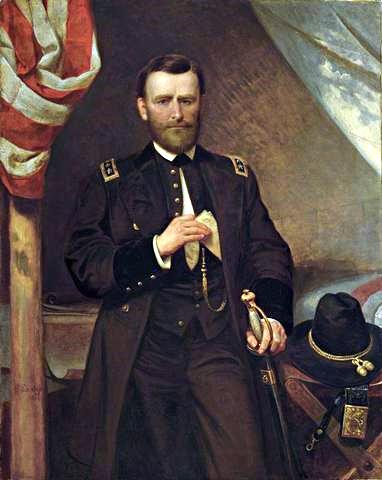
Ulysses S. Grant, the Transcontinental Railroad and Sage Broiled Hen
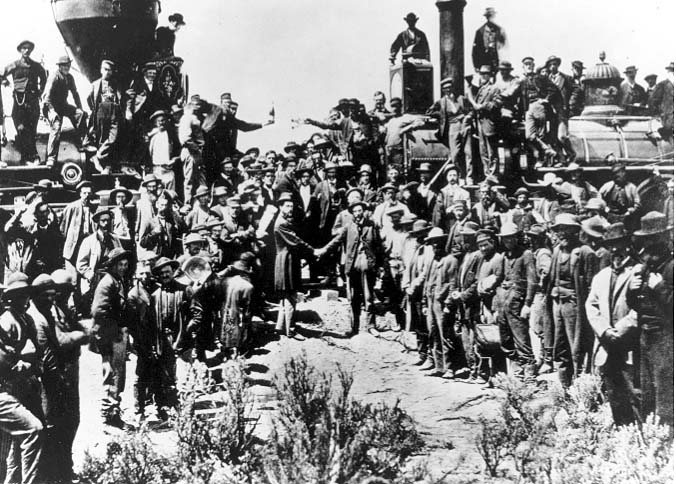
After the Civil War, peace between the North and South made it possible for the nation’s first Transcontinental Railroad to be completed. In 1863, the Union Pacific began laying track in Omaha, Nebraska, heading west. At the same time, the Central Pacific started laying track in Sacramento, California, heading east. Work in the beginning was slow and difficult, as you can imagine. After less than 25 miles of track had been laid in California, the Central Pacific “faced the daunting task of laying tracks over terrain that rose 7,000 feet in less than a hundred miles.” To conquer the sheer embankments, workers, the vast majority of whom were Chinese immigrants, were lowered by rope from the top of cliffs. While dangling in mid-air, they chipped away at the granite with picks and axes and then planted explosives to blast tunnels through the cliffs.
On October 10, 1865, Leland Stanford, president of the Central Pacific, submitted a progress report to President Ulysses S. Grant:
A large majority of the white laboring class on the Pacific Coast find more
profitable and congenial employment in mining and agricultural pursuits, than in railroad work. The greater portion of the laborers employed by us are Chinese, who constitute a large element in the population of California. Without them it would be impossible to complete the western portion of this great national enterprise within the time required by the Acts of Congress...
Their wages, which are always paid in coin, at the end of each month, are divided among them by their agents…in proportion to the labor done by each person. These agents…furnish them their supplies of food, the value of which they deduct from their monthly pay. We have assurances from leading Chinese merchants that ...the [company] will be able to procure during the next year not less than 15,000 laborers. With this large force, the Company will be able to push on the work so as not only to complete it within the time required by the Acts of Congress, but so as to meet the public impatience.
Four and a half years later, the two tracks finally met and the final “Golden Spike” was driven in with great ceremony at Promontory, Utah on May 10, 1869. By the end of the century, four more railways crisscrossed the United States. By then, most trains had luxury dining cars where first class passengers like President Grant dined on superb regional fare. The Baltimore and Ohio, for example, was famous for fresh seafood from the Chesapeake Bay while the Santa Fe was reportedly known for its Prairie Chicken and Broiled Sage Hen.
Although those railway recipes would be difficult to duplicate today, you can try this simple and simply delicious recipe for Lemon Sage Roasted Chicken from Bon Appetit.
4 chicken breast halves with skin and bones
8 very thin lemon slices, seeded
12 fresh sage leaves
Olive oil
4 teaspoons fresh lemon juice
2 large garlic cloves, coarsely chopped
1 cup low-salt chicken broth
Preheat oven to 450°F. Slide fingertips under chicken skin to loosen. Arrange 2 lemon slices and 3 sage leaves under skin on each breast; smooth skin over to enclose. Place chicken on rimmed baking sheet; brush with oil. Drizzle 1 teaspoon lemon juice over each breast; sprinkle with garlic, salt, and pepper. Pour 1/2 cup broth onto sheet around chicken.
Roast chicken until brown and cooked through, basting once or twice with pan juices, about 25 minutes. Transfer chicken to platter. Place baking sheet directly atop 2 burners; add remaining 1/2 cup broth. Using back of fork, mash any garlic on baking sheet into broth and pan juices. Boil over high heat until broth reduces almost to glaze, scraping up browned bits, about 4 minutes. Spoon sauce over chicken and serve.
FAST FACT: For every track of mile laid, railroads were granted a certain sum of money and 20 square miles of free land. The transcontinental railroad brought rapid economic growth to the nation, as farming, cattle-ranching and other agricultural businesses rapidly developed along the main lines.
Monday, August 12, 2019
George Washington Sweet Cherry Cobbler
Reprinted in ever more inventive editions over the next 25 years, it contains, according to Edward Lengel, "some of the most beloved lies of American history, including the cherry tree myth" and other exaggerated or invented anecdotes that extolled Washington’s virtues and provided an entertaining and morally instructive tale for the young republic.
In telling his cherry tree story, Weems attributed it to "an aged lady,” who was reportedly a distant relative of George, and who, as a young girl, supposedly spent much time with him. This is how the fable famously unfolded:
"When George was about six years old, he was made the wealthy master of a hatchet of which, like most little boys, he was immoderately fond, and was constantly going about chopping everything that came in his way. One day, in the garden, where he often amused himself hacking his mother's pea-sticks, he unluckily tried the edge of his hatchet on the body of a beautiful young English cherry-tree, which he barked so terribly, that I don't believe the tree ever got the better of it.
The next morning, [George’s father], finding out what had befallen his tree, which, by the by, was a great favorite, came into the house, and with much warmth asked for the mischievous author, declaring at the same time, that he would not have taken five guineas for his tree.
Nobody could tell him anything about it. Presently George and his hatchet made their appearance. "George," said his father, "do you know who killed that beautiful little cherry-tree yonder in the garden?" This was a tough question; and George staggered under it for a moment; but quickly recovered himself: and looking at his father, with the sweet face of youth brightened with the inexpressible charm of all-conquering truth, he bravely cried out, "I can't tell a lie, Pa; you know I can't tell a lie. I did cut it with my hatchet."
“Run to my arms, you dearest boy,” cried his father in transports, “run to my arms; glad am I, George, that you killed my tree; for you have paid me for it a thousand fold. Such an act of heroism in my son, is more worth than a thousand trees, though blossomed with silver, and their fruits of purest gold.”
Although plausible enough, most historians generally agree that this quaint story is almost certainly not true. What is true, however, is that George was particularly fond of cherries, and Martha Washington's Booke of Cookery contains several family “receipts” for preserving this sweet and tangy highly versatile fruit.
Of course, then, as today, sweet and sour cherries can be used in all kinds of pies, tarts, jellies, jams, breads, muffins, and soups, as well as in a fabulously wide array of cobblers, like this recipe for cherry cobbler, which George surely would have loved had he had time to try it during his extraordinarily illustrious life:
Crust: 1 1/4 cups flour
2 tablespoons sugar
2 tablespoons yellow cornmeal
1/2 teaspoon salt
6 tablespoons butter, cut into 1/2-inch pieces and chilled
1 large egg yolk
3 tablespoons cold milk, cream or water
Filling: 2 cups cherry preserves
1/3 cup sliced almonds
Confectioners' sugar, for dusting
In the workbowl of a food processor, combine the flour, sugar, cornmeal and salt. Pulse to combine. Add the butter, toss carefully with your hands to coat the butter cubes in flour. Pulse in the food processor several times until the mixture resembles coarse oatmeal. Add the egg and 2 tablespoons of milk, cream or water, and pulse until the dough begins to come together in a ball. Add the additional tablespoon of liquid if needed until the dough comes together.
Transfer the dough to a lightly floured work surface and knead it briefly to shape it into a disk about 5 inches across. Wrap in plastic and refrigerate at least 1 hour or overnight. Using a lightly floured rolling pin, roll the dough into a shape a ½ inch wider than the tart pan you are using. Loosely fold the dough in half and transfer it to the tart pan.
Line the pan with the dough, being. Trim any excess dough from the rim of the pan, leaving a blunt neat edge. Gather the trimmings into a ball (it should be about the size of a pingpong ball). Wrap the tart and the ball of dough in plastic and refrigerate for 1 hour.
Heat to 375 degrees. Remove tart pan from refrigerator and spread the marmalade evenly over the crust. Grate the chilled ball of pastry onto the filling, and sprinkle the almonds over the top. Bake until the pastry is golden, the filling is bubbly and the almonds are toasted, 40 minutes. Transfer to a wire rack to cool. When the tart is completely cool, dust with confectioners' sugar. Serve at room temperature.Goegre
Wednesday, August 7, 2019
George Bush, Barack Obama and the Politics of Peanut Butter and Jelly Sandwiches
George Bush's memoir Decision Points has been described by the New York Times as "an autobiography focused around 'the most consequential decisions' of his presidency and his personal life from his decision to give up drinking in 1986 to his decision to invade Iraq in 2003 to his decisions regarding the financial crisis of 2008." According to the Product Description of the book:President Bush brings readers inside the Texas Governor’s Mansion on the night of the hotly contested 2000 election; aboard Air Force One on 9/11, in the hours after America’s most devastating attack since Pearl Harbor; at the head of the table in the Situation Room in the moments before launching the war in Iraq; and behind the Oval Office desk for his historic and controversial decisions on the financial crisis, Hurricane Katrina, Afghanistan, Iran, and other issues that have shaped the first decade of the 21st century...
With so many momentous issues to review, it's not surprising that Mr. Bush didn't bother to mention his favorite foods, but...in an interview with Oprah Winfrey during the 2000 presidential campaign, he did say that his favorite sandwich is peanut butter and jelly on white bread.
.
Eight years later, during the 2008 presidential campaign, peanut butter and jelly sandwiches once again made national headlines. Responding to charges that his economic policies were socialistic in nature, Barack Obama ridiculed his opponent John McCain for constantly resorting to trivialities and distractions:
Now, because he knows that his economic theories don't work, he's been spending these last few days calling me every name in the book. Lately he's called me a socialist for wanting to roll-back the Bush tax cuts for the wealthiest Americans so we can finally give tax relief to the middle class. I don't know what's next. By the end of the week he'll be accusing me of being a secret communist because I shared my toys in kindergarten. I shared my peanut butter and jelly sandwich.
.
Although neither Bush nor Obama mentioned how they prefer their PB&Js to be made, we do know that John Harvey Kellogg, the cereal pioneer, was the first person to receive a patent for the process of making peanut butter in 1895. According to Andrew Smith's Peanuts: The Illustrious History of the Goober Pea, early peanut butters had several problems:
The first was that peanut oil has a melting point below room temperature. Gravity separated the oil, which then oxidized and turned rancid. Likewise, salt added to the peanut butter separated and crystallized. Grocers received peanut butter in tubs or pails and were advised to use a wooden paddle to stir it frequently...
During the early years of the twentieth century, William Norman, an English chemist, invented a method of saturating unsaturated and polyunsaturated fatty acids, thus preventing them from turning rancid. In 1922, Joseph L. Rosefield...applied these principles to peanut butter [and] developed a process to prevent oil separation and spoilage in peanut butter...The result was a semisolid peanut butter [that]...was thick and creamy and did not stick to the roof of the mouth as much as previous products.
Selecting the name "Skippy" for his product, Rosefield introduced creamy and chunky-style peanut butter in 1932. Three years later, the company inaugurated its first wide-mouth peanut-butter jar, which quickly became the industry standard. And in less than twenty five years, peanut butter had "evolved from a hand ground delicacy to a mass-produced commercial commodity sold in almost every grocery store in America."
FOOD FACT: Florence Cowles' 1928 cookbook Seven Hundred Sandwiches includes dozens of creative recipes for peanut butter sandwiches, including: Peanut Butter and Egg Sandwich, Peanut Butter and Cabbage Sandwich, Peanut Butter and Marshmallow Sandwich, Peanut Butter and Prune Sandwich, Peanut Butter and Cherry Sandwich, Peanut Butter and Cheese Sandwich, and Peanut Butter and Olive Sandwich made with Mayonnaise on Rye. Oh my!
Tuesday, July 2, 2019
Zachary Taylor, the Fourth of July, and a Basket of Cherries and Two Pitchers of Iced Milk
After participating in Fourth of July festivities at the Washington Monument on a blistering hot day, Zachary Taylor devoured a large basket of cherries and downed two pitchers of iced milk and suddenly fell ill with a terrible stomach ache. Five days later, he was dead.
At the time, the United States was embroiled in the bitter conflict over slavery and many people believed that Taylor had been poisoned. Today, most historians agree that he died from cholera or acute gastroenteritis, an inflammation of the stomach and gastrointestinal tract.
Either way, if Taylor were here with us today, he'd no doubt steer away from anything prepared with cherries. That's understandable, but it's no reason for us to do the same, especially when there are so many fabulous recipes for preparing fresh sweet and sour summer cherries, like this one for Cherry Cobbler from Emeril Lagasse or this one from tinynewyorkkitchen.com :
Filling:
6 cups tart red cherries, pitted
1 1/4 cups sugar
1/4 cup water
4 teaspoons cornstarch
Topping:
1 cup flour
1/4 cup sugar
2 tablespoons brown sugar
1 teaspoon baking powder
1/2 teaspoon cinnamon
3 tablespoons butter
1 egg, beaten
3 tablespoons milk
Preheat oven to 400 degrees F. In a saucepan combine filling ingredients and cook, stirring until bubbling and thickened. Pour into an 8-inch square baking dish. Meanwhile, stir together flour, sugars, baking powder, and cinnamon. Cut in butter until it is crumbly. Mix together egg and milk. Add to flour mixture and stir with a fork just until combined. Drop topping by tablespoonfuls onto filling. Bake for 25 minutes until browned and bubbly.
A LITTLE HISTORY: Before he became president, Taylor fought in the War of 1812, the Black Hawk War, and the second Seminole War before achieving fame in the Mexican-American War. On February 23, 1847, Taylor led his troops against General Santa Anna at the Battle of Buena Vista. When the smoke finally cleared, Taylor's force of 6,000 had defeated a Mexican army of 20,000 and "Old Rough and Ready" was a national hero!
Credit: Oil Portrait of Zachary Taylor by Joseph Henry Bush, 1849 (White House Historical Assocation)
Monday, July 1, 2019
John and Abigail Adams Gooseberry Fool
As a delegate to the Second Continental Congress, John Adams was one of the fiercest advocates of the Declaration of Independence. Contrary to popular belief, the declaration wasn't signed by all of the delegates on July 4, 1776. Instead, it was initially approved on July 2, 1776. The delegates then continued debating and slightly revised it the following day and formally adopted it on the Fourth of July. Most historians agree that the Declaration wasn’t signed by all the delegates (with a few holdouts) until nearly a month later, on August 2, 1776.
Nevertheless, on July 3, 1776, John Adams wrote a letter to his wife Abigail, describing these momentous events. This, in part, is what he wrote:
The second day of July, 1776, will be the most memorable epoch in the history of America. I am apt to believe that it will be celebrated by succeeding generations as the great anniversary festival...It ought to be solemnized with pomp and parade, with shows, games, sports, guns, bells, bonfires, and illuminations, from one end of this continent to the other, from this time forward forever more.
Although no one knows what the delegates ate on those momentous days, biographers say that Adams was fond of Green Sea Turtle Soup, Indian Pudding and other simple foods of his New England youth. Gooseberry Fool, a traditional eighteenth century British and early American dish, was another Adams family favorite.
As an example of how national foodways change over time, gooseberries were abundant in John's day, but aren't widely available in the United States today. So, if you can't find gooseberries in your local grocery store, you can use blueberries or raspberries. Either way, this delicious, nutritious, and refreshingly sweet little treat would make a great addition to your Fourth of July festivities this week!
If you'd like to whip up some Gooseberry Fool today, here's a simple and simply delicious recipe to try from epicurious.com
3 cups pink or green gooseberries (or blueberries)
1/2 cup granulated sugar
1/2 cup well-chilled heavy cream
1/4 cup crème fraîche
1/4 cup superfine granulated sugar
Pull off tops and tails of gooseberries and halve berries lengthwise. In a heavy skillet cook berries and granulated sugar over moderate heat, stirring occasionally until liquid is thickened, about 5 minutes. Simmer mixture, mashing with a fork to a coarse puree, 2 minutes more. Chill puree, covered, until cold, about 1 hour, and up to 1 day.
In a bowl with an electric mixer beat heavy cream with crème fraîche until it holds soft peaks. Add superfine sugar and beat until mixture just holds stiff peaks. Fold chilled puree into cream mixture until combined well. Fool may be made 3 hours ahead and chilled, covered.
Credit: Declaration of Independence, painting by John Trumball
Monday, June 10, 2019
Taylor Swift, the NFL, and the Launch of Michelle Obama's "Let's Move" Campaign
The announcement was made at Woldenberg Park in New Orleans during the NFL PLAY 60 Youth Football Festival, part of the NFL’s celebration to kick off the 2010 season. After her remarks, the First Lady took part in football drills, along with students from a local elementary school and former NFL players. Lending support on the sidelines was former country singer turned mega-pop-star Taylor Swift decked out in a patriotic blue and white polka dotted sundress.
Earlier in the day, Mrs. Obama gave a speech in which she encouraged kids to “Play 60” and join her in competing for the President’s Active Lifestyle Award. To earn an award, children need to "engage in physical activity for 60 minutes every day, five days a week, for six weeks." And to show everyone just how much fun it can be, Mrs. Obama sportingly pledged to work toward earning her own award. This is what she said:
I’m going to do it. And I want kids across the country to join me. Actually, I want all you all to join me. Don't just leave it on the kids. I want you all to join me. So in a couple weeks -- I'm not sure when it’s going to start -- starting soon, I'm going to be recording my progress online, so if I start falling behind, I want everyone to be checking on me and make sure that I'm not slacking. Send me emails to shame me into staying on track. So I’m excited about it, and I think it’s something that’s very doable. And the thing is, is that if your kids see you doing it -- your grandparents, uncles, teachers -- they’re going to be engaged.
At the launch of the Let's Move! campaign, President Barack Obama signed a Presidential Memorandum creating "the first ever Task Force on Childhood Obesity to conduct a review of every single program and policy relating to child nutrition and physical activity."
According to the Let's Move! website, the Task Force’s recommendation focuses on the four pillars of the First Lady's campaign: empowering parents and caregivers; providing healthy food in schools; improving access to healthy, affordable foods; and increasing physical activity.
Of course, the First Lady also emphasizes healthy, organic foods at the White House, as demonstrated by the Obama's fabulous kitchen garden, the first at the White House since the Roosevelt's Victory Garden that was planted during World War II.
Wednesday, June 5, 2019
Franklin Delano Roosevelt, World War II, and "There's Not Enough Milk for the Babies"
The daily conditions of camp life are especially vivid in descriptions of the mass feeding of thousands of Japanese men, women and children. On May 11, 1942, Joseph Conrad of the American Friends Service Committee submitted a Progress Report to the federal government which read:
There's not enough milk for the babies in camp because the Army's contract for milk is with farmers in Oregon and even though there is plenty of milk in the neighboring towns begging to be used, red tape makes it impossible.
There hasn't been enough food to go around because there were [more] arrivals than were expected. Some have gone without meals several times. There has been no fresh vegetables; no fruit (and a large part of the population are children), no fresh meat, but plenty of canned food for those who were early in line to get it...
Meanwhile, as thousands of interned children were suffering from malnutrition, millions of homeless and unemployed Americans were starving during the Great Depression. To address this national crisis, Soup Kitchens began opening in large cities and small towns throughout the United States.
When soup kitchens first appeared, they were generally run by churches or private charities. But by the mid-1930s, when Roosevelt was in office, state and federal governments were also operating them. Why soup? Throughout history, soup has been one of the primary foods consumed by poor and homeless people. If you think about it, this makes sense because soup is economical (it can be prepared with whatever scraps of food are available and can be stretched to feed more people by adding water). It is also quick and simple to make (only a pot is needed) and easy to serve (it requires only a bowl and spoon, or, in a pinch, can be sipped).
There was never such a family for soups as the Roosevelts. All the years they occupied the White House we kept the big steel soup kettles singing in the White House - clear soup for dinner and cream soup for lunch. Pretty nearly every usable variety of fish, fowl, beast, mineral, vegetable, and contiment was used in our White House soups...
Give Mrs. Roosevelt a bowl of soup and a dish of fruit for lunch and she'd be off with recharged vitality on one of her trips...Cream of almond - L'Amande soup - was one of her special favorites. The President was partial to fish soups... Among the recipes his mother gave me was the one for clam chowder...Another of his favorites was the green turtle soup, and there was always a great fuss when it was made.
Today, green turtle soup is prohibited in the United States because most species of sea turtles are considered threatened or endangered. But you can try this simple and economical recipe for Chicken Rice Soup from the Food Network courtesy of Ree Drummond or this one for Creamy Chicken Soup:
.
3 tablespoons unsalted butter
2 tablespoons all-purpose flour
4 cups chicken stock
2 cups heavy cream
2 egg yolks, beaten
coarse Salt, to taste
fresh ground black pepper, to taste
2 cups diced cooked boneless, skinless, chicken breast
chopped fresh parsley
Add butter to stockpot. Melt over low heat. Stir in flour, and stir for 2 minutes. Gradually stir in chicken stock. Heat over medium heat, almost but not boil. Add heavy cream and egg yolks to medium bowl. Whisk to combine. Ladle in ½ cup hot soup. Blend with whisk. Stir cream mixture into stockpot. Season with coarse salt and ground black pepper. Add chicken meat and Simmer until heated through but not boiling. Serve hot in individual soup bowls. Garnish with chopped parsley.
FOOD FACT: In a 1942 New Republic article, Ted Nakashima described the daily conditions of camp life this way: The food and sanitation problems are the worst. We have had absolutely no fresh meat, vegetables or butter since we came here. Mealtime queues extend for blocks; standing in a rainswept line, feet in the mud, waiting for the scant portions of canned wieners and boiled potatoes, hash for breakfast or canned wieners and beans for dinner. Milk only for the kids. Coffee or tea dosed with saltpeter and stale bread are the adults' staples.
Tuesday, May 14, 2019
Andrew Jackson Benne Wafers
During his two terms of office, Jackson vetoed the recharter of the Second Bank of the United States, signed the “Tariff of Abominations” which led to the Nullification Crisis and ignored an important Supreme Court decision protecting Native American rights.
Jackson was also no stranger to slavery. More than 150 slaves worked day and night at his stately Tennessee mansion "The Hermitage" where cooks prepared his favorite southern foods, including Braised Duck, Chicken Hash, Old Hickory Soup and Wild Barbecued Goose.
Popular in the south throughout the nineteenth century, Benne Wafers were another Jackson family favorite. Today, these delightfully light, crisp, paper-thin cookies can still be found in bakeries and candy shops throughout the south.
If you'd like to whip up a batch of Benne Wafers today, here's a a recipe to try from CookinCanuck.com and here's another one that's simple to make and tastes simply delicious!
¾ cup sesame seeds, toasted
1 cup firmly packed brown sugar
4 tablespoons (½ stick) butter, softened
1 egg, lightly beaten
½ cup all purpose flour
¼ teaspoon salt
¼ teaspoon baking powder
1 teaspoon vanilla extract
Preheat oven to 325º F. Cover cookie sheet with parchment paper or lightly grease it. In a heavy skillet over medium heat, toast the sesame seeds until they are golden brown, about 4 minutes.
In a medium bowl, beat the brown sugar and butter together until fluffy, about 3 minutes. Beat in the egg. In a separate bowl, whisk together the flour, salt, and baking powder, then add to the butter, sugar and egg mixture and mix until well-combined. Stir in the sesame seeds and vanilla.
Drop by teaspoonful onto prepared cookie sheet about 3 inches apart. Bake for 10 minutes, or until the edges are lightly browned. Let cool for a few minutes and then transfer to a rack to continue cooling.
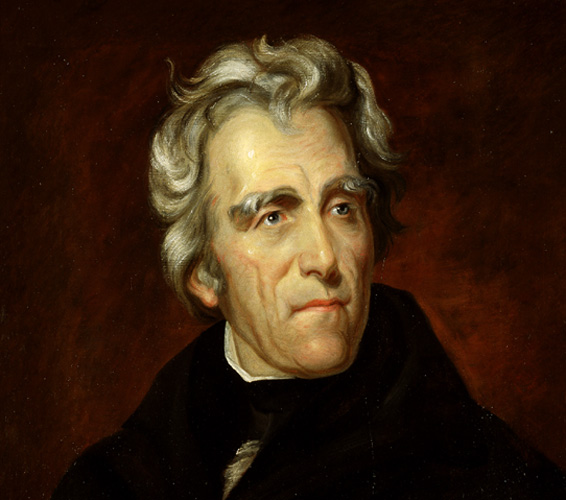
Credit: Jackson in 1824, painting by Thomas Sully.
Saturday, April 20, 2019
Friday, April 5, 2019
Warren Harding, Prohibition and Finger Foods
Unfortunately, Harding also surrounded himself with an "unpleasant group of dishonest cheats," who came to be known as the Ohio Gang. According to historians at the Miller Center:
Warren’s close friend and political manager, Harry Daugherty, whom he named attorney general, was one of the worst - and one of the slickest. He survived impeachment attempts by Congress and two indictments for defrauding the government in the disposal of alien property confiscated by his office from German nationals. Another schemer, Albert Fall, Secretary of the Interior, secretly allowed private oil companies to tap the Teapot Dome oil reserve in Wyoming and the Elk Hills oil reserve in California in return for least $300,000 paid to him in bribes.
Whether Harding was aware of his advisors' crimes is uncertain. What is certain, however, is that he played card games and drank whiskey with his advisors upstairs at the White House in private defiance of Prohibition.
Describing the scene at one of Harding's card games that she encountered, Alice Roosevelt, daughter of Teddy Roosevelt, wrote: "the air heavy with tobacco smoke, trays with bottles containing every imaginable brand of whiskey, cards and poker chips ready at hand – a general atmosphere of waistcoat unbuttoned, feet on the desk, and spittoons alongside."
Meanwhile, as Harding was downing whiskey with his advisors at the White House, millions of Americans were drinking at secret taverns and bars called speakeasies, a term used to describe an establishment that sold illegal alcoholic beverages.
According to The Encyclopedia of American Food and Drink:
In order to gain entrance, you had to speak in a low voice through a small opening in the back door and tell the attendant inside who it was who sent you to the place. The term itself...may derive from the English "Speak-softly-shop," an underworld term for a smuggler's house where one might get liquor cheaply, its usage in this sense having been traced back to 1823.
But with the onset of Prohibition, speakeasies sprang up overnight, sometimes in shabby sections of town, but often in the best neighborhoods, and many of these establishments were actually fine restaurants in their own right. New York's "21" club was a speakeasy during this period and had two bars, a dance floor, an orchestra, and dining rooms on two floors...French diplomat Paul Morande, visiting New York in 1925, reported his experience at a speakeasy: "the food is almost always poor, the service deplorable."
It was during this period (referred to today as the Roaring Twenties) that the custom of throwing cocktail parties at home also became popular. The rise of cocktail parties, in turn, inspired the development of finger foods, which worked well for tipsy guests who jiggled Gin Fizzes, Whiskey Smashes, and other popular cocktails while mingling with others in loud, crowded rooms.
Some popular finger foods of the era include Lobster Canapés, Crabmeat Cocktails, Stuffed Deviled Eggs, Caviar Rolls, Oyster Toast, and Savory Cheese Balls. For his part, Harding often served Bratwurst Rolls and Frankfurts with Saurkrauet at his cocktail parties at the White House.
If you’d like to serve up some Bratwurst Rolls at your next cocktail party, here's a simple and delicious recipe from epicurious.com:
1/4 cup butter
2 medium onions, sliced into thin rings
4 garlic cloves, finely chopped
3 to 4 (12-ounce) cans beer
8 bratwurst links
8 small, crusty hoagie rolls
whole-grain mustard
dill pickle spears
Prepare the grill for a medium-hot fire. Place the butter in a medium disposable foil roasting pan. Place the pan on the grill rack and cook until the butter melts. Add the onions and garlic (if using). Cook until softened, three to five minutes. Add the beer and bring to a simmer. Place the pan on the low heat zone and keep the onion mixture warm.
Place the bratwurst on the grill rack. Grill, turning occasionally, until evenly charred, four to five minutes. Transfer the bratwurst to the onion mixture and let stand until ready to serve. With tongs, place the bratwurst in the rolls. Serve with the onions, mustard, and pickles.
FOOD FACT: Some mass-manufactured foods introduced during the Roaring Twenties include the Baby Ruth Bar, Wonder Bread, Reese's Peanut Butter Cups, Hostess Snack Cakes, Kool-Aid, Peter Pan Peanut Butter, and Velveeta!
Friday, March 8, 2019
William Henry Harrison, the Election of 1840, and a Brief Constitutional Crisis
A few days later, Harrison caught a bad cold which quickly turned into pneumonia. Doctors tried to cure the president with opium, castor oil, Virginia snakeweed, and other remedies, but the treatments only made Harrison worse, and he died on April 4, 1841. The first American president to die in office, Harrison served only 31 days.
Did "the Same" mean the Office of the Presidency itself or merely the powers and duties of the office?
After consulting with Chief Justice Roger Taney (who responded with extreme caution, saying he wished to avoid raising "the suspicion of desiring to intrude into the affairs which belong to another branch of government"), Harrison’s advisors decided that if Tyler simply took the Oath of Office, he would become president. Despite his own strong reservations, Tyler obliged and was sworn in as the 10th president of the United States on April 6, 1841.
When Congress convened in May, it passed a resolution that confirmed Tyler as president. Once established, this precedent of presidential succession remained in effect until the Twenty-Fifth Amendment of the Constitution was ratified in 1967.
FOOD FACT: Used by Harrison's doctors, castor oil comes from the seed of the castor bean plant. It, along with many other plants, herbs, oils, and weeds have been used to treat human disease for thousands of years.
FAST FACT: Harrison’s death resulted in three presidents serving in one year (Martin Van Buren, Harrison, and Tyler). This has happened on only one other occassion in American history. In 1881, Rutherford B. Hayes was succeeded by James Garfield, who died from an assassin's bullet later that year, and Chester Arthur became president.
Tuesday, February 12, 2019
FDR's Beloved Dog Fala and the Election of 1944
On November 10, 1940, a cute black Scottish terrier puppy arrived at the White House as a gift for President Franklin Delano Roosevelt and his family. At first, the dog’s name was "Big Boy," but the president soon renamed him “Murray the Outlaw of Falahill” after a distant Scottish ancestor.One of the most famous presidential pets, Fala, as he was nicknamed, went just about everywhere with the President and quickly became part of his public image. In her Pulitzer-Prize-winning biography, No Ordinary Time, presidential historian Doris Kearns Goodwin wrote:
Fala accompanied the president everywhere, eating his meals in Roosevelt's study, sleeping in a chair at the foot of his bed. Within a few weeks of his arrival, the puppy was sent to the hospital with a serious intestinal disturbance. He had discovered the White House kitchen, and everyone was feeding him. When he came home, Roosevelt issued a stern order to the entire White House staff: "Not even one crumb will be fed to Fala except by the President." From then on, Fala was in perfect health.
While being pampered at the White House and traveling with Roosevelt, Fala had the good fortune to meet many famous political leaders, including British Prime Minister Winston Churchill and Mexican President Manuel Camacho.
Thrust as he was into the national spotlight, it’s perhaps not surprising that Fala became embroiled in a political controversy during the presidential campaign of 1944. You see, earlier that year, Fala had faithfully accompanied his master on a diplomatic trip to the Aleutian Islands. Shortly after the president returned home, a rumor began circulating that Fala was accidentally left on one of the islands and that the Navy had to send a destroyer back to retrieve him.
Capitalizing on the rumors, Republicans accused Roosevelt of spending millions of taxpayers' dollars in the effort to get his dog back. Responding sharply but light-heartedly to these and other accusations, FDR delivered his famous “Fala Speech” at a campaign dinner in Washington D.C., before the International Brotherhood of Teamsters, Chauffeurs, Warehousemen and Helpers of America. These are some of the remarks that President Roosevelt made that evening:
These Republican leaders have not been content with attacks on me, or my wife, or on my sons. No, not content with that, they now include my little dog, Fala. Well, of course, I don't resent attacks, and my family doesn't resent attacks — but Fala does resent them.
You know, Fala is Scotch, and being a Scottie, as soon as he learned that the Republican fiction writers in Congress and out had concocted a story that I'd left him behind on an Aleutian island and had sent a destroyer back to find him — at a cost to the taxpayers of two or three, or eight or 20 million dollars — his Scotch soul was furious.
He has not been the same dog since. I am accustomed to hearing malicious falsehoods about myself — such as that old, worm-eaten chestnut that I have represented myself as indispensable. But I think I have a right to resent, to object, to libelous statements about my dog.
Sadly, less than a year after he delivered that speech, President Roosevelt died. In her autobiography, Roosevelt's wife Eleanor described her recollections of Fala's reaction to his master's untimley death:
his legs straightened out, his ears pricked up and I knew that he expected to see his master coming down the drive as he had come so many times. Later, when we were living in the cottage, Fala always lay near the dining-room door where he could watch both entrances just as he did when his master was there...Fala accepted me after my husband's death, but I was just someone to put up with until the master should return.
FAST FACT: Fred D. Fair was Roosevelt’s porter on the Ferdinand Magellan, the presidential Pullman rail car. In a Washington Post article, Mr. Fair recalled his memories of the president's beloved dog in a letter titled "Feeding Fala":
I served him his meals, made his bed. We would serve the president highballs before dinner. Before the meal, I would fix Fala's food. He would never go into the dining room until you called him. We'd serve him in there. But you couldn't serve Fala yourself, oh no. You had to hand it to the president, and he'd feed Fala out of his hand. Many times, I remember dignitaries and other important folks waiting for their supper until Mr. Roosevelt finished feeding Fala."
Friday, January 25, 2019
Richard Nixon, Watergate, and Family-Style Meatloaf
Around 2:30 a.m. on June 17, 1972, five men, one of whom was a former employee of the CIA, were arrested in what authorities would later describe as "an enormous plot to bug the offices of the Democratic National Committee" at the Watergate complex in Washington D.C.
It was an election year, and, as the investigation into the break-in unfolded, a pattern of unlawful activites within President Richard Nixon's administration was uncovered by the press. Together, these federal crimes and misdeeds would become known as "the Watergate scandal" and lead to Nixon's resignation from the Office of the Presidency on August 9, 1974.
On his final day in office, Nixon reportedly awoke at 7:00 a.m. after "a fitful night." After a light breakfast, Nixon signed a one-sentence Letter of Resignation and said an emotional goodbye to his staff. Shortly after 9:00 a.m. he entered the East Room and made a brief Farewell Address to an overflow crowd of White House staff and Cabinet members. He then joined Gerald Ford for a short walk across the South Lawn to a helicopter that would whisk him away into history.
The previous evening, Nixon had delivered a televised Resignation Address to the nation. After acknowledging that he had lost the support of Congress and saying, "I have never been a quitter," Nixon said:
To leave office before my term is completed is abhorent to every instinct in my body. But as President I must put the interests of America first. America needs a full-time President and a full-time Congress, particularly at this time with problems we face at home and abroad.
To continue to fight through the months ahead for my personal vindication would almost totally absorb the time and attention of both the President and the Congress in a period when our entire focus should be on the great issues of peace abroad and prosperity without inflation at home.
Therefore, I shall resign the Presidency effective at noon tomorrow. Vice President Ford will be sworn in as President at that hour in this office. As I recall the high hopes for America with which we began this second term, I feel a great sadness that I will not be here in this office working on your behalf to achieve those hopes in the next 2 1/2 years.
It doesn't take too much investigative work to uncover records of what Nixon ate for breakfast on his final day in office, as it has been reported that it consisted of a small plate of cottage cheese with sliced pineapple and a glass of milk.
White House Chef Henry Haller later revealed that, at breakfast, Nixon "liked fresh fruit, wheat germ with nondairy creamer and coffee." At dinner, Nixon enjoyed Sirloin Steak, cooked medium-rare and lightly seasoned; Chicken Cordon Blue; and more simple dishes like Spaghetti and Meatballs. He was also fond of his wife Patricia's Family-Style Meatloaf. According to Haller:
Meat loaf appeared about once a month on the family dinner menus. As soon as the public became aware of this fact, the White House was inundated with inquires for the recipe that so pleased the presidential palate. To ease my burden, Mrs. Nixon's meat loaf recipe was printed on White House stationery to be sent in response to the thousands of requests for it.
If you'd like to get a taste of Pat Nixon's Meatloaf at your next family dinner, here's a recipe to try here and here's the original recipe from The White House Cookbook by Henry Haller:
2 tablespoons butter
1 cup finely chopped onions
2 garlic cloves, minced
3 slices white bead
1 cup milk
2 pounds lean ground beef
2 eggs, lightly beaten
1 teaspoon salt
ground black pepper, to taste
1 tablespoon chopped fresh parsley
1/2 teaspoon dried thyme
1/2 teaspoon dried marjoram
2 tablespoons tomato puree
2 tablespoons bread crumbs
Grease a 13-by-9-inch baking pan. Melt butter in a saute pan, add garlic and saute until just golden. Let cool. Dice bread and soak it in milk. In a large mixing bowl, mix ground beef by hand with sauteed onions and garlic and bread pieces. Add eggs, salt, pepper, parsley, thyme and marjoram and mix by hand in a circular motion.
Turn this mixture into the prepared baking pan and pat into a loaf shape, leaving at least one inch of space around the edges to allow fat to run off. Brush the top with the tomato puree and sprinkle with bread crumbs. Refrigerate for 1 hour to allow the flavors to penetrate and to firm up the loaf.
Preheat oven to 375 degrees. Bake meatloaf on lower shelf of oven for 1 hour, or until meat is cooked through. Pour off accumulated fat while baking and after meat is fully cooked. Let stand on wire rack for five minutes before slicing.
FAST FACT: A year and a half before Nixon resigned, an entirely different calamity unfolded in Washington. This time, it didn't involve illegal break-ins and phone taps but...pigeons! It all began the day before Nixon's second inaugural parade when attempts were made to clear pigeons from Pennsylvania Avenue. Upon Nixon's request, the inaugural committeee spent $13,000 to smear tree branches with a chemical repellent called “Roost No More” which was supposed to drive the bothersome birds away by making their feet itch. Sadly, many of the pigeons ate the stuff and keeled over, leaving the parade route littered with "dead and dying birds which had to be hurriedly swept away.” Doh!
Tuesday, January 15, 2019
George Washington's Ice House at Mount Vernon
Historians say that Washington’s icehouse was located on a riverbank about 75 yards from the Potomac. To store ice, Washington’s slaves had to use chisels and axes to pull large chunks of ice from the frozen river during the wintertime and then haul them to the icehouse where they were stacked in layers and stored for use throughout the spring and summer.
Before constructing his ice house, Washington sought advice from his friend and fellow patriot Robert Morris, who had an ice house at his home at 6th & Market Streets in Philadelphia. In a letter to Washington, Morris provided a detailed account of how his ice house had been constructed:
My Ice House is about 18 feet deep and 16 square, the bottom is a Coarse Gravell & the water which drains from the ice soaks into it as fast as the Ice melts, this prevents the necessity of a Drain...the Walls of my Ice House are built of stone without Mortar...On these [walls] the Roof is fixed...I nailed a Ceiling of Boards under the Roof flat from Wall to Wall, and filled the Space between the Ceiling and the Shingling of the Roof with Straw so that the heat of the Sun Cannot possibly have any Effect...
The Door for entering this Ice house faces the north, a Trap Door is made in the middle of the Floor through which the Ice is put in and taken out. I find it best to fill with Ice which as it is put in should be broke into small pieces and pounded down with heavy Clubs or Battons such as Pavers use, if well beat it will after a while consolidate into one solid mass and require to be cut out with a Chizell or Axe. I tried Snow one year and lost it in June. The Ice keeps until October or November and I believe if the Hole was larger so as to hold more it would keep untill Christmas...
Although Morris didn't mention what he stored in his icehouse, we do know that the Washingtons used theirs to preserve meat and butter, chill wine, and make ice cream and other frozen delicacies for their many guests at Mount Vernon.
Of course, George Washington wasn’t the only president who enjoyed ice cream. Accounts of it often appear in letters describing the many elegant dinner parties hosted by James and Dolley Madison, and the dish frequently appears in visitors' accounts of meals with Thomas Jefferson.
One particular guest wrote: "Among other things, ice-creams were produced in the form of balls of the frozen material inclosed in covers of warm pastry, exhibiting a curious contrast, as if the ice had just been taken from the oven." If you'd like to whip up some ice cream contained in warm pastry for your next dinner party, here is a simple and delicious recipe to try from puffpastry.com
1/2 of a 17.3-ounce package pastry sheets, 1 sheet, thawed
1 pint chocolate ice cream, softened
1 pint strawberry ice cream, soft
Chocolate fudge topping
Heat the oven to 400°F. Unfold the pastry sheet on a lightly floured surface. Cut the pastry sheet into 3 strips along the fold marks. Place the pastries onto a baking sheet. Bake for 15 minutes or until the pastries are golden brown. Remove the pastries from the baking sheet and let cool on a wire rack for 10 minutes. Split each pastry into 2 layers, making 6 in all.
Reserve 2 top pastry layers. Spread the chocolate ice cream on 2 bottom pastry layers. Freeze for 30 minutes. Top with another pastry layer and spread with the strawberry ice cream. Top with the reserved top pastry layers. Freeze for 30 minutes or until the ice cream is firm. Drizzle with the chocolate topping.
FAST FACT: In 1790, Robert Morris's house at 6th & Market Streets became the Executive Mansion of the United States while Philadelphia served as the temporary capital of the nation. Morris' icehouse was used by President Washington and his household until 1797, and by President John Adams and his family from 1797 to 1800.
For my new literary agent profile and submission guidelines, click here
Wednesday, January 2, 2019
Ulysses S. Grant Simple Cinnamon Rice Pudding
To her credit, Grant’s wife Julia refrained from complaining at first, but when it became clear that the "chef" viewed the White House dining room as little more than “an enlarged mess hall,” she replaced him with an Italian steward named Valentino Melah, who had catered for some of the finest hotels in New York and "specialized in opulent banquents."
Describing a twenty-nine course banquet at the Grant White House, Emily Edson Briggs, a Washington newspaper columnist, wrote:
In the beginning of the feast, fruit, flowers, and sweetmeats grace the tables, while bread and butter only give a Spartan simplicity to the "first course," which is composed of a French vegetables oul, and according to the description by those who have tasted it, no soup, foreign or domestic, has ever been known to equal it.
It will readily be seen that a full description of the twenty-nine courses would be altogether too much for the healthy columns of a newspaper to bear, so we pass to the dessert...[which] is inaugurated by...a rice pudding [that] would make our grandmothers clap their hands with joy. After the rice pudding, canned peaches, pears, and quinces are served. Then follow confectionery, nuts, ice-cream, coffee, and chocolate...
Although Grant enjoyed partaking in such opulent banquets, he retained a taste for more basic fare, no doubt shaped by his old soldier's days. One of his favorite breakfasts consisted of "broiled Spanish mackerel and steak, fried apples with bacon, buckwheat cakes, and a cup of strong black coffee." At lunch and dinner, he enjoyed such simple meals as roast beef with wheat bread and boiled hominy, and for dessert, if he had any, nothing ever pleased him as much as "simple rice pudding."
Although Grant's favorite recipe for Rice Pudding may have been lost to posterity, you can try this recipe from simplyrecipes.com or this one for Cinnamon Rice Pudding that's great to serve at breakfast or as a light dessert:
2 1/2 cups of whole milk
1/3 cup of uncooked short grain white rice
Pinch of salt
1 egg
1/4 cup dark brown sugar
1 teaspoon of vanilla extract
1/4 teaspoon of cinnamon
1/3 cup raisins
In a saucepan, bring the milk, rice and salt to a boil over high heat. Reduce heat to low and simmer until the rice is tender, about 20-25 minutes. Stir frequently to prevent the rice from sticking to the bottom of the pan.
In a small mixing bowl, whisk together egg and brown sugar until well mixed. Add a half cup of the hot rice mixture to the egg mixture, a tablespoon at a time, vigorously whisking to incorporate.
Add egg mixture back into the saucepan of rice and milk and stir, on low heat, for 10 minutes or so, until thickened. Stir in the vanilla. Remove from heat and stir in the raisins and cinnamon. Serve warm or cold and enjoy!
Subscribe to:
Posts (Atom)