Wednesday, October 5, 2011

Theodore Roosevelt, Muckrakers, and the "Monarchical Manners" of the White House

In keeping with the progressive, muckraking nature of the times, a journalist for Harper's Weekly complained about "the monarchical manners" of the White House during Theodore Roosevelt's administration.

In particular, the journalist alleged that "since Mr. Roosevelt became President there have been witnessed behind the White House doors an exclusiveness, a rigor of etiquette, and a display of swords and gold braid such as no one of his predecessors ever dreamed of...The atmosphere of the White House, once democratic and free, has become tainted with the manners of monarchy."

Similar criticisms were expressed in a June 1906 Washington Post column in which Roosevelt was condemned for indulging in extravagant dining practices at the White House. Responding to the allegations, a spokesman for the president sent a letter to the Post which appeared the next day:

When anyone endeavors to create a widespread impression that the President and his family sit down to a four or five course breakfast, a six or seven course luncheon, and a ten-course dinner, the President feels that a denial is not inappropriate. Instead of a breakfast consisting of oranges, cantaloupes, cereals, eggs, bacon, lamb chops, hot cakes, and waffles, President Roosevelt insists that the regular White House breakfast consists of hard boiled eggs, rolls, and coffee.

Instead of a luncheon of such delicious viands as Little Neck clams, stuffed olives, celery, consommé of chicken, fish sauté, eggs a la turque, Spring lamb, new string beans, asparagus, mashed potatoes, lettuce, tomatoes, strawberries and ice cream, President Roosevelt declares that when alone he always contents himself with a bowl of bread and milk.

When Mrs. Roosevelt or the children are present, the luncheon consists of cold meat, tea, cantaloupe in season, and bread. Instead of a ten-course dinner, the President declares that nine times out of ten a three-course dinner is served, and the other time a two-course dinner.


Despite the muckrakers' monarchical allegations, Roosevelt's reputation inside the White House was that of a simple family man. Ike Hoover served in the White House for forty-two years, eventually serving as Chief Usher in charge of day-to-day operations. In his memoirs, published in 1934, Hoover provided insight into the Roosevelt family’s daily dining habits:

The entire family [sat] down [for] breakfast at eight o'clock. After breakfast the President spent an hour or so in his study, perhaps reading, while Mrs. Roosevelt arranged the details of the day's program. The President went to his office at nine-thirty or ten o'clock, and Mrs. Roosevelt for a walk or shopping...All returned just about in time for lunch. Those famous lunches!

Something indeed was wrong when there were not two or more guests for this meal. To prepare properly for a certain number was almost a physical impossibility, for notice was continually coming from the office that someone had been invited at the last minute, and many times the family and guests had to wait until the table was made larger before they could be seated. The place was really a transient boardinghouse, and how every one got enough to eat was the wonder of the household...


Although Hoover didn't mention what particular dishes were served at those famous Roosevelt luncheons, researchers tell us that TR's diet consisted of "quite a bit of game from hunting expeditions" and that he was also fond of Southern Fried Chicken with White Gravy and Grits. If you'd like to whip up some Southern Fried Chicken for your next family luncheon or dinner this week, here's a simple and simply delicious recipe to try from Paula Dean:

3 eggs
1/3 cup water
About 1 cup hot red pepper sauce
2 cups self-rising flour
1 teaspoon pepper
House seasoning, recipe follows
1 (1 to 2 pound) chicken, cut into pieces
Oil, for frying, preferably peanut oil

In a medium size bowl, beat the eggs with the water. Add enough hot sauce so the egg mixture is bright orange. In another bowl, combine the flour and pepper. Season the chicken with the house seasoning. Dip the seasoned chicken in the egg, and then coat well in the flour mixture. Heat the oil to 350 degrees F in a deep pot. Do not fill the pot more than 1/2 full with oil. Fry the chicken in the oil until brown and crisp. Dark meat takes longer then white meat. It should take dark meat about 13 to 14 minutes, white meat around 8 to 10 minutes.

FAST FACT: As for the Roosevelt's evenings, Hoover noted that "it was more to the liking of the family to spend a quiet evening in the library, either playing cards or reading the current magazines. The whole family were fiends when it came to reading. No newspapers. Never a moment was allowed to go to waste; from the oldest to the youngest they always had a book or a magazine before them. The President...would just devour a book and it was no uncommon thing for him to go entirely through three or four volumes in the course of an evening. Likewise we frequently saw one of the children stretched out on the floor flat on his stomach eating a piece of candy and with his face buried deep in a book."

Monday, October 3, 2011

"Ike Runs the Country, I Turn the Pork Chops"

During the 1952 presidential campaign, Dwight Eisenhower's wife Mamie was by his side every step of the way, delighting crowds with her quick wit and natural charm. Campaign songs were written about her and colorful buttons and posters proclaimed, “I LIKE IKE, BUT I LOVE MAMIE.”

Biographers say that one reason Mamie was so popular as First Lady was that she shared the country’s interests and middle-class values. She watched soap operas, played board games, and reportedly encouraged White House cooks to use boxed cake mixes and Jell-O.

Even her personal tastes reflected those of the nation. She was a fan of such hit shows as “I Love Lucy” and "The Milton Berle Show" and let it be known that she and Ike liked to take their dinner on trays while watching TV in the private family quarters at the White House.

As First Lady, Mamie was proud of her role as a traditional housewife, and was famously quoted as saying, “Ike runs the country, I turn the pork chops.” But Mamie did occasionally break with tradition in her entertaining as First Lady. According to White House historians, she regularly decorated the State Dining Room each holiday season with Halloween skeletons, witches, jack-o-lanterns, St. Patrick's Day leprechauns and green ribbons.

The Eisenhowers also entertained more royalty and heads-of-state than most previous administrations. Among their guests were the emperor of Ethiopia; the presidents of Panama, Haiti, Turkey, Italy, and Ireland; the rulers of Greece, Nepal, and Denmark, as well as Nikita Khrushchev and Winston Churchill.

The highlight of the 1957 social season, however, was undoubtedly the round of festivities celebrating Queen Elizabeth II’s first trip to Washington, D.C., after she became Queen of England. In addition to hosting reciprocal state dinners and exchanging diplomatic gifts, the president and the queen also shared recipes through the mail.

Yet for all its glamour and excitement, the Queen’s visit came at a difficult time for Eisenhower. In September of 1957, racial tensions over desegregation had exploded in violence in Little Rock, Arkansas. Then came news in early October that the Soviet Union had orbited the first space satellite (Sputnick), causing many Americans to fear that the United States was losing both the "space race" and the Cold War.

Nevertheless, the Eisenhowers’ charismatic personalities and traditional middle-class values allowed them to maintain the affection and approval of an overwhelming majority of Americans throughout the 1950s and into their retirement.

Saturday, September 24, 2011

John Quincy Adams Johnny Cake

Although John Quincy Adams spent much of his youth traveling with his father overseas, he never expressed much interest in any of Europe’s many fine cuisines, but family members said that he was "excessively fond” of fruit and could often be seen plucking fresh pears, plums and cherries from local orchard trees when they blossomed each spring.

Like his mother and father, John also retained a childhood taste for the simple foods his New England youth, like Boston Baked Beans, Seafood Chowder and Indian Pudding. He may have also enjoyed Baptist Cakes. Back in those days, these little bits of deep-fried bread dough were popular throughout New England, but their name changed from state to state. Connecticut residents reportedly called them "Holy Pokes" but they were known as "Huff Puffs" along Maine’s rocky coast!

Johnny Cake was another popular nineteenth century treat. Some historians say that the name derives from Journey Cake, a "small, hard biscuit that was easily carried in a pocket on a long trip." Johnny Cake was often served at clambakes. Even more popular at breakfast or as a dessert, they were usually served with butter and molasses or maple syrup.

If you'd like to whip up a batch of Johnny Cake today, here's a simple and simply delicious recipe to try from whatsoookingamerica.com

1 cup white cornmeal
3/4 teaspoon salt
1 cup water
1/2 cup milk
Bacon drippings

In a medium bowl, place cornmeal and salt. In a medium saucepan over high heat, bring water to a rapid boil; remove from heat. With the saucepan in one hand, let the boiling water dribble onto the cornmeal while stirring constantly with the other hand. Then stir the milk into the mixture (it will be fairly thick, but not runny).

Generously grease a large, heavy frying pan (I like to use my cast-iron frying pan) with the bacon drippings and heat. When pan is hot, drop the batter by spoonfuls. Flatten the batter with a spatula to a thickness of approximately 1/4 inch. Fry until golden brown, turn, and brown on the other side (adding more bacon drippings as needed). Serve hot with butter, maple syrup, or applesauce.

FAST FACT: At the age of ten, John Quincy embarked on "an incredible European adventure" that prepared him for his later political career. In 1777, John Adams was sent as a convoy to Europe and John Quincy went with him. Sailing from Boston, father and son spent the next seven years living in Paris, the Netherlands, St. Petersburg, and England. After returning to the United States, John Quincy enrolled at Harvard and completed his studies in two years!

Friday, September 23, 2011

Theodore Roosevelt, a Brooklyn Candy Shop Owner, and the Invention of the Teddy Bear


According to historians, it all began when Roosevelt went on a four-day bear hunting trip in Mississippi in November of 1902. Although Roosevelt was known as an experienced big game hunter, he had not come across a single bear on that particular trip.

According to historians at the National Park Service:

Roosevelt’s assistants, led by Holt Collier, a born slave and former Confederate cavalryman, cornered and tied a black bear to a willow tree. They summoned Roosevelt and suggested that he shoot it. Viewing this as extremely unsportsmanlike, Roosevelt refused to shoot the bear.

The news of this event spread quickly through newspaper articles across the country. The articles recounted the story of the president who refused to shoot a bear. However, it was not just any president, it was Theodore Roosevelt the big game hunter!


So that's how Roosevelt's name became associated with a bear. But the story doesn't end there because when a political cartoonist named Clifford Berryman read reports about the incident, he decided to lightheartedly lampoon it. Then, when a Brooklyn candy shop owner by the name of Morris Michton saw Berryman’s cartoon in the Washington Post on November 16, 1902, he came up with a brilliant marketing idea.


You see, Michtom's wife Rose was a seamstress and made stuffed animals at their shop, and so he asked her to make a stuffed toy bear that resembled Berryman's drawing. He then showcased his wife's cute cuddly creation in the front window of their shop along with a sign that read "Teddy's Bear."

After receiving Roosevelt’s permission to use his name, Michtom began mass producing the toy bears which became so popular that he launched the Ideal Novelty and Toy Company, and, by 1907, more than a million of the cuddly bears had been sold in the United States. And so NOW you know how Theodore Roosevelt, a political cartoonist and a Brooklyn candy shop owner led to the invention of the Teddy Bear!

Now...I'm guessing that you probably don't want to feast on juicy bear steaks like those that Roosevelt and his fellow hunters surely enjoyed, but you might like to try these cute Teddy Bear Cupcakes that are a snap to make and great to serve at children's birthday parties and play dates.


1 box Betty Crocker® SuperMoist® yellow cake mix
1 cup water
1/2 cup creamy peanut butter
3 eggs
1 container Betty Crocker® Whipped chocolate frosting
1/3 cup miniature semisweet chocolate chips
48 teddy bear-shaped graham snacks

In large bowl, beat cake mix, water, peanut butter and eggs with electric mixer on low speed 30 seconds. Beat on medium speed 2 minutes, scraping bowl occasionally. Divide batter evenly among muffin cups. Bake 13 to 18 minutes or until toothpick inserted in center comes out clean and tops spring back when touched lightly in center. Cool 10 minutes. Remove from pan to cooling rack. Cool completely, about 30 minutes.

Reserve 1/4 cup of the frosting. Spread remaining frosting over tops of cupcakes. Sprinkle each cupcake with 1/2 teaspoon of chocolate chips; press gently into frosting. Spread about 1/2 teaspoon reserved frosting on flat sides of 2 graham snacks. Place on cupcakes, pressing candles slightly into cupcakes to hold in place.

Tuesday, September 20, 2011

Bill Clinton, Matt Lauer, and Dunkin' Donuts


In September, 2011, The Today Show's Matt Lauer sat down for an interview with Bill Clinton about the 2011 meeting of the Clinton Global Initiative that was about to get underway in New York.

Near the end of the segment, Lauer got more personal and asked the former president about his healthy new vegan lifestyle. "Thirty seconds to end on a lighter note," Lauer said. "When you were president, you were known for your appetite. Man, you loved the doughnuts, the junk food, anything southern fried. Now we sit here and you've just turned 65, you've had a quadruple bypass and you're a vegan. Does that suck?"

Although Lauer's comments no doubt steamed some vegans and senior citizens, Clinton took it in characteristic stride. “Who’d of thought it?” he laughed. “No, no, you know, when you get older your appetites change and abate and you're more interested in having another good day so I'd like to have as many good days as possible and this seems to be the best way to get it."

Of course, the former president was once famous for his love of McDonalds and Dunkin Donuts, but what's not so well-known is that Hillary Clinton reportedly spent $1,200 of campaign funds to splurge on Dunkin' Donuts during her 2008 presidential campaign. But, according to this article in the New York Times, that expense was just icing on the cake:

An hourlong investigation by the New York Times has found, in the ten months ending in January, that the Clinton campaign reported expenditures of $1,884.83 at Dunkin’ Donuts in New Hampshire and Florida (which she won) and in Virginia (which she didn’t), and $504.02 at Krispy Kreme stores in South Carolina (which she also lost)...

Her bakery bills totaled $5,950.53 (at Dunkin’ prices, about 12,000 doughnuts). Andrea Rowell, assistant manager at the Dunkin’ Donuts in Concord, N.H., where the campaign spent $273 one day last month, said the workers ordered coffee, too. “It wasn’t just doughnuts,” she said.


Now, that's a lot of dough to spend on doughnuts, but it's nothing compared to the amount of stock-market dough that Dunkin' Donuts made that year with its initial public offering. According to this Reuters news report:

Investors eagerly bought the shares of Dunkin' Donuts parent Dunkin' Brands Group Inc sending them up as much as 56 percent on their first day of trading on Wednesday. The stock gained almost 47 percent to close at $27.85 after hitting an session high of $29.62 during its first day of Nasdaq trading.

Although it's not known if the Clintons bought any shares, Hillary could probably save a lot of dough during her 2016 campaign by baking some donuts at home with this recipe for Homemade Glazed Doughnuts from The Pioneer Woman.

Tuesday, September 13, 2011

Barack Obama and the "Controversy" over Chicken Fingers in the White House Bowling Alley

So did you know that there's a one-lane bowling alley at the White House? According to the White House Museum website, bowling lanes were first built on the ground floor of the West Wing in 1947 as a birthday gift for President Harry Truman in "the location of what is the present-day Situation Room."

During the Eisenhower administration, the bowling lanes were moved to the Old Executive Office Building to make way for a mimeograph room. Ten years later, friends of Richard Nixon , an avid bowler, paid for a new one-lane alley to be built in the White House in an underground area below the driveway leading to the North Portico.

Since then, many presidents and politicians have thrown a strike or two in the bowling alley, but perhaps no one has enjoyed this perk of living in the White House more than the presidents' children and grandchildren.

According to an article in the Los Angeles Times, President George Bush and his wife Barbara were enjoying a big family dinner shortly after moving into the White House when the First Lady realized that her twin granddaughters Jenna and Barbara were not at the table. Turning to the butler, Mrs. Bush reportedly asked if he knew where they were, to which he replied, "In the bowling alley, waiting to be served."

Not fully amused, the First Lady ordered the girls back to the family quarters by "sending word that Bush grandchildren do not eat in the bowling alley, they eat with the family in the dining room." She also light-heartedly warned the White House staff to "beware of young charm artists."

But much bigger political "scandals" involving the White House bowling alley arose in October of 2009. According to new reports, things got a little tense during a White House Press Briefing when CBS correspondent Chip Reid questioned White House Press Secretary Robert Gibbs about a Washington Times story that accused the White House of "selling access to the bowling alley," among other things.

Following up on a question posed by a CNN reporter, Reid asked Gibbs if the Obama administration would release the names of donors who were given special access to White House advisors and "perks like the bowling alley.” Gibbs caustically responded by noting that the administration would indeed be releasing "the names of everyone who visited the White House, with whom they met, and for what time period."

Not satisfied, Reid pressed the bowling alley issue further, at which point Gibbs, defusing the spat with humor, quipped, "I can report to you that [my son] Ethan Gibbs, with the bumpers down, bowled a couple of games while eating some chicken fingers.”

Now, while most of you probably haven't had the chance to bowl a few games at the White House while eating chicken fingers, you can make this tasty recipe for Crispy Chicken Fingers before knocking down a few pins at your local bowling alley!

1 1/4 pound boneless, skinless chicken breasts, cut across into 1-inch pieces
1/2 cup lowfat buttermilk
Cooking spray
4 cups whole-grain corn cereal
1/4 teaspoon salt
Freshly ground pepper

Preheat oven to 400 degrees F. Combine the chicken and buttermilk in a shallow dish. Cover and chill for 15 minutes. Spray a baking sheet with cooking spray. Put the cereal in a sealed plastic bag and crush with a rolling pin. Transfer the crumbs to a shallow dish.

Season the chicken with the salt and a few grinds of pepper. Dip each piece of chicken in the cereal to fully coat and arrange on the baking sheet. Bake until cooked through, about 8 minutes. Leave the chicken on the baking sheet to cool slightly. Serve warm with ketchup or honey mustard sauce. To read an excerpt from my new book click here

Monday, September 12, 2011

Herbert Hoover, "A Chicken in Every Pot" and the Great Depression

During the Great Depression, many Americans couldn't afford to pay their mortgages and lost everything they owned. Suddenly homeless, millions of American families had no choice but to find shelter in shanty towns, or Hoovervilles, which sprang up throughout the United States in the early 1930s.

In the popular musical Annie, which takes place in a Hooverville beneath the 59th Street Bridge in New York City, there is a song called “We'd Like to Thank You, Herbert Hoover." In it, the chorus blames President Hoover for all the hardships they are forced to endure as a result of the Great Depression. Maybe you've heard the lyrics:

[ALL]
Today we're living in a shanty
Today we're scrounging for a meal

[SOPHIE]
Today I'm stealing coal for fires
Who knew I could steal?...

[ALL]
We'd like to thank you: Herber Hoover
For really showing us the way
We'd like to thank you: Herbert Hoover
You made us what we are today...

In ev'ry pt he said "a chicken"
But Herbert Hoover he forgot
Not only don't we have the chicken
We ain't got the pot!


During the Election of 1928, Hoover never actually uttered the phrase “a chicken in every pot and two automobiles in every back yard,” but the Republican Party ran ads suggesting that this was what Americans could expect if he was elected.

As far as modern campaign slogans go, "A Chicken in Every Pot" sounds rather modest. But "the words rang hollow during the Great Depression that blighted Hoover's presidency and shook the economic foundations" of the nation to the core. As one observer remarked, "daily bread and shoes without holes were hard enough to come by, let alone stewing chickens and automobiles."

Nevertheless, while millions of American families were scrounging for food in the streets, President Hoover and his wife Lou were entertaining on a scale not seen at the White House in years. According to historian Poppy Cannon, "The watchword had been economy while the Coolidges lived at the White House. Now it was elegance...Mrs. Hoover never questioned the amount of food consumed or its cost. Her only requirement was that it be of the best quality, well cooked and well served.”

Needless to say, this infuriated many struggling Americans, and, in the Election of 1932, Franklin Delano Roosevelt won in a landslide, ushering in decades of Democratic dominance in presidential elections. Meanwhile, Hoover left the White House in disgrace, "having incurred the public's wrath for failing to lift the nation out of the Great Depression."

Monday, August 29, 2011

Hasty Pudding and the French and Indian War

So did you know that Hasty Pudding is mentioned in a verse in the patriotic song YANKEE DOODLE DANDY? A popular British song, its origins can be traced to the French and Indian War. It was later adopted in the United States and is the state anthem of Connecticut today. Maybe you remember the lyrics:

Yankee Doodle went to town
A-riding on a pony
Stuck a feather in his cap
And called it macaroni'

Yankee Doodle keep it up
Yankee Doodle dandy
Mind the music and the step
And with the girls be handy

Fath'r and I went down to camp
Along with Captain Gooding
And there we saw the men and boys
As thick as hasty puddin'


Part of the Seven Years War between France and England, the French and Indian War was fought in North America between 1754 and 1763. The name of the war refers to the two main enemies of the British: the Royal French forces and the various American Indian tribes allied with them.

Heavily outnumbered and outgunned by the British, the French and Indian forces “collapsed in a massive defeat” in Quebec in 1759, and, in less than a year, the British controlled most of the North American frontier.

Although victorious, the war plunged Britain deeply into debt, which King George III sought to pay off by imposing taxes on sugar, coffee, wine, rum, tea, and other imports to the colonies. These taxes, along with other increasingly oppressive measures, united the colonists in opposition and set them down the path toward the Revolutionary War.

Now...Hasty Pudding most certainly wasn't a standard wartime ration, but, by the early eighteenth century, it was a common dish in England and the colonies, with its origins reaching back to the various pottages of the Middle Ages. According to the Oxford Companion to Food and Drink:

Hasty pudding, the simplest of all puddings, if it can be called a pudding at all, for it is no more than a porridge of flour and milk. Such a pudding should be made in little more time than it took to boil the milk, and it has no doubt been a popular emergency dish since the Middle Ages, if not earlier.

Sweetened, flavoured with spice or rosewater, and dotted with butter, hasty pudding can be quite palatable; and in fact in the 18th and 19th centuries in England it was esteemed as a delicacy...In the far north of England, and in Scotland, at least as early as the 18th century, the name came to be applied to a plain porridge of oats and barley, made with water as often as milk. In Victorian England...Hasty pudding was sometimes made with oatmeal, or with sago or tapioca. Milk was always used.


While recipes vary considerably, most early American versions were known as Indian Pudding because it was typically prepared with ground Indian maize and sweetened with maple sugar or molasses. If you'd like to whip up a batch of this classic American dish, here's a simple recipe to try from simplyrecipes.com:

6 cups of milk
1/2 cup (1 stick) butter
1/2 cup yellow cornmeal
1/4 cup flour
1 teaspoon salt
1/2 cup molasses
3 eggs, beaten
1/3 cup of granulated sugar
1 teaspoon of cinnamon
1 teaspoon of nutmeg

Scald the milk and butter in a large double boiler. Or heat the milk and butter for 5 or 6 minutes on high heat in the microwave, until it is boiling, then transfer it to a pot on the stove. Keep hot on medium heat. Preheat oven to 250°F. In a separate bowl, mix cornmeal, flour, and salt; stir in molasses. Thin the mixture with about 1/2 cup of scalded milk, then gradually add the mixture back to the large pot of scalded milk. Cook, stirring until thickened.

Temper the eggs by slowly adding a half cup of the hot milk cornmeal mixture to the beaten eggs, whisking constantly. Add the egg mixture back in with the hot milk cornmeal mixture, stir to combine. Stir in sugar and spices, until smooth.

At this point, if the mixture is clumpy, you can run it through a blender to smooth it out. Pour into a 2 1/2 quart casserole dish. Bake for 2 hours at 250°F. Allow the pudding to cool about an hour. It should be reheated to warm temperature if it has been chilled. Serve with whipped cream or vanilla ice cream.

To learn about my new book click here

Friday, July 29, 2011

What did Leonardo da Vinci Like to Eat?

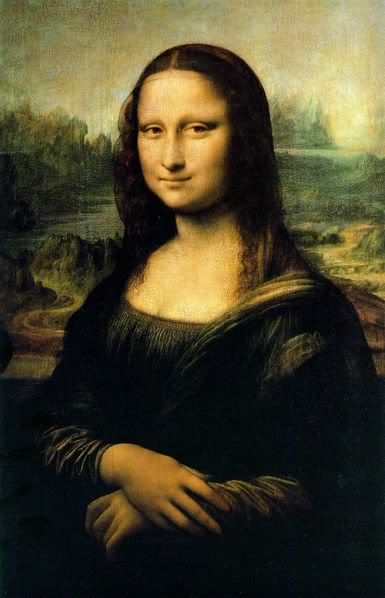
How Leonardo da Vinci used rudimentary pigments in 1503 to create such subtle shadows and light on the Mona Lisa has long baffled art historians. Now French researchers are using X-ray fluorescence spectroscopy to isolate and study each ultra-thin layer of paint and glaze da Vinci used to create the effect he was seeking, according to recent new stories.

By beaming x-rays on the Mona Lisa without removing it from the wall on which it is mounted in Paris' Louvre Museum, scientists found that da Vinci used a Renaissance painting technique known as sfumato, intricately mixing thin layers of pigment, glaze and oil to create the appearance of lifelike shadows and light. Scientists now believe that da Vinci used up to 30 layers of paint on his works.

While this research may solve one mystery about the Mona Lisa, others remain, like: who is this enigmatic woman and why does she hold her subtle half-smile? To these questions we can add another: what did this mysterious woman and da Vinci eat?

According to one researcher who studied the culinary habits of fifteenth and sixteenth century Italy, some Renaissance favorites were Risi e Bisi, Saffron Risotto with Duck and Mushrooms, and Spinach Soup with Hazelnuts. Although those recipes would be impossible to duplicate today, this one for Saffron Risotto with Mushrooms from the New York Times might give you a sense of how and what Leonardo da Vinci ate.

4 cups beef or chicken stock
1/8 teaspoon ground saffron
3 tablespoons unsalted butter
2 tablespoons olive oil
1/4 cup finely minced scallions
1/4 cup finely minced onions
1 pound fresh wild mushrooms, trimmed, cleaned and sliced (see note)
1 1/2 cups Italian Arborio rice
Salt and freshly ground black pepper to taste
3/4 cup freshly grated Parmigiano-Reggiano cheese

Place stock in a saucepan and over medium heat bring to a simmer. Add saffron, stir, and simmer slightly. Meanwhile, in a larger saucepan over medium heat, melt 1 tablespoon butter in olive oil. When foam subsides, add scallions and onions and cook, stirring frequently, until softened and yellow but not browned. Add mushrooms and saute, stirring occasionally until liquid has evaporated.

Add rice to mushrooms, and cook, stirring to coat well, with butter and oil. Add approximately 3/4 cup of simmering stock to rice and mushrooms. Stir well and continue to cook, stirring occasionally, until rice has absorbed most of stock. Continue adding stock to rice by half-cupful adding only after rice has absorbed previous addition.

As cooking continues, stir more frequently. After 25 minutes, all the stock should be absorbed, and rice should be tender but still chewy. Remove from heat. Add salt and pepper to taste. Stir in remaining butter and 1/4 cup of Parmigiano-Reggiano. Serve immediately, passing the rest of the cheese.

Friday, July 22, 2011

The Assassination of James Garfield and a Fresh Supply of Milk

The opulent Gilded Age banquets that characterized the Grant White House were but a distant memory when James Garfield, a farmer’s son, moved into the White House in 1881. But his days there were limited.

On the morning of July 2, he reportedly wrestled in bed with his two older sons and then “lingered over a long breakfast” in the family dining room. A few hours later, he was escorted to Union Station, where Charles Gutieau, a crazed office seeker fired a bullet into the president’s chest and cried, “I am a Stalwart and Arthur is President now!”

For two months, Garfield suffered in the sweltering heat of Washington D.C. unable to consume anything more than soup and milk, and when he died on September 19th, the nation went into a state of mourning that reportedly surpassed that accorded to Lincoln.

Although Garfield wasn't president for a long enough period of time to leave any lasting culinary stamp on the White House, historians say that he preferred healthy nutritious food over the rich European dishes typically served by White House cooks. It has also been said that Garfield was particularly fond of squirrel soup and that his favorite drink was milk, so much so that, as he was dying, "the Adams Express Company in Baltimore sent a cow to the White House to ensure a fresh supply of milk."

FAST FACT: Garfield's death resulted in three presidents assuming office in one year (Rutherford B. Hayes, Garfield, and Chester Arthur). This has happened one only one other occasion in our nation's history. In 1841, William Henry Harrison succeeded Martin Van Buren but died one month later and John Tyler became president.

Thanks for stopping by THE HISTORY CHEF! For a free excerpt of my new book from Simon and Schuster please click here!

Tuesday, July 19, 2011

George Bush, Barack Obama, and the Politics of Peanut Butter and Jelly Sandwiches

Published in 2011, George W. Bush's memoir Decision Points has been described by the New York Times as "an autobiography focused around 'the most consequential decisions' of his presidency and his personal life from his decision to give up drinking in 1986 to his decision to invade Iraq in 2003 to his decisions regarding the financial crisis of 2008."

According to the Product Description of the book:

President Bush brings readers inside the Texas Governor’s Mansion on the night of the hotly contested 2000 election; aboard Air Force One on 9/11, in the hours after America’s most devastating attack since Pearl Harbor; at the head of the table in the Situation Room in the moments before launching the war in Iraq; and behind the Oval Office desk for his historic and controversial decisions on the financial crisis, Hurricane Katrina, Afghanistan, Iran, and other issues that have shaped the first decade of the 21st century...

With so many momentous political issues to review, it's not surprising that Mr. Bush didn't spend much time discussing his favorite foods, but...in an interview with Oprah Winfrey during the 2000 presidential campaign, he did say that his favorite sandwich is peanut butter and jelly on white bread.

Eight years later, during the 2008 presidential campaign, peanut butter and jelly sandwiches once again made national headlines. Responding to charges "that his economic policies were socialistic in nature," Barack Obama ridiculed his opponent John McCain for constantly resorting to trivialities and distractions. Here is a video of Obama's remarks:

Now, because he knows that his economic theories don't work, he's been spending these last few days calling me every name in the book. Lately he's called me a socialist for wanting to roll-back the Bush tax cuts for the wealthiest Americans so we can finally give tax relief to the middle class. I don't know what's next. By the end of the week he'll be accusing me of being a secret communist because I shared my toys in kindergarten. I shared my peanut butter and jelly sandwich."

Although neither Bush nor Obama mentioned how they prefer their PB&Js to be made, we do know that John Harvey Kellogg, the cereal pioneer, was the first person to receive a patent for the process of making peanut butter butter in 1895. According to Andrew Smith's Peanuts: The Illustrious History of the Goober Pea, early peanut butters had several problems:

The first was that peanut oil has a melting point below room temperature. Gravity separated the oil, which then oxidized and turned rancid. Likewise, salt added to the peanut butter separated and crystallized. Grocers received peanut butter in tubs or pails and were advised to use a wooden paddle to stir it frequently...

During the early years of the twentieth century, William Norman, an English chemist, invented a method of saturating unsaturated and polyunsaturated fatty acids, thus preventing them from turning rancid. In 1922, Joseph L. Rosefield...applied these principles to peanut butter [and] developed a process to prevent oil separation and spoilage in peanut butter...The result was a semisolid peanut butter [that]...was thick and creamy and did not stick to the roof of the mouth as much as previous products.


Selecting the name "Skippy" for his product, Rosefield introduced creamy and chunky-style peanut butter in 1932. Three years later, the company inaugurated its first wide-mouth peanut-butter jar, which quickly became the industry standard. And in less than twenty five years, peanut butter had "evolved from a hand ground delicacy to a mass-produced commercial commodity sold in almost every grocery store in America."

FOOD FACT: Florence Cowles' 1928 cookbook Seven Hundred Sandwiches includes dozens of creative recipes for peanut butter sandwiches, including: Peanut Butter and Egg Sandwich, Peanut Butter and Cabbage Sandwich, Peanut Butter and Marshmallow Sandwich, Peanut Butter and Prune Sandwich, Peanut Butter and Cherry Sandwich, Peanut Butter and Cheese Sandwich, and Peanut Butter and Olive Sandwich made with Mayonnaise on Rye. Oh my!

Thursday, July 14, 2011

Abraham Lincoln Chicken Fricassee

Despite the exigencies of the Civil War, Abraham Lincoln took his entertaining duties at the White House seriously, and if the only extant culinary records of his administration were the menus of his gala state banquets and balls, one could justifiably conclude , according to food historian Poppy Cannon, that he was "a gourmet to end gourmets, a connoisseur of exquisite sensitivity [and] a bon vivant supreme."

But nothing could be further from the truth. Not prone to eating breakfast every day, it has been said that he had an egg and biscuit only occasionally. Lunch was often only an apple with a glass of milk, and dinner could be entirely forgotten unless a tray of food was forced on him. “Abe can sit and think longer without food than any other person I have ever met,” Lincoln’s former law partner in Chicago wrote. And, shortly after his death, Lincoln’s sister-in-law recalled, “He loved nothing and ate mechanically. I have seen him sit down at the table and never unless recalled to his senses, would he think of food.”

But when Lincoln did turn his attention to food, he ate heartily and never lost a boyhood taste for Kentucky Corn Cakes, Gooseberry Cobbler, Rail Splitters, Gingerbread Cookies, and Corn Dodgers. And it has been said that one of the few entrees that would tempt Lincoln was Chicken Fricassee. According to A Treasury of White House Cooking by Francois Rysavy, Lincoln "liked the chicken cut up in small pieces, fried with seasonings of nutmeg and mace and served with a gravy made of the chicken drippings."

Although Abe's favorite recipe for Chicken Fricassee has surely been lost to posterity, you can try this more recent one for Tarragon Chicken Fricassee from Gourmet Magazine:

3 1/2 to 4 pounds chicken pieces with skin and bone
3/4 teaspoon salt
1/2 teaspoon black pepper
2 tablespoons vegetable oil
1/2 cup finely chopped shallots
1 garlic clove, finely chopped
1 Turkish or 1/2 California bay leaf
1/2 cup dry white wine
1 cup heavy cream
1/2 cup reduced-sodium chicken broth
1 1/2 tablespoons finely chopped fresh tarragon
1/4 teaspoon fresh lemon juice

Pat chicken dry and sprinkle all over with salt and pepper. Heat oil in a 12-inch heavy skillet over moderately high heat until hot but not smoking, then sauté chicken in 2 batches, skin side down first, turning over once, until browned, 10 to 12 minutes total per batch. Transfer to a plate.

Pour off all but 2 tablespoons oil from skillet, then cook shallots, garlic, and bay leaf over moderate heat, stirring occasionally, until shallots are softened, about 2 minutes. Add wine and bring to a boil. Stir in cream, broth, and 1 tablespoon tarragon, then add chicken, skin side up, and simmer, covered, until just cooked through, 20 to 25 minutes. Transfer chicken with tongs to a platter and keep warm, loosely covered. If necessary, boil sauce until thickened slightly. Stir in lemon juice, remaining 1/2 tablespoon tarragon, and salt and pepper to taste. Discard bay leaf; pour sauce over chicken.

Tuesday, July 12, 2011

Dickens Meets Tyler at the White House

One of the most famous guests to dine at the White House during John Tyler’s presidency was the great English writer, Charles Dickens. Upon his arrival in the United States, Dickens was honored at a lavish ball in New York City, where he was greeted by such famous American writers as Washington Irving, Henry Wadsworth Longfellow, Harriet Beecher Stowe and Edgar Allan Poe.

A few days later, Dickens met Tyler in the White House and later penned this about the president:

He looked somewhat worn and anxious, and well he might; being at war with everybody - but the expression of his face was mild and pleasant, and his manner was remarkably unaffected, gentlemanly, and agreeable.

Although Dickens seemed to like Tyler, he strongly disliked slavery. Describing a particular meal in Baltimore, Dickens wrote:

We stopped to dine at Baltimore, and…were waited on, for the first time, by slaves. The sensation of exacting any service from human creatures who are bought and sold…is not an enviable one. The institution exists, perhaps, in its least repulsive and most mitigated form in such a town as this; but it IS slavery; and though I was, with respect to it, an innocent man, its presence filled me with a sense of shame and self-reproach.

After returning to England, Dickens wrote his first travel book entitled American Notes. In it, he criticized Americans for their poor table manners and disgusting habit of chewing and spitting tobacco. He also devoted an entire chapter to slavery in the United States.

FAST FACT: Oliver Twist is perhaps Dickens’ most famous novel. Set in England, the main character is a nine-year old orphan in a London workhouse where the boys are given only three meals of thin gruel a day. When Oliver asks for more (“Please, sir, I want some more”) he is dubbed a troublemaker and treated even more cruelly. Oliver Twist called attention to the problem of poor and starving children in England and, to a lesser extent, the United States.

For the announcement of my new children's book, please click here.

Thursday, July 7, 2011

Richard Nixon, U.S.-China Relations, and the 40th Anniversary of Ping Pong Diplomacy

During Richard Nixon's administration, one of the first public signs of improved U.S.-China relations came on April 6, 1971, when the American Ping-Pong team, in Japan for the 31st World Table Tennis Championship, received "a surprise invitation from their Chinese colleagues for an all-expense paid visit to the People's Republic of China." Four days later, on April 10, 1971, "nine players, four officials, and two spouses stepped across a bridge from Hong Kong to the Chinese mainland," thus becoming the first group of Americans allowed into China since the Communist takeover in 1949 and ushering in an era of what has been dubbed "Ping-Pong Diplomacy."

According to PBS:

Ten journalists, including five Americans, were also invited to cover the team’s visit, ending the information blockade from the People's Republic in place since 1949. From April 11th to 17th, a delighted American public followed the daily progress of the visit in newspapers and on television, as the Americans played - and lost - exhibition matches with their hosts, toured the Great Wall and Summer Palace, chatted with Chinese students and factory workers, and attended the Canton Ballet.

Premier Chou En-lai worked the public relations opportunity beautifully, receiving the Americans at a banquet in the Great Hall of the People on April 14. "You have opened a new chapter in the relations of the American and Chinese people," he told the unlikely diplomats. "I am confident that this beginning again of our friendship will certainly meet with majority support of our two peoples." He also extended an invitation for more American journalists to visit China, provided they do not "all come at one time." That same day, the U.S. announced plans to remove a 20-year embargo on trade with China.


Despite the public rapproachment between the two states, Nixon and Secretary of State Henry Kissinger "decided to keep their back-channel negotiations with China to themselves [and] it was not until July 15, after Kissinger's secret mission to Beijing, that Nixon announced that he, too, would make the journey the following year, as the first American president to visit China."

This week, The Richard Nixon Foundation will commemorate the 40th anniversary of this extraordinary series of 1971 and 1972 Chinese-American matches in "The 40th Anniversary of Ping Pong Diplomacy: The Rematch," to be held July 8, 2011 in the White House East Room at the Richard Nixon Presidential Library, featuring members of the original '71 and '72 teams.

According to the official press release, "an impressive lineup of American and Chinese Olympic and World champions, including original players, will go head-to-head in free exhibitions on July 8 beginning at 9 a.m. The competition will showcase exciting youth, elite and collegiate rounds, with a spectacular finale of rematches of the original games. Huiaiying Zheng and Liang Geliang will again represent the Chinese and Judy Hoarfrost and George Braithwaite, the first Americans to visit China since 1949 at the time, will represent the U.S."

The Foundation will also host an All-American Welcome BBQ in the Library's East Room on Thursday, July 7 at 5 p.m. The program will feature remarks by President Nixon's brother Edward, Ping Pong Diplomacy veteran Tim Boggan, U.S. and Chinese officials, and table tennis matches between celebrities and world champions. If you happen to be in Southern California this week and would like to get in on the action, please click here.

Wednesday, July 6, 2011

Meat Rationing at the Roosevelt White House

When she toured the White House kitchen in 1933, Henrietta Nesbitt, Eleanor Roosevelt's housekeeper, reportedly found cockroaches crawling about. In her book White House Diary Nesbitt described her first inspection of the premises: “I can’t work up any charm for cockroaches. No matter how you scrub it, old wood isn’t clean. This was the ‘first kitchen in America,’ and it wasn’t even sanitary...The refrigerator was wood inside and bad-smelling. Even the electric wiring was old and dangerous. I was afraid to switch things on.”

“There is only one solution,” she told Mrs. Roosevelt. “We must have a new kitchen.”

And so it was that Public Works Project No. 634 was instituted, with demolition and construction on the kitchen beginning in the summer of 1935. But because the jobless rate was so high during the Great Depression, President Roosevelt insisted that "relief workers be employed for the reconstruction whenever possible." According to historian Mary Barrett:

The renovation, planned by the White House staff and engineers from General Electric and Westinghouse corporations, reconfigured the working space, replaced rusted pipes, put in a whole new electrical system with all-new electric appliances, and installed more efficient dumbwaiters to transport the food to the State Floor dining rooms above.

New equipment included six roasting ovens, a sixteen-foot-long stove, eight refrigerators, five dishwashers, a soup kettle, a meat grinder, waffle irons, multiple mixers, a thirty-gallon ice-cream storage freezer, and a deep fryer that held five gallons of fat. Stainless steel storage and counter tops were installed throughout.

The President and Mrs. Roosevelt were delighted, but Mrs. Nesbitt reported that the staff was overwhelmed by the latest technological innovations. They continued to do things the way they had been done in the past: washing dishes, as well as chopping and slicing food—by hand. And unfortunately for President Roosevelt, a new kitchen did not improve the quality or variety of Mrs. Nesbitt’s menus.

Mrs. Nesbitt believed in economical, simple, American fare: cheap cuts of meat including brains, sweetbreads, and beef tongues; mashed potatoes; flavorless canned vegetables; molded gelatin salads dotted with marshmallows; and insipid desserts. Franklin Roosevelt once joked that the only reason he sought a fourth term of office was so that he could return to the White House to fire Mrs. Nesbitt!


Of course, Roosevelt did win a fourth election, but Mrs. Nesbitt "and her bland menus remained." In her biography of Eleanor Roosevelt, Blanche Cook conjectured that Eleanor's "curious disregard for her husband’s tastes suggests an explanation for her persistent defense of Henrietta Nesbitt: The housekeeper was one expression of her passive-aggressive behavior in a marriage of remarkable and labyrinthine complexity.”

But culinary historian Barbara Haber offers a different take on the relationship between Eleanor, Nesbitt, and the meals that appeared on the Roosevelt's table. In an essay titled, “Home Cooking in the FDR White House,” Haber explains that Eleanor cared little about what she ate. Her goal for White House menus was to "keep them strictly within the bounds of culinary propriety for a nation that was suffering first from economic hardship, and later from the restrictions of rationing." It was her social conscience, Haber claims, not her marital frustrations, that ruled the table.

Whatever the case may be, Nesbitt herself confirmed that when meat was rationed during World War II, the White House had to stretch its meat allotment, too, which led to some rather bland meals at the Roosevelt White House. Some of Nesbitt's usual “meat-stretcher foods” included stuffed peppers, stew, ham scallops, noodles and mushrooms with chicken scraps, spaghetti with meat-cakes “cut down to the size of mere marbles,” curries and omelets with meat tidbits, croquettes for “a sustaining meal in themselves,” minestrone soup, fish chowder, gumbo z’herbes, stuffed eggs with meat bits for stuffing, baked beans, deviled meats, and casseroles.

And at an old-fashioned, American-style picnic held in the summer of 1939 in honor of Queen Elizabeth and Prince Philip of England, menu items included Virginia Ham, Smoked Turkey, and Hot Dogs! The next day, news of the picnic made the front page of the New York Times under the headline, “KING TRIES HOT DOG AND ASKS FOR MORE.” While the King reportedly “ate his hot dog by hand like an American,” the Queen daintily cut hers with a knife and fork.

Although that particlar recipe may have been lost to posterity, you can try this recipe for Hot Dogs with Homemade Pickle Relish from Bobby Flay for your next old-fashioned, All-American style barbecue:

8 link hot dogs
quality hot dog buns
Homemade Pickle Relish, recipe follows

Directions: Heat grill to high. Grill the hot dogs until golden brown on all sides. Place in buns and top with your favorite mustard and the homemade pickle relish.

For the Pickle Relish:
1 1/2 cups cider vinegar
1 teaspoon mustard seeds
1 teaspoon coriander seeds
2 tablespoons sugar
8 large dill pickles (sour, not half-sour), finely diced
1 small red pepper, grilled, peeled, seeded, and finely diced
1 small yellow pepper, grilled, peeled, seeded, and finely diced
1 small white onion, finely diced
2 tablespoons chopped fresh dill

Bring vinegar, mustard seeds, and coriander seeds to a boil in a medium saucepan on the grates of the grill; cook until reduced by half and slightly syrupy. Remove from the heat, add remaining ingredients, and gently toss to coat. Season with salt and pepper, to taste. Cover and refrigerate for at least 1 hour before serving.

To read an excerpt from my new book from Simon and Schuster click here

Wednesday, June 29, 2011

John Adams Gooseberry Fool

As a delegate to the Second Continental Congress, John Adams was one of the fiercest advocates of the Declaration of Independence. Contrary to popular belief, the Declaration wasn't signed by all of the delegates on July 4, 1776. Instead, it was initially approved on July 2, 1776. The delegates then continued debating and slightly revised it the following day and formally adopted it on the fourth of July. Most historians agree that the Declaration wasn’t signed by all the delegates (with a few holdouts) until nearly a month later, on August 2, 1776.

On July 3, 1776, John Adams wrote a letter to his wife Abigail in which he described these momentous events. This is what he wrote:

The second day of July, 1776, will be the most memorable epoch in the history of America. I am apt to believe that it will be celebrated by succeeding generations as the great anniversary festival...It ought to be solemnized with pomp and parade, with shows, games, sports, guns, bells, bonfires, and illuminations, from one end of this continent to the other, from this time forward forever more.

You will think me transported with Enthusiasm but I am not. -- I am well aware of the Toil and Blood and Treasure, that it will cost Us to maintain this Declaration, and support and defend these States. -- Yet through all the Gloom I can see the Rays of ravishing Light and Glory. I can see that the End is more than worth all the Means. And that Posterity will tryumph in that Days Transaction, even altho We should rue it, which I trust in God We shall not.

Although no one knows what the delegates ate on those momentous days, we do know that Adams was fond of Gooseberry Fool, a traditional eighteenth century British dish. As an example of how national food preferences change over time, gooseberries were abundant in John's day but are not widely available in the United States today.

Unless you have your own little gooseberry patch, you can substitute blueberries and call this dessert Blueberry Fool. Or you can use strawberries or raspberries, whichever you prefer. Either way, this delicious and refreshingly sweet little treat would make a great addition to your Fourth of July festivities next week. If you'd like to whip up a batch, here's a simple recipe to try from epicurious.com

3 cups pink or green gooseberries (or blueberries)
1/2 cup granulated sugar
1/2 cup well-chilled heavy cream
1/4 cup crème fraîche
1/4 cup superfine granulated sugar

Pull off tops and tails of gooseberries and halve berries lengthwise. In a heavy skillet cook berries and granulated sugar over moderate heat, stirring occasionally until liquid is thickened, about 5 minutes. Simmer mixture, mashing with a fork to a coarse puree, 2 minutes more. Chill puree, covered, until cold, about 1 hour, and up to 1 day.

In a bowl with an electric mixer beat heavy cream with crème fraîche until it holds soft peaks. Add superfine sugar and beat until mixture just holds stiff peaks. Fold chilled puree into cream mixture until combined well. Fool may be made 3 hours ahead and chilled, covered.

Credit: Declaration of Independence, painting by John Trumball

Thanks for stopping by THE HISTORY CHEF! For a free excerpt of my new book from Simon and Schuster click here

Monday, June 27, 2011

Betty Ford and a Royal Bicentennial State Dinner

On the evening of July 7, 1976, President Gerarld Ford and his wife Betty hosted an elegant state dinner at the White House dinner in honor of Queen Elizabeth II and Prince Philip of England. The royal visit was part of the celebration of the Bicentennial of the American Revolution. In her memoir, The Times of My Life, Mrs. Ford recalled the Queen's dinner this way:

We put up a tent for the Queen's dinner. There were so many state events coming up one right after the other that without the tent we'd probably have had to close the White House to the public for a good portion of the summer, and it was the Bicentennial year and the influx of tourists was heavy. A tent over the Rose Garden would be the answer, just a great white tent which would also enable us to invite more guests than we could have served indoors.

An hour and a half before the Queen's dinner, there was a sudden downpour with torrential rain, thunder, lightning. Three trees on the White House grounds were struck. Fortunately, I'd insisted that our tent have a floor...I'd seen it done at the French Embassy and been very impressed...For the Queen's dinner, we had violinists stationed along the paths, and to be out in the gorgeous night air, with the moon shining down and the violins playing as you walked by, was unforgettable.

The Queen was easy to deal with. She was very definite about what she wanted and what she didn't want. She loves Bob Hope and Telly Savalas, so we invited Bob Hope and Telly Savalas...and if I hadn't kept mixing up Your Highness and Your Majesty (he's His Highness, she's Her Majesty) I'd give myself four stars for the way that visit went off.


As for the dinner itself, more than two hundreds guests dined on New England Lobster en Bellevue and Saddle of Veal with Rice Croquettes and Broccoli Mornay. Dessert items included Peach Ice Cream Bombee with Fresh Raspberries and a Demitasse. Although Mrs. Ford didn't include the recipes for these dishes in her memoir, you can whip up this recipe for Peach Ice Cream Bombee from Rachel Ray:

2 pound peaches - peeled, pitted and coarsely chopped
1/2 cup plus 2 tablespoons sugar
1/2 teaspoon fresh lemon juice
1 pinch salt
1-1/3 cups heavy cream
1/2 cup milk
1/2 teaspoon ground cinnamon

In a medium saucepan, combine the peaches, 7 tablespoons sugar, the lemon juice and salt. Cook over medium heat, mashing, until jam like, about 15 minutes. Let cool. In a medium bowl, whisk together the cream, milk, remaining 3 tablespoons sugar and the cinnamon until the sugar is dissolved. Stir in the peach mixture and refrigerate for 4 hours. Using an ice cream machine, process the peach mixture according to the manufacturer’s instructions. Transfer to an airtight container and freeze until firm, about 4 hours.

FAST FACT: A gifded athlete, Gerald Ford was offered two contracts to play in the NFL (from the Detroit Lions and Green Bay Packers) but turned the offers down to continue his education. After graduating from the University of Michigan at Ann Arbor, Ford became a boxing and football coach at Yale University and later graduated from Yale Law School in the top 25 percent of his class despite the time he had to devote to his coaching duties.

Wednesday, June 22, 2011

George Bush Apple-Cranberry Brown Betty

According to New York Times columnist Maureen Dowd, George H.W. Bush has always had a "whopping appetite," but it isn't for vegetables like broccoli (as he made clear to reporters at a news conference in 1990) or other healthy, nutritious dishes. Instead, our 41st president loves to munch on pork rinds, beef jerky, nachos, tacos, gaucamole, chile, refried beans, hamburgers, hot dogs, barbecued ribs, and popcorn. And "even when he eats something healthy, like yogurt or oat bran," according to Dowd, "he tries to spice it up with Butterfingers or something else to give it a little zip."

Given his unpretentious tastes, it’s not surprising that George and Barbara Bush made no particular culinary demands on their Executive Chef and both often “exulted in the pleasures of White House dining.” In a burst of gustatory fervor, Mrs. Bush reportedly wrote, “Duck soup, smoked trout, delicate salad and peaches and passion fruit! Glorious. The food is so special that you cannot believe it.”

As for Mr. Bush's culinary preferences, the Washington Post reported that, shortly after taking office, the new president was making them known:

For a black-tie $1,500-a-plate inaugural dinner what did he choose? A baked bean and scrod dinner to commemorate the great state of his birth, Massachusetts? Oysters a la Connecticut to note the days of his youth? A messy Texas barbecue from his adopted home state? Or, from his Kennebunkport summer home, Maine lobsters? Instead George and Barbara Bush for the first of many presidential dinners designed a meal around the taste buds of George Washington and called it "From George to George."

If you'd like to whip up the delicious dessert that was served at that gala dinner, here is the recipe for Apple-Cranberry Brown Betty:

Butter and sugar for preparing the souffle dish
10 Granny Smith apples
1 teaspoon lemon juice
6 tablespoons butter, plus additional 1/2 cup melted
3 tablespoons sugar
2 cups fresh cranberries, washed and dried
1 cup golden raisins, soaked in warm water for 15 minutes then squeezed dry
Zest of 2 oranges
1 cup light brown sugar
1/4 teaspoon mace
1 teaspoon ground cinnamon
3 cups stale white-bread crumbs, crusts removed

Preheat the oven to 375 degrees. Butter a 2-quart straight-sided glass souffle dish and then sprinkle with sugar. Peel, core and quarter the apples, then cut each quarter into 3 chunks. Reserve in a bowl. Sprinkle the lemon juice over the apples and toss to combine.

In a large frying pan, heat 2 tablespoons of the butter until hot and add 1/3 of the apple pieces. Sprinkle with 1 tablespoon of the sugar and saute over high heat until the apples are lightly caramelized. Remove the apples from heat and reserve in a large bowl. Repeat process until all the apples are cooked. Combine the apples with the cranberries, raisins, orange zest, brown sugar, mace and cinnamon and mix well. Mix the bread crumbs with the remaining 1/2 cup melted butter.

Line bottom of souffle bowl with 1/3 of the bread-crumb mixture. Add 1/2 of the apple-cranberry mixture, then sprinkle with 1/3 more of the bread crumbs. Add rest of apple-cranberry mixture, then top with the remaining bread crumbs. Bake in the preheated oven for 1 1/4 to 1 1/2 hours.

Thanks for stopping by THE HISTORY CHEF! For a free excerpt of my new book from Simon and Schuster click here!

Tuesday, June 21, 2011

George Washington's Fishery

So did you know that before he became president, George Washington ran a successful fishery in the Potomac River near his Mount Vernon home. During the annual spring run, Washington's slaves would catch and harvest more than a million herring, shad, striped bass, oysters, crabs, and clams.

The Potomac River, of course, flows into the Chesapeake Bay, which is the largest estuary in the United States. Back in George’s day, it was known for its great abundance of shellfish and fish. Today, it is not nearly as productive due to overharvesting, pollution, runoff, and disease, but it still yields more fish and shellfish (about 500 million pounds each year) than any other estuary in the United States.

What are estuaries? Estuaries are typically defined as partially enclosed coastal bodies of water that are formed where freshwater from rivers and streams mix with salt water from an ocean. Some estuaries, like the Chesapeake Bay and the lower part of the Hudson River, were formed thousands of years ago when melting glaciers caused sea levels to rise and flood low lying valleys and lands.

Others, like those found in Northern Europe, Alaska and Canada, were formed during periods of glaciation. Still others, like the San Francisco Bay, are known as tectonic estuaries that were formed by the buckling or folding of land surfaces along major fault lines. Regardless of how they were formed, estuaries are critical for marine life and have provided an important source of food for human beings since the beginning of recorded time.

So what do estuaries have to do with George Washington and food? Alot, if you consider the fact that by the time he became president, George had lost almost all of his teeth and had to eat soft foods, like fresh fish from the Chesapeake and its many rivers, throughout most of his adult life.

Baked Shad was another Washington family favorite. Although no recipes for it are contained in Martha Washington's Booke of Cookery, historians explain that cooks at Mount Vernon were "undoubtedly so familiar with it that directions for preparation were unnecessary. Like boiling eggs, cooking shad was something everyone could do!"

Although it can be difficult to find, shad is now in season and so here is a simple and delicious recipe for Broiled Shad with Thyme to try from Food and Wine magazine:

2 pounds shad fillets, cut to make 4 pieces
1 tablespoon olive oil
3/4 teaspoon chopped fresh thyme
1/2 teaspoon salt
1/8 teaspoon fresh-ground black pepper
1 tablespoon butter
4 lemon wedges, for serving

Heat the broiler. Lightly oil a broiler pan or baking sheet. Put the fish in the pan and rub the surface with the oil. Sprinkle with the chopped or dried thyme, the salt, and pepper. Dot with the butter. Broil the fish until golden brown and just done, about 4 minutes for 3/4-inch-thick fillets. Decorate with the thyme sprigs, if using. Serve with the lemon wedges.

FAST FACT: Contrary to popular belief, George Washington did not wear wooden dentures. Instead, a talented dentist named John Greenwood hand-crafted his dentures from elephant ivory, hippopotamus tusks, and parts of horse and donkey teeth!

Monday, June 20, 2011

James Buchanan Snickerdoodles

Presiding over the nation during a time of great strife, James Buchanan is the only president who never had a wife. And while he dined very fine at many White House parties, historians say that James retained a childhood taste for Scrapple, Confederate Pudding, and sweet Dutch-German cookies called Apees.

Snickerdoodles are another traditional Dutch-German cookie that are usually covered with cinnamon and sugar and baked in the shape of a snail. Some food historians say that their fanciful name comes from the German term Schnecke Knödel which can be translated as “snail dumpling.” Others say that “snicker” comes from the Dutch word snekrad or the German word schnecke, both of which refer to a small, snail-like shape.

Although no one knows who came up with their name, we do know that these sweet little sugar cookies have been popular in Buchanan's native state of Pennsylvania for centuries. If you'd like to whip up a batch of Snickerdoodles today, here's a fabulous recipe to try from Emeril Lagasse:

For the topping:

3 tablespoons sugar
1/2 teaspoon cinnamon

For the cookie dough:

3 1/2 cups flour
1 tablespoon baking powder
2 teaspoons baking soda
1/4 teaspoon salt
1/4 teaspoon cinnamon
1 cup butter
2 cups sugar
2 eggs
1 tablespoon light corn syrup
2 1/2 teaspoons vanilla extract

In a small bowl, stir together the sugar and cinnamon and set aside. To make the cookie dough, stir together the dry ingredients. In a bowl with a paddle attachment, cream the butter. Add the sugar and continue to mix, then add the eggs, corn syrup, and vanilla, and mix thoroughly. Add the dry ingredients and mix until blended. Chill dough 1 hour if it's sticky or difficult to handle.

Preheat oven to 375 degrees F. Roll balls of dough about the size of a walnut then roll in the cinnamon sugar to coat. Place on an ungreased sheet pan 2 1/2 inches apart. Bake for 10 to 12 minutes until puffed up and the surface is slightly cracked. Let cool on the sheet a few minutes then remove to a wire rack to cool.

FOOD FACT: At Buchanan’s inaugural reception in 1857, five thousand guests dined on eight rounds of beef, seventy-five hams, sixty saddles of mutton, four saddles of venison, four hundred gallons of oysters, five quarts of jellies, twelve hundred quarts of ice cream, and "pates of infinite variety." The high point of the night was a Pyramid Cake that stood four feet high and was decorated with a flag bearing the insignia of each state. As president, Buchanan’s annual $25,000 salary wasn’t enough to cover his tabs and he often had to pay the bills for his extravagant White House parties out of his own pocket!

Friday, June 17, 2011

A Brief History of Father's Day and Lyndon Johnson's Barbecue Diplomacy

Some historians say that the origins of Father’s Day in the United States can be traced to a young woman by the name of Sonora Smart Dodd, who reportedly came up with the idea while listening to a Mother’s Day sermon in Spokane, Washington in 1909. Raised by her widowed father, a Civil War veteran who had lost his wife after the birth of their sixth child, Sonora felt that her father should be honored in the same way that mothers were on Mother’s Day.

Toward that end, a special Father’s Day observance was held on June 19, 1910. Although that celebration was a local affair, the idea of a national Father’s Day picked up steam when it was endorsed by President Calvin Coolidge in 1924, but it would take another thirty years before Father’s Day was recognized by a Joint Resolution of Congress. Then, in 1966, the first proclamation honoring fathers was issued by President Lyndon Johnson, who designated the third Sunday in June as Father's Day.

Today, of course, Americans celebrate Father's Day in a wide variety of ways, with perhaps the most traditional festivity being an old-fashioned, American-style barbecue, and so it seems only fitting this week to honor President Johnson, who was well-known for his love of down-home country barbecues at his beloved family ranch in Gillespie County, Texas.

Barbecuing, of course, has been used as a tool in American political campaigns and elections for more than a century, but no politician ever used “the conviviality and informality of cooking and eating outdoors” more than Johnson. As his political career progressed, LBJ's barbecues got bigger and more elaborate, and as more important guests visited the ranch, his wife Lady Bird “undertook the first of several remodeling plans to host them in style. Eventually the ranch would include several guest suites, a swimming pool, a radio tower, and an airstrip capable of handling small jets.”

But the most important barbecue ever planned for the LBJ Ranch never happened. It was scheduled, according to historians,

for November 23, 1963, when Vice President [Johnson], President Kennedy, and their entourages were planning to dine beneath the oaks on the Pedernales. But a few hours before they were to board the choppers from Dallas to Johnson City, on November 22, Kennedy was assassinated two cars in front of Johnson as they drove in a motorcade. Instead of taking his boss for a tour around his spread and feeding him barbecue, Johnson found himself back in Washington attending memorial services, and meeting with the cabinet, leaders of Congress, and former Presidents Eisenhower and Truman.

A month later, frazzled from, as Ladybird described it, the "tornado of activity that has surrounded us", the Johnson family retreated to the ranch on Christmas Eve. West German Chancellor Ludwig Erhard was scheduled to visit the President to discuss the Soviet threat, the Berlin Wall, and other important matters. Rather than return to Washington for a formal State Dinner, Lyndon invited Erhard and his entourage on down to what historians claim was the first official Presidential barbecue in history. Yes, Johnson's first state dinner was a barbecue for 300 catered by Walter Jetton on December 29, 1963.

When his staff realized it would be chilly that day, the sit-down part was moved indoors to Stonewall High School gymnasium, about two miles away. Workers did an admirable job of creating an outdoorsy feel with bales of hay, red lanterns, red-checkered table cloths, saddles, lassos, and mariachis. According to Lady Bird's diary, "there were beans (pinto beans, always), delicious barbecued spareribs, cole slaw, followed by fried apricot pies with lots of hot coffee. And plenty of beer."


Although those particular recipes may have been lost to posterity, biographers say that some Johnson family favorites included Chipped Beef covered with Cream, Pedernales River Chili, and Beef Stroganoff. And Lady Bird reportedly enjoyed handing out her own recipe for Barbecue Sauce.

If you’d like to add a little history and zip to your Father's Day celebation this weekend, here is the original recipe for Lady Bird's Barbecue Sauce:

¼ cup butter
¼ cup vinegar
¼ cup ketchup
¼ cup fresh lemon juice
¼ cup Worcestershire sauce
Salt, pepper, red pepper flakes, and Tabasco to taste

Melt butter in a medium sauce pan over medium-high heat. Add other ingredients and bring to a boil. Yields 1 ½ cups.

FAST FACT: With the Vietnam War raging overseas, the Johnson family cut back on the lavish White House entertaining that had been a Kennedy hallmark. There were occasional barbecues at the White House, according to historians, but most social occasions were used to elicit political support. Johnson's Texas ranch provided the real refuge from the pressures of office, and the family retreated there often, where Johnson could be seen driving the dusty ranch roads in a large Cadillac convertible or relaxing on long walks."

Thursday, June 16, 2011

Civil War Rations and Hard Tack Crackers

Civil War rations generally consisted of 12 ounces of pork or bacon or one pound of fresh or salt beef; beans or peas; rice or hominy; sugar; coffee or tea; and hard biscuits or crackers known as Hardtack. Hardtack was usually square or rectangular in shape with small holes baked into it, similar to the soda crackers we are familiar with today.

According to historians, factories in the north “baked thousands of hardtack crackers every day, packed them in crates, and shipped them out by wagon or rail.” Sometimes the hardtack didn't get to the soldiers until weeks, or even months, after they had been made. By then, the crackers were so hard that soldiers called them "tooth dullers" or "sheet iron crackers."

Older crackers were often infested with maggots or weevils and so soldiers referred to them as "worm castles" because of “the many holes bored through them by these tiny pests.” Civil War soldiers dreaded these crackers so much that they sang a wartime tune about them called “Hard Tack, Come Again No More!” Here are some of the lyrics:

Let us close our game of poker, take our tin cups in our hand
As we all stand by the cook's tent door
As dried monies of hard crackers are handed to each man.
O, hard tack, come again no more!

CHORUS: 'Tis the song, the sigh of the hungry:
"Hard tack, hard tack, come again no more."
Many days you have lingered upon our stomachs sore.
O, hard tack, come again no more!

'Tis a hungry, thirsty soldier who wears his life away
In torn clothes - his better days are o'er.
And he's sighing now for whiskey in a voice as dry as hay,
"O, hard tack, come again no more!" - CHORUS

'Tis the wail that is heard in camp both night and day,
'Tis the murmur that's mingled with each snore.
'Tis the sighing of the soul for spring chickens far away,
"O, hard tack, come again no more!" - CHORUS


But to all these cries and murmurs, there comes a sudden hush
As frail forms are fainting by the door,
For they feed us now on horse feed that the cooks call mush!
O, hard tack, come again once more!

'Tis the dying wail of the starving:
"O, hard tack, hard tack, come again once more!"
You were old and very wormy, but we pass your failings o'er.
O, hard tack, come again once more!


Despite the bad rap that Hardtack got, soldiers prepared it in a number of ways. Some would crumble it into coffee or tea or soften it in water and fry it in bacon grease. Others made a popular dish called "skillygallee" by crumbling the crackers into salted fried pork. If you’d like to get a sense of what Hardtack tastes like, here is a simple recipe to try from americancivilwar.com:

2 cups of flour
1/2 to 3/4 cup water
1 tablespoon of Crisco or vegetable fat
6 pinches of salt

Mix the ingredients together into a stiff batter, knead several times, and spread the dough out flat to a thickness of 1/2 inch on a non-greased cookie sheet. Bake for one-half an hour at 400 degrees. Remove from oven, cut dough into 3-inch squares, and punch four rows of holes, four holes per row into the dough. Turn dough over, return to the oven and bake another half hour. Turn oven off and leave the door closed. Leave the hardtack in the oven until cool. Remove, eat with coffee or tea and sing "Hardtack, Come Again No More!"

FOOD FACT: According to researchers at visitgettysburg.com, rations also consisted of fresh vegetables (sometimes fresh carrots, onions, turnips and potatoes), dried fruit, and dried vegetables when available. Men also "foraged and scavenged the countryside for fresh food at times." Many also "received supplements mailed from their family, or they could buy foods from sulters who followed the troops selling pickles, cheese, sardines, cakes, candies, beer, and whisky, even though the troops were forbidden to drink alcohol."

For the announcement for my new children's book, please click here!