Showing posts with label Paula Dean. Show all posts

Thursday, January 23, 2014

Benjamin Harrison and the American Corn Belt

Now please don't tell People magazine or TMZ, but Benjamin Harrison and his wife Caroline were reportedlty "corn-addicts," which isn’t surprising since they were born in Ohio and lived for many years in Indiana, two of the states that make up the American Corn-Belt, which produces more than half of the corn grown each year in the United States.

The other states that make up the Corn-Belt include Iowa and Illinois and parts of Kansas, Nebraska, Minnesota, and Missouri. Experts say that the warm nights, hot days, and well-distributed rainfall of the region during the growing season are ideal conditions for raising this highly versatile vegetable.

And did you know that more than half of the corn grown in the United States is used to feed cattle, sheep, chickens, hogs and other livestock? The rest is used to produce an astonishingly wide array of consumer foods and products, including ketchup, crayons, soap, detergent, cough syrup, marshmallows, graham crackers, pancake mix, chewing gum, soft drinks, toothpaste, salad dressings, breakfast cereals, licorice, disposable diapers, shoe polish, paint, peanut butter, and, of course, popcorn.

Although the popcorn that Harrison ate was nothing like the microwavable kind we are familiar with today, biographers say that he was fond of such traditional midwestern dishes as Corn Muffins, Stewed Corn, and Green-Corn Fritters. And being the "corn-addict" that he was, he surely would have enjoyed this delicious recipe for Corn Chowder from the Food Network's Paula Dean:

1 cup (2 sticks) butter
1 small onion, diced
1 small carrot, finely diced
1 small celery stalk, diced
1 clove garlic, minced
1/2 cup all-purpose flour
3 cups white corn kernels, fresh or frozen
3 cups chicken stock
2 cups half-and-half
Pinch freshly grated nutmeg
Kosher salt and freshly ground black pepper

Melt 1 stick of butter in a large saucepan over medium heat. Add the onion, carrot, celery, and garlic, and saute for 2 minutes. Add the flour and stir to make a roux. Cook until the roux is lightly browned; set aside to cool to room temperature.

Meanwhile, combine the corn and chicken stock in another saucepan, and bring to a boil. Simmer for 10 minutes. Pour the boiling stock with the corn (a little at a time) into the saucepan with the roux, whisking briskly so it doesn't lump. Return the skillet to the heat and bring to a boil. The mixture should become very thick.

In a small saucepan, gently heat the half-and-half; stir it into the thick corn mixture. Add the nutmeg and salt and pepper, to taste. Just before serving, cut the remaining stick of butter into large chunks. Add it to enrich the soup, stirring until the butter melts.

FOOD FACT: Popcorn's ability to "pop" lies in the fact that corn kernels contain a tiny amount of water stored in a circle of soft starch inside a hard outer casing. When heated to a high enough temperature, the water expands which exerts an increasing amount of pressure until the outer casing eventually gives way and the kernels explode, or “pop,” allowing the water to escape as steam and turning the kernels inside out!

Credit: Oil Portrait of Benjamin Harrison (1895), Eastman Johnson, White House Historical Association (White House Collection)

Wednesday, October 5, 2011

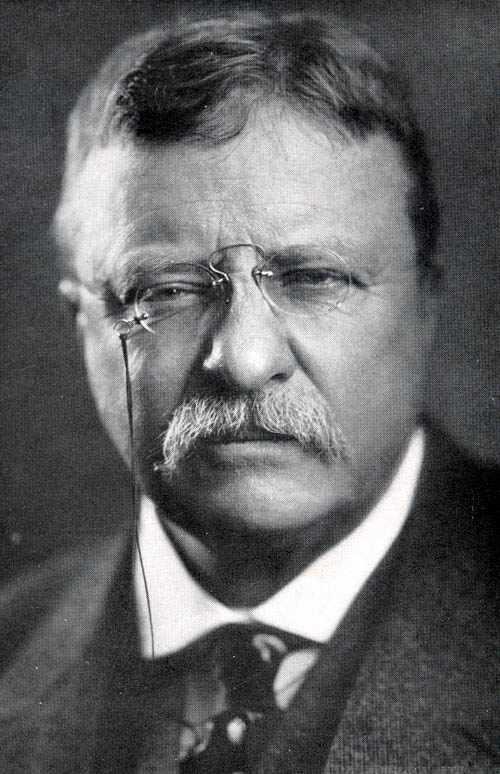
Theodore Roosevelt, Muckrakers, and the "Monarchical Manners" of the White House

In keeping with the progressive, muckraking nature of the times, a journalist for Harper's Weekly complained about "the monarchical manners" of the White House during Theodore Roosevelt's administration.

In particular, the journalist alleged that "since Mr. Roosevelt became President there have been witnessed behind the White House doors an exclusiveness, a rigor of etiquette, and a display of swords and gold braid such as no one of his predecessors ever dreamed of...The atmosphere of the White House, once democratic and free, has become tainted with the manners of monarchy."

Similar criticisms were expressed in a June 1906 Washington Post column in which Roosevelt was condemned for indulging in extravagant dining practices at the White House. Responding to the allegations, a spokesman for the president sent a letter to the Post which appeared the next day:

When anyone endeavors to create a widespread impression that the President and his family sit down to a four or five course breakfast, a six or seven course luncheon, and a ten-course dinner, the President feels that a denial is not inappropriate. Instead of a breakfast consisting of oranges, cantaloupes, cereals, eggs, bacon, lamb chops, hot cakes, and waffles, President Roosevelt insists that the regular White House breakfast consists of hard boiled eggs, rolls, and coffee.

Instead of a luncheon of such delicious viands as Little Neck clams, stuffed olives, celery, consommé of chicken, fish sauté, eggs a la turque, Spring lamb, new string beans, asparagus, mashed potatoes, lettuce, tomatoes, strawberries and ice cream, President Roosevelt declares that when alone he always contents himself with a bowl of bread and milk.

When Mrs. Roosevelt or the children are present, the luncheon consists of cold meat, tea, cantaloupe in season, and bread. Instead of a ten-course dinner, the President declares that nine times out of ten a three-course dinner is served, and the other time a two-course dinner.


Despite the muckrakers' monarchical allegations, Roosevelt's reputation inside the White House was that of a simple family man. Ike Hoover served in the White House for forty-two years, eventually serving as Chief Usher in charge of day-to-day operations. In his memoirs, published in 1934, Hoover provided insight into the Roosevelt family’s daily dining habits:

The entire family [sat] down [for] breakfast at eight o'clock. After breakfast the President spent an hour or so in his study, perhaps reading, while Mrs. Roosevelt arranged the details of the day's program. The President went to his office at nine-thirty or ten o'clock, and Mrs. Roosevelt for a walk or shopping...All returned just about in time for lunch. Those famous lunches!

Something indeed was wrong when there were not two or more guests for this meal. To prepare properly for a certain number was almost a physical impossibility, for notice was continually coming from the office that someone had been invited at the last minute, and many times the family and guests had to wait until the table was made larger before they could be seated. The place was really a transient boardinghouse, and how every one got enough to eat was the wonder of the household...


Although Hoover didn't mention what particular dishes were served at those famous Roosevelt luncheons, researchers tell us that TR's diet consisted of "quite a bit of game from hunting expeditions" and that he was also fond of Southern Fried Chicken with White Gravy and Grits. If you'd like to whip up some Southern Fried Chicken for your next family luncheon or dinner this week, here's a simple and simply delicious recipe to try from Paula Dean:

3 eggs
1/3 cup water
About 1 cup hot red pepper sauce
2 cups self-rising flour
1 teaspoon pepper
House seasoning, recipe follows
1 (1 to 2 pound) chicken, cut into pieces
Oil, for frying, preferably peanut oil

In a medium size bowl, beat the eggs with the water. Add enough hot sauce so the egg mixture is bright orange. In another bowl, combine the flour and pepper. Season the chicken with the house seasoning. Dip the seasoned chicken in the egg, and then coat well in the flour mixture. Heat the oil to 350 degrees F in a deep pot. Do not fill the pot more than 1/2 full with oil. Fry the chicken in the oil until brown and crisp. Dark meat takes longer then white meat. It should take dark meat about 13 to 14 minutes, white meat around 8 to 10 minutes.

FAST FACT: As for the Roosevelt's evenings, Hoover noted that "it was more to the liking of the family to spend a quiet evening in the library, either playing cards or reading the current magazines. The whole family were fiends when it came to reading. No newspapers. Never a moment was allowed to go to waste; from the oldest to the youngest they always had a book or a magazine before them. The President...would just devour a book and it was no uncommon thing for him to go entirely through three or four volumes in the course of an evening. Likewise we frequently saw one of the children stretched out on the floor flat on his stomach eating a piece of candy and with his face buried deep in a book."

Wednesday, September 1, 2010

Teddy Roosevelt Sand Tart Cookies

At home in the White House from 1901 until 1909, Theodore Roosevelt’s six young kids had the complete run of the place. They took their favorite pony for a ride in the White House elevator and frightened visiting officials with a four foot king snake. No doubt famished after such action-packed days, “TR’s Brood” favored hearty country foods, like Southern Fried Chicken with White Gravy and Grits or Chicken Fried Steak with Mashed Potatoes and Dutch Apple Cake.

Historians say that the Roosevelt family also loved eating cookies and other sweet, sugary treats. According to Poppy Cannon, a "particularly cherished family recipe" for Sand Tarts was found written on the inside cover of one of Edith Roosevelt's many cookbooks. Although that particular recipe might be difficult to duplicate today, you can try this sweet and simple recipe for Sand Tart Cookies from Good Housekeeping and Paula Deen:

1 cup butter (2 sticks), softened
1 tsp. vanilla extract
1 cup confectioners' sugar
1 3/4 cup all-purpose flour
1 cup pecans, finely chopped

Preheat oven to 275°F. In large bowl, with mixer on medium speed, beat butter, vanilla, and 1/2 cup sugar until smooth, occasionally scraping bowl with rubber spatula. Reduce speed to low; gradually beat in flour just until blended, occasionally scraping bowl. With spoon, stir in pecans.

With floured hands, shape dough by level measuring tablespoons into about 2" by 1/2" crescents. Place crescents, 2 inches apart, on 2 ungreased large cookie sheets. Place cookie sheets on 2 oven racks. Bake about 45 minutes or until edges are lightly browned. With metal spatula, transfer cookies to wire racks set over waxed paper. Immediately sprinkle remaining confectioners' sugar through sieve over cookies to coat well. Cool completely and enjoy!

FAST FACT: Teddy and his second wife Edith were married in 1886. His daughter Alice (from his first marriage) was 17 when the family moved into the White House. The other children were Ted, Kermit, Ethel, Archie, and Quentin. When the Roosevelts moved into the White House, they brought along a whole menagerie of exotic pets with them. Kermit had a Kangaroo Rat that reportedly ate lumps of sugar off the breakfast table and four-year-old Quentin had a pet green snake named Emily Spinach!

Thanks for stopping by THE HISTORY CHEF! For a free excerpt of my new book from Simon and Schuster click here!