Showing posts with label Gilbert Stuart. Show all posts
Wednesday, November 30, 2016
Dolley Madison's Wednesday Squeezes
When James Madison and his wife Dolley moved into the President's House, she decided that the place could use some sprucing up and the room that Thomas Jefferson had used as an office soon became the State Dining Room. The adjacent parlor (today’s Red Room) was "redecorated in sunflower yellow, with sofas and chairs to match" and, one room over, the smaller but more formal elliptical salon was "decorated in the Grecian style with elegant cream-colored walls."
Together, these three rooms with their interconnecting doors became the venue for Dolley Madison’s legendary “Drawing Rooms,” or "Wednesday Squeezes," which often attracted as many as three hundreds guests and were the most popular social event in town!
Dressed in brightly colored satins or silks and often donning a feathered headpiece or bejeweled turban, Dolley cheerfully greeted and mingled with guests as they enjoyed a festive evening of refreshments, music, and lively conversation. Mrs. Madison also presided over elaborate dinner parties where she delighted guests with such unusual dessert items as pink pepperment ice cream baked in warm pastries.
The Madisons continued to entertain this way until "their brilliant social whirlwind" went up in flames during the War of 1812. On August 24, 1814, while James was away getting a report on the war, Dolley was supposedly awaiting forty dinner guests. Around three o’clock, word was received that British troops had defeated American forces at nearby Blandensburg and were marching toward the capital.
Before fleeing to safety, Dolley quickly gathered what she could, including important documents of her husband’s and Gilbert Stuart’s famous portrait of George Washington. When British soldiers entered the Executive Mansion later that day, they supposedly devoured the lavish dinner that had been left behind. They then piled up furniture, scattered oil-soaked rags in all of the rooms, and lit the President’s House afire!
Although the British quickly evacuated the capital, the months that followed weren't happy ones for the Madisons as many Americans criticized them for abandoning the President’s House and “allowing the destruction of the most visible symbol of the young republic.”
At their temporary residence, Dolley eventually hosted her Wednesday Squeezes again, but “the spirit was gone.” Then came word of General Andrew Jackson’s brilliant victory over the British in the Battle of New Orleans and the mood of the country was again jubilant. Although a peace treaty had been signed weeks earlier, the Battle of New Orleans transformed “Mr. Madison’s War” (which had been condemned as an unnecessary folly) into “a glorious reaffirmation of American independence."
Saturday, October 26, 2013
Dolley Madison's Wednesday Squeezes
When James Madison and his wife Dolley moved into the President's House, the room that Thomas Jefferson had used as an office became the State Dining Room. The adjacent parlor (today’s Red Room) was "redecorated in sunflower yellow, with sofas and chairs to match" and "outfitted with a piano, a guitar, and a portrait of Dolley.” One room over, the smaller but more formal elliptical salon was "decorated in the Grecian style" with cream-colored walls.
Together, these three rooms with their interconnecting doors became the venue for Dolley Madison’s legendary “Drawing Rooms,” or "Wednesday Squeezes," which often attracted as many as three hundreds guests and were the most popular social event in town!
Dressed in brightly colored satins or silks and often donning a feathered headpiece or bejeweled turban, Dolley cheerfully greeted and mingled with guests as they enjoyed a festive evening of refreshments, music, and lively conversation. Mrs. Madison also presided over elaborate dinner parties where she delighted guests with such unusual dessert items as pink pepperment ice cream baked in warm pastries.
The Madisons continued to entertain this way until "their brilliant social whirlwind" went up in flames during the War of 1812. On August 24, 1814, while James was away getting a report on the war, Dolley was supposedly awaiting forty dinner guests. Around three o’clock, word was received that British troops had defeated American forces at nearby Blandensburg and were marching toward the capital.
Before fleeing to safety, Dolley quickly gathered what she could, including important documents of her husband’s and Gilbert Stuart’s famous portrait of George Washington. When British soldiers entered the Executive Mansion later that day, they supposedly devoured the lavish dinner that had been left behind. They then piled up furniture, scattered oil-soaked rags in all of the rooms, and lit the President’s House afire!
Although the British quickly evacuated the capital, the months that followed were not happy ones for the Madisons. Many Americans criticized them for abandoning the President’s House and for “allowing the destruction of the most visible symbol of the young republic.”
At their temporary residence, Dolley started up her Wednesday Squeezes again, but “the spirit was gone.” Then came word of General Andrew Jackson’s victory over the British in the Battle of New Orleans and the mood of the country was again jubilant. Although a peace treaty had been signed weeks earlier, the Battle of New Orleans transformed “Mr. Madison’s War” (which had been condemned until then as an unnecessary folly) into “a glorious reaffirmation of American independence.”
Source: The President's Table: Two Hundred Years of Dining and Diplomacy (NY, Harper Collins: 2007)
Credit: Dolley Madison, oil on canvas, by Gilbert Stuart
Monday, November 7, 2011
James Monroe, Mississippi Steamboatin' and "Food Piled High on a Long Linen Cloth"
Historians say that the steamboat completely revolutionized shipping. For the first time in history, people "didn't have to rely on unpredictable currents and winds and could travel to any port at any time." Plantation owners in the southern states of Mississippi, Missouri, and Louisiana, for example, could cheaply and easily ship cargoes of sugar, cotton, and other goods upriver on the Mississippi rather than send it around the tip of Florida and up the Eastern seaboard as they had previously done.
Steamboats also provided a luxurious way for wealthy passengers to travel. In Mississippi Steamboatin’, Herbert Quick described the palatial setting and abundance of food served on later steamboats:
The palatial setting of later steamboats attracted pleasure-seekers and wealthy travelers...More comfortable than their 'settin' rooms,' more ornate than their prim and uncomfortable parlors...they saw the steamboat's cabin as a bewilderingly beautiful palace. The...glistening cut-glass chandeliers; the soft oil paintings on every stateroom door; the thick carpets that transformed walking into a royal march; the steaming foods piled high on the long linen cloth in the dining room, with attentive waiters standing at the traveler's elbow, waiting with more food, and gaily colored desserts in the offing - neither homes nor hotels...were ever like this.
Between 1814 (three years before Monroe took office) and 1834, steamboat arrivals in New Orleans increased from 20 to 1,200 each year. For the next half century, steamboats were the main transporter of American goods, and tiny river towns grew into thriving cities “when steamboats began to make regular stops at their docks.”
FAST FACT: If you've ever watched steam rise from a cup of hot chocolate or coffee, you might think that a steamboat is propelled by steam. That makes sense, but that isn't exactly how a steamboat works. In a steamboat's engine, wood or other fuel is burned to heat water in a boiler, and the steam that rises from the water is forced through small spaces (piston cylinders) to increase the speed at which it escapes, similar to the release of a valve on a pressure-cooker. The concentrated steam then hits and moves a paddlewheel which, in turn, propels the steamboat through water!
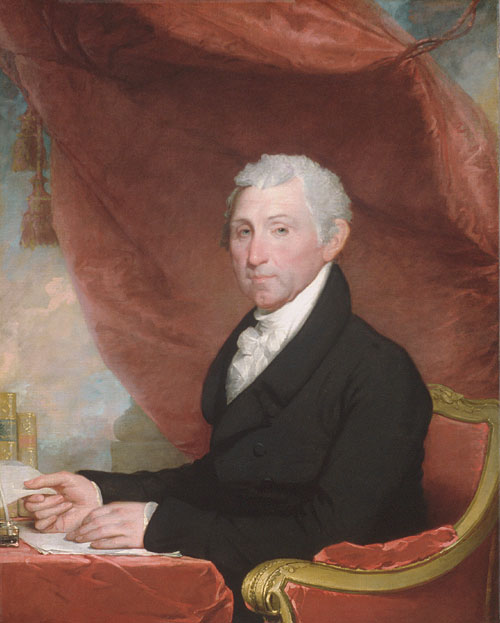
Credit: James Monroe, oil on canvas by Gilbert Stuart (Metropolitan Museum of Art, New York)
Tuesday, July 20, 2010
Dolley Madison's Wednesday Squeezes
Together, these three rooms with their interconnecting doors became the venue for Dolley Madison’s legendary “Drawing Rooms,” or "Wednesday Squeezes," which often attracted as many as three hundreds guests and were the most popular social event in town!
Dressed in brightly colored satins or silks and often donning a feathered headpiece or bejeweled turban, Dolley cheerfully greeted and mingled with guests as they enjoyed a festive evening of refreshments, music, and lively conversation. Mrs. Madison also presided over elaborate dinner parties where she delighted guests with such unusual dessert items as pink pepperment ice cream baked in warm pastries.
The Madisons continued to entertain this way until "their brilliant social whirlwind" went up in flames during the War of 1812. On August 24, 1814, while James was away getting a report on the war, Dolley was supposedly awaiting forty dinner guests. Around three o’clock, word was received that British troops had defeated American forces at nearby Blandensburg and were marching toward the capital.
Before fleeing to safety, Dolley quickly gathered what she could, including important documents of her husband’s and Gilbert Stuart’s famous portrait of George Washington. When British soldiers entered the Executive Mansion later that day, they supposedly devoured the lavish dinner that had been left behind. They then piled up furniture, scattered oil-soaked rags in all of the rooms, and lit the President’s House afire!
Although the British quickly evacuated the capital, the months that followed were not happy ones for the Madisons. Many Americans criticized them for abandoning the President’s House and for “allowing the destruction of the most visible symbol of the young republic.”
At their temporary residence, Dolley started up her Wednesday Squeezes again, but “the spirit was gone.” Then came word of General Andrew Jackson’s victory over the British in the Battle of New Orleans and the mood of the country was again jubilant. Although a peace treaty had been signed weeks earlier, the Battle of New Orleans transformed “Mr. Madison’s War” (which had been condemned until then as an unnecessary folly) into “a glorious reaffirmation of American independence.”
Source: Barry Landau, The President's Table: Two Hundred Years of Dining and Diplomacy (NY, Harper Collins: 2007)
Credit: Dolley Madison, oil on canvas, by Gilbert Stuart
Subscribe to:
Posts (Atom)