Showing posts with label George Bush. Show all posts

Tuesday, November 19, 2024

George Bush, Barack Obama and the Politics of Peanut Butter and Jelly Sandwiches

George Bush's memoir Decision Points has been described by the New York Times as "an autobiography focused around 'the most consequential decisions' of his presidency and his personal life from his decision to give up drinking in 1986 to his decision to invade Iraq in 2003 to his decisions regarding the financial crisis of 2008." According to the Product Description of the book:

President Bush brings readers inside the Texas Governor’s Mansion on the night of the hotly contested 2000 election; aboard Air Force One on 9/11, in the hours after America’s most devastating attack since Pearl Harbor; at the head of the table in the Situation Room in the moments before launching the war in Iraq; and behind the Oval Office desk for his historic and controversial decisions on the financial crisis, Hurricane Katrina, Afghanistan, Iran, and other issues that have shaped the first decade of the 21st century...

With so many momentous issues to review, it's not surprising that Bush didn't mention his favorite foods, but in an interview with Oprah Winfrey during the 2000 presidential campaign, he did say that his favorite sandwich is peanut butter and jelly on white bread.
.

Eight years later, during the 2008 presidential campaign, peanut butter and jelly sandwiches once again made national headlines. Responding to charges that his economic policies were socialistic in nature, Barack Obama ridiculed his opponent John McCain for constantly resorting to trivialities and distractions:

Now, because he knows that his economic theories don't work, he's been spending these last few days calling me every name in the book. Lately he's called me a socialist for wanting to roll-back the Bush tax cuts for the wealthiest Americans so we can finally give tax relief to the middle class. I don't know what's next. By the end of the week he'll be accusing me of being a secret communist because I shared my toys in kindergarten. I shared my peanut butter and jelly sandwich.
.

Although neither Bush nor Obama mentioned how they prefer their PB&Js to be made, we do know that John Harvey Kellogg, the cereal pioneer, was the first person to receive a patent for the process of making peanut butter in 1895. According to Andrew Smith's Peanuts: The Illustrious History of the Goober Pea, early peanut butters had several problems:

The first was that peanut oil has a melting point below room temperature. Gravity separated the oil, which then oxidized and turned rancid. Likewise, salt added to the peanut butter separated and crystallized. Grocers received peanut butter in tubs or pails and were advised to use a wooden paddle to stir it frequently...

During the early years of the twentieth century, William Norman, an English chemist, invented a method of saturating unsaturated and polyunsaturated fatty acids, thus preventing them from turning rancid. In 1922, Joseph L. Rosefield...applied these principles to peanut butter [and] developed a process to prevent oil separation and spoilage in peanut butter...The result was a semisolid peanut butter [that]...was thick and creamy and did not stick to the roof of the mouth as much as previous products.


Selecting the name "Skippy" for his product, Rosefield introduced creamy and chunky-style peanut butter in 1932. Three years later, the company inaugurated its first wide-mouth peanut-butter jar, which quickly became the industry standard. And in less than twenty five years, peanut butter had "evolved from a hand ground delicacy to a mass-produced commercial commodity sold in almost every grocery store in America."


FOOD FACT: Florence Cowles' 1928 cookbook Seven Hundred Sandwiches includes dozens of creative recipes for peanut butter sandwiches, including: Peanut Butter and Egg Sandwich, Peanut Butter and Cabbage Sandwich, Peanut Butter and Marshmallow Sandwich, Peanut Butter and Prune Sandwich, Peanut Butter and Cherry Sandwich, Peanut Butter and Cheese Sandwich, and Peanut Butter and Olive Sandwich made with Mayonnaise on Rye. Oh my!

Tuesday, November 19, 2019

Golfer-in-Chief: Barack Obama, Tiger Woods, and Grilled Rosemary Lamb Chops


While Donald Trump's round of golf with Tiger Woods this year made national headlines, Tiger's round with Barack Obama in 2013 also caused quite a stir. Although scores remain top secret, what's not so secret is that many American presidents have been avid golfers.

According to Don van Natta’s First Off the Tee, 14 of the last 17 presidents have been serious golfers and how they played the game reveals a lot about their character. Dwight Eisenhower played more than 800 times during his eight years in office and had a putting green installed on the South Lawn of the White House.

A member of Augusta National Golf Club, Ike broke 80 on a dozen occasions and the Eisenhower Pine, once located on the 17th hole, was named after him. Ike hit the tree so many times that, at a club meeting in 1956, he proposed that the tree be cut down. Not wanting to offend the president, the club’s chairman adjourned the meeting rather than reject the request.

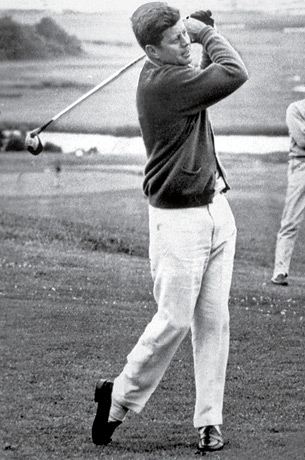
John F. Kennedy was a serious golfer but didn't want to be seen playing because he wanted to contrast his image with Ike’s reputation of “golfing his way through the presidency.” JFK and his aides reportedly made a lot of hay out of Ike's constant playing, and dubbed him "Duffer in Chief.”


As for LBJ, van Natta says that he “really tore it up” on the course and would take 300, sometimes 400 swings, in a round. "He just wanted the feel of one perfect shot," van Natta notes, "and if it took 400 swings to do it, he was going to do it. He was the president and nobody was going to get in his way."

Ronald Reagan only played the game about a dozen times while in office, but he loved putting around the Oval Office and aboard Air Force One.


But nowhere does golf run deeper than in the Bush family bloodline.

George H.W. Bush's maternal grandfather, George Herbert Walker, served as president of the United States Golf Association in 1920. A single-digit handicapper, he donated the Walker Cup, the trophy awarded to the winning team in the biennial matches between leading amateur golfers from the U.S. and Great Britain/Ireland. And 41’s father, Senator Prescott S. Bush, was a scratch golfer who served as president of the USGA in 1935.


As for Clinton, Van Natta says he "followed the rules for about a hole and a half. Then...started taking these do-over shots, gimme putts and, at the end of the 18 holes, it took him about 200 swings to score an 82."

And as for Barack Obama, an article in Time magazine notes that he took up golf “as a relaxing alternative to basketball...but now that his game is out of the closet, it is clear that he duffs in much the same way that he tries to govern.” Wellington Wilson, Obama’s longtime golf buddy, was quoted as saying, “You can really tell a person's personality by the way he plays golf. He just goes with the flow. Not too high. Not too low."


And while it's hard to know if Donald Trump chose to just "go with the flow" with Tiger Woods last year, we do know that Obama attended a Black Caucus Dinner in Washington D.C. after his match with #MacDaddySanta, then flew to California for a fundraiser at the ritzy Fig and Olive restaurant in West Hollywood.

According to obamafoodroma.com, celebrity guests included Jack Black, Jamie Foxx, Danny DeVito, and Quincy Jones. Judd Apatow and Aaron Sorkin were also on hand for the festivities, where guests reportedly shelled out a whopping $17,900 each for dinner.

So what kind of meal comes with such a price tag? Well, one guest revealed that appetizer options included:

jamón ibérico and a fig Gorgonzola tartlet, while entree options included striped bass filet en papillote with zucchini, eggplant, fennel, tomato, thyme, scallion, and saffron served with Arbequina olive oil mashed potato & chives; free range organic chicken breast with grilled zucchini, eggplant, heirloom tomato, cipollini onion, roasted fig, Parmesan polenta, and marinated red bell pepper; and rosemary lamb chops, grilled then smoked a la minute with Herbs de Provence, goat cheese, and chive gnocchi.

Sounds delish, but since most of us don't have a spare $18k to drop on dinner, here's a fabulous and more affordable recipe for Grilled Rosemary Lamb Chops from epicurious.com:


3/4 cup balsamic vinegar
6 tablespoons olive oil
3 tablespoons fresh lemon juice
3 tablespoons minced fresh rosemary or 3 teaspoons dried
6 garlic cloves, minced
1 teaspoon ground black pepper
12 1-inch-thick loin lamb chops, fat trimmed

Mix first 6 ingredients in small bowl. Place lamb chops in single layer in 13x9x2-inch glass dish. Pour marinade over. cover with foil and refrigerate 4 hours, turning lamb chops occasionally.

Prepare barbecue (medium-high heat). When coals turn white, drain chips, if using, and scatter over coals. When chips begin to smoke, season lamb with salt and pepper and place on grill. Cover; grill shops to desired doneness, basting often with marinade, about 4 minutes per side for medium-rare. Transfer to platter and serve.

Saturday, August 25, 2018

George Bush, Barack Obama, and the Politics of Peanut Butter and Jelly Sandwiches

George Bush's memoir Decision Points has been described by the New York Times as "an autobiography focused around 'the most consequential decisions' of his presidency and his personal life from his decision to give up drinking in 1986 to his decision to invade Iraq in 2003 to his decisions regarding the financial crisis of 2008." According to the Product Description of the book:

President Bush brings readers inside the Texas Governor’s Mansion on the night of the hotly contested 2000 election; aboard Air Force One on 9/11, in the hours after America’s most devastating attack since Pearl Harbor; at the head of the table in the Situation Room in the moments before launching the war in Iraq; and behind the Oval Office desk for his historic and controversial decisions on the financial crisis, Hurricane Katrina, Afghanistan, Iran, and other issues that have shaped the first decade of the 21st century...

With so many momentous issues to review, it's not surprising that Mr. Bush didn't bother to mention his favorite foods, but...in an interview with Oprah Winfrey during the 2000 presidential campaign, he did say that his favorite sandwich is peanut butter and jelly on white bread.
.

Eight years later, during the 2008 presidential campaign, peanut butter and jelly sandwiches once again made national headlines. Responding to charges that his economic policies were socialistic in nature, Barack Obama lightheartedly chided his opponent John McCain for constantly resorting to trivialities and distractions:

Now, because he knows that his economic theories don't work, he's been spending these last few days calling me every name in the book. Lately he's called me a socialist for wanting to roll-back the Bush tax cuts for the wealthiest Americans so we can finally give tax relief to the middle class. I don't know what's next. By the end of the week he'll be accusing me of being a secret communist because I shared my toys in kindergarten. I shared my peanut butter and jelly sandwich.
.

Although neither Bush nor Obama mentioned how they prefer their PB&Js to be made, we do know that John Harvey Kellogg, the cereal pioneer, was the first person to receive a patent for the process of making peanut butter in 1895. According to Andrew Smith's Peanuts: The Illustrious History of the Goober Pea, early peanut butters had several problems:

The first was that peanut oil has a melting point below room temperature. Gravity separated the oil, which then oxidized and turned rancid. Likewise, salt added to the peanut butter separated and crystallized. Grocers received peanut butter in tubs or pails and were advised to use a wooden paddle to stir it frequently...

During the early years of the twentieth century, William Norman, an English chemist, invented a method of saturating unsaturated and polyunsaturated fatty acids, thus preventing them from turning rancid. In 1922, Joseph L. Rosefield...applied these principles to peanut butter [and] developed a process to prevent oil separation and spoilage in peanut butter...The result was a semisolid peanut butter [that]...was thick and creamy and did not stick to the roof of the mouth as much as previous products.


Selecting the name "Skippy" for his product, Rosefield introduced creamy and chunky-style peanut butter in 1932. Three years later, the company inaugurated its first wide-mouth peanut-butter jar, which quickly became the industry standard. And in less than twenty five years, peanut butter had "evolved from a hand ground delicacy to a mass-produced commercial commodity sold in almost every grocery store in America."


FOOD FACT: Florence Cowles' 1928 cookbook Seven Hundred Sandwiches includes dozens of creative recipes for peanut butter sandwiches, including: Peanut Butter and Egg Sandwich, Peanut Butter and Cabbage Sandwich, Peanut Butter and Marshmallow Sandwich, Peanut Butter and Prune Sandwich, Peanut Butter and Cherry Sandwich, Peanut Butter and Cheese Sandwich, and Peanut Butter and Olive Sandwich made with Mayonnaise on Rye. Oh my!

Sunday, January 4, 2015

James Polk, the Treaty of Guadalupe Hidalgo, and Food on the Range

So did you know that in 1848 James Polk signed the Treaty of Guadalupe Hidalgo which ended the Mexican-American War and gave most of present-day Texas, New Mexico, Arizona, Colorado, California, Wyoming, and Utah to the United States?

With the addition of these vast tracts of land, more and more cowboys headed to the southwest, where they herded cattle north to market and sold them for beef. As they galloped along, cowboys would sing songs about food like "Trouble for the Range Cook" and "Starving to Death on My Government Claim."

"Git Along Little Dogies" is another classic cowboy tune. In it, a cowboy tells the dogies (the calves in the herd) that it’s their misfortune (and none of his own) that they will soon be sold at market. Maybe you’ve heard the lyrics:

As I walked out this morning for pleasure,
I met a cowpuncher a jogging along;
his hat was throwed back and his spurs was a jingling,
and as he advanced he was singing this song.

Yippee ti yi yo, get along little dogies
It's your misfortune and none of my own
Yippee ti yi yo get along little dogies
For you know that Wyoming will soon be your home...


It's early in spring that we round up the dogies,
And mark 'em and brand 'em and bob off their tails;
We round up our horses and load the chuckwagon,
And then throw them dogies out onto the trail.

Whoopee ti yi yo, git along, little dogies,
It's your misfortune And none of my own;
Whoopee ti yi yo, Git along, little dogies,
You know that Wyoming will be your new home.


As cowboys drove cattle north, cooks drove Chuck Wagons (which carried all of the food and supplies for meals) ahead of the herds to set up camp for the night. Meals on the range typically consisted of beef, hash, beans, chili peppers, coffee, biscuits, sugar, and dried fruit.

Like cowboys, cooks would sing snappy tunes about food while working hard on the range. In “Punchin’ Dough” a cook tells some bothersome and ungrateful cowboys that cooking is just as demanding as herding cattle:

Come, all you young waddies, I'II sing you a song
Stand back from the wagon, stay where you belong
I've heard you complaining' I'm fussy and slow,
While you're punchin' the cattle and I'm punchin' dough.

Now I reckon your stomach would grow to your back
If it was'n't for the cook that keeps fillin' the slack
With the beans in the box and the pork in the tub
I'm a-wonderin' now, who would fill you with grub?

When you're cuttin' stock, then I'm cuttin' a steak,
When you're wranglin' hosses, I'm wranglin' a cake.
When you're hazin' the dogies and battin' your eyes,
I'm hazin' dried apples that aim to be pies…


Meanwhile, as cowboys were devouring biscuits and beans on the range, President Polk was dining on fancy French cuisine at the White House. But Polk was no stranger to grub. As a boy growing up on the frontier, he reportedly ate Black Bear Steak and Barbecued Deer. Like other frontier folk, basic country fare, like Tenesseee Ham and Corn Pone, was what pleased Polk the most!

If you'd like to wrangle up some corn pone one of these days, here's a simple recipe to try from The Smokey Mountain Cookbook

1 tablespoon of shortening
3/4 cup of boiling water
1 cup yellow corn meal
1 teaspoon of salt

Melt shortening in heavy 8 or 9-inch skillet. Heat water to boiling point and pour immediately over corn meal and salt. Add melted shortening; stir to blend well. As soon as mixture has cooled enough to handle, divide into four equal portions. Shape each portion into a pone about 3/4 inch thick by patting between the hands. Place in pan and bake at 450°F for about 50 minutes or until golden brown. Serve warm and enjoy!

Thursday, August 21, 2014

Air Force One Tuna Melt on Croissant

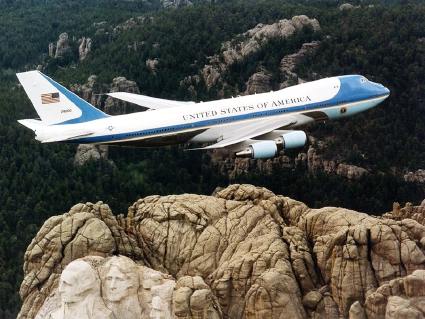
Regardless of where in the world the President travels, "if he flies in an Air Force jet, the plane is called Air Force One." According to White House officials, Air Force One is technically the "call sign" of any Air Force aircraft carrying the President. In practice, however, the name "Air Force One" is used "to refer to one of two highly customized Boeing 747-200B series aircraft, which carry the tail codes 28000 and 29000."

Emblazoned with the words "United States of America" and an image of the American flag and the Seal of the President of the United States, Air Force One is "an undeniable presence wherever it flies." This is how the interior of this amazing, high-tech jet is described on the White House website:

Capable of refueling midair, Air Force One has unlimited range and can carry the President wherever he needs to travel. The onboard electronics are hardened to protect against an electromagnetic pulse, and Air Force One is equipped with advanced secure communications equipment, allowing the aircraft to function as a mobile command center in the event of an attack on the United States.

Inside, the President and his travel companions enjoy 4,000 square feet of floor space on three levels, including an extensive suite for the President that features a large office, lavatory, and conference room. Air Force One includes a medical suite that can function as an operating room, and a doctor is permanently on board. The plane’s two food preparation galleys can feed 100 people at a time.


Although it's proven mighty difficult to find copies of specific Air Force One menus, The Old Foodie tells us that the following luncheon items were served aboard Air Force One on February 6, 1994.

Assorted Relishes
Vegetable Soup
Tuna Melt on Croissant
Chips
Choice of Beverage
Cookies

Now, this is a surprisingly sparse and ordinary menu to present to a sitting president, don't you think? BUT...that was back in 1994, when Bill Clinton was in office, which leads me to believe that perhaps this particular menu was inspired by his wife's or advisors' well-meaning desire to steer the president away from the greasy cheeseburgers and french fries that he once seemed to so much like and nudge him toward more healthy, low-calorie choices to help trim his then-less-than-slender waistline.

Although that specific recipe for "Tuna Melt on Croissant" isn't easily obtainable today, Barack Obama did kindly provide his favorite recipe for Tuna Salad during an interview with "60 Minutes" correspondent Steve Kroft early on in the 2008 presidential campaign. If you're in the mood for tuna salad today, here is President Obama's take on Toasted Tuna Salad Sandwiches:

Tuna
Grey Poupon mustard
Mayonnaise
Chopped gherkins
Toasted Bread

Whatever items might appear on its many in-flight menus, be they simple Tuna Melts on Croissants or crystal-filled dishes of Russian caviar, Air Force One truly is an "undeniable presence" wherever in the world it flies!

FAST FACT: According to the White House website: Air Force One is maintained and operated by the Presidential Airlift Group, part of the White House Military Office. The Airlift Group was founded in 1944 as the Presidential Pilot Office at the direction of President Franklin D. Roosevelt. For the next 20 years, various propeller driven aircraft served the President. In 1962, President John F. Kennedy became the first President to fly in his own jet aircraft, a modified Boeing 707. Over the years, several other jet aircraft have been used, with the first of the current aircraft being delivered in 1990 during the administration of President George H. W. Bush.

Wednesday, December 14, 2011

George Bush, Barack Obama, and the Politics of Peanut Butter and Jelly Sandwiches

Published late last year, George W. Bush's memoir Decision Points has been described by the New York Times as "an autobiography focused around 'the most consequential decisions' of his presidency and his personal life from his decision to give up drinking in 1986 to his decision to invade Iraq in 2003 to his decisions regarding the financial crisis of 2008."

According to the Product Description of the book:

President Bush brings readers inside the Texas Governor’s Mansion on the night of the hotly contested 2000 election; aboard Air Force One on 9/11, in the hours after America’s most devastating attack since Pearl Harbor; at the head of the table in the Situation Room in the moments before launching the war in Iraq; and behind the Oval Office desk for his historic and controversial decisions on the financial crisis, Hurricane Katrina, Afghanistan, Iran, and other issues that have shaped the first decade of the 21st century...

With so many momentous political issues to review, it's not surprising that Mr. Bush didn't spend much time discussing his favorite foods, but...in an interview with Oprah Winfrey during the 2000 presidential campaign, he did say that his favorite sandwich is peanut butter and jelly on white bread.

Eight years later, during the 2008 presidential campaign, peanut butter and jelly sandwiches once again made national headlines. Responding to charges "that his economic policies were socialistic in nature," Barack Obama ridiculed his opponent John McCain for constantly resorting to trivialities and distractions. Here is a video of Obama's remarks:

Now, because he knows that his economic theories don't work, he's been spending these last few days calling me every name in the book. Lately he's called me a socialist for wanting to roll-back the Bush tax cuts for the wealthiest Americans so we can finally give tax relief to the middle class. I don't know what's next. By the end of the week he'll be accusing me of being a secret communist because I shared my toys in kindergarten. I shared my peanut butter and jelly sandwich."

Although neither Bush nor Obama mentioned how they prefer their PB&Js to be made, we do know that John Harvey Kellogg, the cereal pioneer, was the first person to receive a patent for the process of making peanut butter butter in 1895. According to Andrew Smith's Peanuts: The Illustrious History of the Goober Pea, early peanut butters had several problems:

The first was that peanut oil has a melting point below room temperature. Gravity separated the oil, which then oxidized and turned rancid. Likewise, salt added to the peanut butter separated and crystallized. Grocers received peanut butter in tubs or pails and were advised to use a wooden paddle to stir it frequently...

During the early years of the twentieth century, William Norman, an English chemist, invented a method of saturating unsaturated and polyunsaturated fatty acids, thus preventing them from turning rancid. In 1922, Joseph L. Rosefield...applied these principles to peanut butter [and] developed a process to prevent oil separation and spoilage in peanut butter...The result was a semisolid peanut butter [that]...was thick and creamy and did not stick to the roof of the mouth as much as previous products.


Selecting the name "Skippy" for his product, Rosefield introduced creamy and chunky-style peanut butter in 1932. Three years later, the company inaugurated its first wide-mouth peanut-butter jar, which quickly became the industry standard. And in less than twenty five years, peanut butter had "evolved from a hand ground delicacy to a mass-produced commercial commodity sold in almost every grocery store in America."

FOOD FACT: Florence Cowles' 1928 cookbook Seven Hundred Sandwiches includes dozens of creative recipes for peanut butter sandwiches, including: Peanut Butter and Egg Sandwich, Peanut Butter and Cabbage Sandwich, Peanut Butter and Marshmallow Sandwich, Peanut Butter and Prune Sandwich, Peanut Butter and Cherry Sandwich, Peanut Butter and Cheese Sandwich, and Peanut Butter and Olive Sandwich made with Mayonnaise on Rye. Oh my!

Thursday, October 27, 2011

Halloween Parties at the Obama White House

To celebrate their first Halloween in the White House in 2009, First Lady Michelle Obama got in the spirit by dressing as a leopard with furry ears, dramatic cat-like eyes and a spotted orange-and-black animal print top while President Obama played it safe, dressing as, well, “a middle-aged dad, with a black cardigan, checkered shirt and sensible brown slacks.”

According to the Washington Post, about 2,600 trick-or-treaters from local schools swooped, skulked and pitter-pattered their way through the front drive of 1600 Pennsylvania Avenue, stopping at the North Portico to get their treat: a plastic baggy containing White House M&Ms, an orange sugar cookie in the shape of the residence, and clumps of [dried] apricots, apples and papayas.


Meanwhile, wandering around in front of the eerily, orange-lit White House was a motley crew of odd creatures, including musicians dressed as skeletons, walking trees, Star Wars characters, and dancers dressed as red and gold butterflies inside giant bubbles.

After casually chatting with the trick-or-treaters, the Obamas hosted a reception for military families in the East Room of the White House. In his welcoming remarks, the president acknowledged the many sacrifices made by our military families and said, “We are so grateful to you. Especially now, a lot of the times, you guys are separated. It's tough. The spouses who are at home are serving just as much as folks who are deployed. So we are just so thrilled that you guys could be here.”

Of course, this wasn't the first Halloween celebration held at the White House. Known for her playful personality, Mamie Eisenhower hosted a Halloween party for the wives White House staff members. Described as “the most interesting party ever given in the dignified setting of the White House,” it included “skeletons hanging from the State Dining Room chandeliers and witches on broomsticks riding over the white tablecloth.”

In the 1970s, Richard Nixon’s daughter Tricia hosted a Halloween carnival for underprivileged school children in the D.C. area while the Fords and Carters welcomed trick-or-treaters from charitable organizations like UNICEF. And to mark their first Halloween in the White House, George H.W. Bush and First Lady Barbara staged an Anti-Drug Youth Rally for 500 local school children on the South Lawn of the White House, where they loaded youngsters up with treats and spoke to them about the dangers of illegal drugs.

Friday, October 7, 2011

George Bush and the Politics of Broccoli

At an outdoor press conference in 1990, President George Bush told reporters, "I do not like broccoli and I haven't liked it since I was a little kid and my mother made me eat it and I'm President of the United States and I'm not going to eat any more broccoli."

Needless to say, broccoli growers got a little “steamed” by the president’s comment. Within a week, broccoli growers in California had shipped ten thousand pounds of the flowery, green vegetable to the White House where it was donated to a local food bank to help feed the needy.

Ten years later, in February of 2001, President George W. Bush proved that "blood is thicker than diplomacy" at a news conference during a visit with Mexico's newly elected president Vicente Fox, whose family owns a large broccoli farm in Mexico. According to a news report, President Bush was asked by a reporter for his opinion of broccoli. After briefly hesitatating, he reportedly flashed a "thumb's down" sign and said, "Make it cauliflower."

So 41 and 43 are clearly not fond of broccoli, but if they try this simple and simply delicious recipe for Parmesan Roasted Broccoli from Ina Garten they might just change their minds!

4 to 5 pounds broccoli
4 garlic cloves, peeled and thinly sliced
Good olive oil
1 1/2 teaspoons kosher salt
1/2 teaspoon freshly ground black pepper
2 teaspoons grated lemon zest
2 tablespoons freshly squeezed lemon juice
3 tablespoons pine nuts, toasted
1/3 cup freshly grated Parmesan cheese
2 tablespoons julienned fresh basil leaves (about 12 leaves)

Preheat the oven to 425 degrees F. Cut the broccoli florets from the thick stalks, leaving an inch or two of stalk attached to the florets, discarding the rest of the stalks. Cut the larger pieces through the base of the head with a small knife, pulling the florets apart. You should have about 8 cups of florets.

Place the broccoli florets on a sheet pan large enough to hold them in a single layer. Toss the garlic on the broccoli and drizzle with 5 tablespoons olive oil. Sprinkle with the salt and pepper. Roast for 20 to 25 minutes, until crisp-tender and the tips of some of the florets are browned. Remove broccoli from the oven and immediately toss with 1 1/2 tablespoons olive oil, the lemon zest, lemon juice, pine nuts, Parmesan, and basil. Serve hot and enjoy!

Credit: Oil Portrait of George Herbert Walker Bush by Herbert Abrams, White House Historical Assocation (White House Collection)

Tuesday, September 13, 2011

Barack Obama and the "Controversy" over Chicken Fingers in the White House Bowling Alley

So did you know that there's a one-lane bowling alley at the White House? According to the White House Museum website, bowling lanes were first built on the ground floor of the West Wing in 1947 as a birthday gift for President Harry Truman in "the location of what is the present-day Situation Room."

During the Eisenhower administration, the bowling lanes were moved to the Old Executive Office Building to make way for a mimeograph room. Ten years later, friends of Richard Nixon , an avid bowler, paid for a new one-lane alley to be built in the White House in an underground area below the driveway leading to the North Portico.

Since then, many presidents and politicians have thrown a strike or two in the bowling alley, but perhaps no one has enjoyed this perk of living in the White House more than the presidents' children and grandchildren.

According to an article in the Los Angeles Times, President George Bush and his wife Barbara were enjoying a big family dinner shortly after moving into the White House when the First Lady realized that her twin granddaughters Jenna and Barbara were not at the table. Turning to the butler, Mrs. Bush reportedly asked if he knew where they were, to which he replied, "In the bowling alley, waiting to be served."

Not fully amused, the First Lady ordered the girls back to the family quarters by "sending word that Bush grandchildren do not eat in the bowling alley, they eat with the family in the dining room." She also light-heartedly warned the White House staff to "beware of young charm artists."

But much bigger political "scandals" involving the White House bowling alley arose in October of 2009. According to new reports, things got a little tense during a White House Press Briefing when CBS correspondent Chip Reid questioned White House Press Secretary Robert Gibbs about a Washington Times story that accused the White House of "selling access to the bowling alley," among other things.

Following up on a question posed by a CNN reporter, Reid asked Gibbs if the Obama administration would release the names of donors who were given special access to White House advisors and "perks like the bowling alley.” Gibbs caustically responded by noting that the administration would indeed be releasing "the names of everyone who visited the White House, with whom they met, and for what time period."

Not satisfied, Reid pressed the bowling alley issue further, at which point Gibbs, defusing the spat with humor, quipped, "I can report to you that [my son] Ethan Gibbs, with the bumpers down, bowled a couple of games while eating some chicken fingers.”

Now, while most of you probably haven't had the chance to bowl a few games at the White House while eating chicken fingers, you can make this tasty recipe for Crispy Chicken Fingers before knocking down a few pins at your local bowling alley!

1 1/4 pound boneless, skinless chicken breasts, cut across into 1-inch pieces
1/2 cup lowfat buttermilk
Cooking spray
4 cups whole-grain corn cereal
1/4 teaspoon salt
Freshly ground pepper

Preheat oven to 400 degrees F. Combine the chicken and buttermilk in a shallow dish. Cover and chill for 15 minutes. Spray a baking sheet with cooking spray. Put the cereal in a sealed plastic bag and crush with a rolling pin. Transfer the crumbs to a shallow dish.

Season the chicken with the salt and a few grinds of pepper. Dip each piece of chicken in the cereal to fully coat and arrange on the baking sheet. Bake until cooked through, about 8 minutes. Leave the chicken on the baking sheet to cool slightly. Serve warm with ketchup or honey mustard sauce. To read an excerpt from my new book click here

Tuesday, July 19, 2011

George Bush, Barack Obama, and the Politics of Peanut Butter and Jelly Sandwiches

Published in 2011, George W. Bush's memoir Decision Points has been described by the New York Times as "an autobiography focused around 'the most consequential decisions' of his presidency and his personal life from his decision to give up drinking in 1986 to his decision to invade Iraq in 2003 to his decisions regarding the financial crisis of 2008."

According to the Product Description of the book:

President Bush brings readers inside the Texas Governor’s Mansion on the night of the hotly contested 2000 election; aboard Air Force One on 9/11, in the hours after America’s most devastating attack since Pearl Harbor; at the head of the table in the Situation Room in the moments before launching the war in Iraq; and behind the Oval Office desk for his historic and controversial decisions on the financial crisis, Hurricane Katrina, Afghanistan, Iran, and other issues that have shaped the first decade of the 21st century...

With so many momentous political issues to review, it's not surprising that Mr. Bush didn't spend much time discussing his favorite foods, but...in an interview with Oprah Winfrey during the 2000 presidential campaign, he did say that his favorite sandwich is peanut butter and jelly on white bread.

Eight years later, during the 2008 presidential campaign, peanut butter and jelly sandwiches once again made national headlines. Responding to charges "that his economic policies were socialistic in nature," Barack Obama ridiculed his opponent John McCain for constantly resorting to trivialities and distractions. Here is a video of Obama's remarks:

Now, because he knows that his economic theories don't work, he's been spending these last few days calling me every name in the book. Lately he's called me a socialist for wanting to roll-back the Bush tax cuts for the wealthiest Americans so we can finally give tax relief to the middle class. I don't know what's next. By the end of the week he'll be accusing me of being a secret communist because I shared my toys in kindergarten. I shared my peanut butter and jelly sandwich."

Although neither Bush nor Obama mentioned how they prefer their PB&Js to be made, we do know that John Harvey Kellogg, the cereal pioneer, was the first person to receive a patent for the process of making peanut butter butter in 1895. According to Andrew Smith's Peanuts: The Illustrious History of the Goober Pea, early peanut butters had several problems:

The first was that peanut oil has a melting point below room temperature. Gravity separated the oil, which then oxidized and turned rancid. Likewise, salt added to the peanut butter separated and crystallized. Grocers received peanut butter in tubs or pails and were advised to use a wooden paddle to stir it frequently...

During the early years of the twentieth century, William Norman, an English chemist, invented a method of saturating unsaturated and polyunsaturated fatty acids, thus preventing them from turning rancid. In 1922, Joseph L. Rosefield...applied these principles to peanut butter [and] developed a process to prevent oil separation and spoilage in peanut butter...The result was a semisolid peanut butter [that]...was thick and creamy and did not stick to the roof of the mouth as much as previous products.


Selecting the name "Skippy" for his product, Rosefield introduced creamy and chunky-style peanut butter in 1932. Three years later, the company inaugurated its first wide-mouth peanut-butter jar, which quickly became the industry standard. And in less than twenty five years, peanut butter had "evolved from a hand ground delicacy to a mass-produced commercial commodity sold in almost every grocery store in America."

FOOD FACT: Florence Cowles' 1928 cookbook Seven Hundred Sandwiches includes dozens of creative recipes for peanut butter sandwiches, including: Peanut Butter and Egg Sandwich, Peanut Butter and Cabbage Sandwich, Peanut Butter and Marshmallow Sandwich, Peanut Butter and Prune Sandwich, Peanut Butter and Cherry Sandwich, Peanut Butter and Cheese Sandwich, and Peanut Butter and Olive Sandwich made with Mayonnaise on Rye. Oh my!

Tuesday, October 26, 2010

Halloween Parties at the White House

To celebrate their first Halloween at White House last year, First Lady Michelle Obama got into the spirit by dressing as a leopard, with furry ears, dramatic cat like eyes, and a spotted orange-and-black animal print top. For his part, President Obama played it safe, dressing as, well, “a middle-aged dad, with a black cardigan, checkered shirt and sensible brown slacks.”

According to the Washington Post, about 2,600 trick-or-treaters from local schools “swooped, skulked and pitter-pattered their way through the front drive of 1600 Pennsylvania Avenue, stopping at the North Portico to get their treat: a plastic baggy containing White House M&Ms, an orange sugar cookie in the shape of the residence, and clumps of [dried] apricots, apples and papayas.”

Meanwhile, wandering around in front of the orange-lit White House were hundreds of odd creatures, including musicians dressed as skeletons, walking trees, Star Wars characters, and dancers dressed as red and gold butterflies inside giant bubbles.

Before casually chatting with the trick-or-treaters, President Obama and the First Lady hosted a Halloween reception for military families in the East Room of the White House. In his brief welcoming remarks, the president acknowledged the many sacrifices made by military families and said, “'We are so grateful to you. Especially now, a lot of the times, you guys are separated. It's tough. The spouses who are at home are serving just as much as folks who are deployed. So we are just so thrilled that you guys could be here.”

Of course, this wasn't the first Halloween event held at the White House. Known for her playful personality, Mamie Eisenhower hosted a Halloween party for the wives of White House staff members. Described as “the most interesting party ever given in the dignified setting of the White House,” it included “skeletons hanging from the State Dining Room chandeliers and witches on broomsticks riding over the white tablecloth.”

In more recent years, Richard Nixon’s daughter Tricia hosted a Halloween party for underprivileged children while the Fords and Carters welcomed trick-or-treaters from charitable organizations like UNICEF. And, in 1989, President George Bush and his wife Barbara treated 500 local school children to a Halloween party, where they loaded them up with treats and taught them about the dangers of drugs.

FAST FACT: Although know one knows exactly how the Obamas plan to celebrate Halloween this year, we do know that the holiday had its beginnings in an ancient, pre-Christian Celtic festival of the dead. According to historians at the Library of Congress, “the wearing of costumes and roaming from door-to-door demanding treats can be traced to the Celtic period and the first few centuries of the Christian era, when it was thought that the souls of the dead were out and around, along with fairies, witches, and demons. Offerings of food and drink were left out to placate them. As the centuries wore on, people began dressing like these dreadful creatures, performing antics in exchange for food and drink." This practice is called mumming, from which the modern-day practice of trick-or-treating evolved. To this day, witches, ghosts, and skeleton figures are among the favorite disguises worn by children each Halloween!

Monday, September 20, 2010

Barack Obama, the White House Family Theatre, and Healthy Oatmeal Raisin Cookies

The private Family Theater at the White House is occasionally used by the president to rehearse major speeches, like the State of the Union address each January, but much more often it is where the First Family can watch just about any movie they please, "often sent direct from Hollywood before its release."

According to an adapted article from the Guardian Unlimited posted on the White House Museum website, many presidents have enjoyed private screenings of their favorite films in this luxurious theatre that features four large arm chairs and forty red upholstered seats. This is what the article reveals about some of the presidents' favorite flicks:

Dwight Eisenhower was obsessed with westerns...One of his particular favorites was the Gary Cooper film High Noon, but he would watch almost anything about cowboys...Because of his chronic back pain, John Kennedy's aides installed his favorite rocking chair in the middle of the front row. Later on, he had an orthopedic bed set up in the cinema, so he could watch propped up on pillows...

Richard Nixon saw most of his movies with the same person, his golfing and drinking buddy, Charles "Bebe" Rebozo, who came to the White House theatre 150 times...Their favorites, alongside Patton, were old-fashioned escapist musicals such as the ultra-patriotic Yankee Doodle Dandy, with James Cagney.

Starting with All the President's Men - about the Watergate scandal that ultimately brought him to office — Jimmy Carter held 480 screenings at the White House over four years...The devout Baptist started off insisting that only family films be shown, but eventually relented and became the first president to watch an X-rated film at the family theatre: Midnight Cowboy...

Ronald Reagan watched very few films at the White House. He and Nancy watched most of their movies on their weekends at Camp David, preferring Jimmy Stewart movies, High Noon (the president's favorite), and, on special occasions such as the president's birthday, his own films.

Bill Clinton also loved High Noon, but his taste in movies mirrored the style of his presidency. It ranged from the earnest and complex — Schindler's List and American Beauty were among his favorites — to simple and earthy, like the Naked Gun movies.

George Bush is a fan of the Austin Powers series and has been known to raise his little finger to his lips in imitation of the characters Dr Evil and Mini-Me. [After] the September 11 attacks, however, his viewing [became] more somber. In early 2002, after the worst of the fighting was over in Afghanistan and plans were being hatched to invade Iraq, President Bush watched more war movies, like We Were Soldiers, about Vietnam, and Ridley Scott's soldier's-eye view of Mogadishu in 1993, Black Hawk Down.


Like his predecessors, President Obama occasionally rehearses speeches in the Family Theatre and has enjoyed star-studded, pre-release screenings of such Hollywood blockbusters as Julie & Julia (with stars Meryl Streep and Stanley Tucci in attendance) and Slumdog Millionaire, as well as the recent HBO miniseries "The Pacific," with executive producers Steven Spielberg and Tom Hanks in attendance.

An avid sports fan, the president also hosted a Super Bowl party last year in the Family Theatre, where he and his guests tried out special 3D effects as they watched the Pittsburgh Steelers narrowly defeat the Arizona Cardinals by a score of 27-23. And when it came time for Super Bowl snacks, the president rolled up his sleeves and personally served Oatmeal Raisin cookies to his invited friends and guests.

Although that particular White House recipe is difficult to obtain, you can try this one from Martha Stewart if you'd like to serve some Healthy Oatmeal Raisin Cookies at your next Family Movie Night or other fun social gathering:

1/2 cup whole-wheat flour
1/2 cup all-purpose flour
1 teaspoon baking powder
1/3 cup vegetable oil
2/3 cup packed dark-brown sugar
1 large egg
1 teaspoon pure vanilla extract
1/2 cup rolled oats (not quick-cooking)
1/2 cup dried currants or raisins

Preheat oven to 350 degrees. In a medium bowl, whisk together flours and baking powder; set aside. In a large bowl, whisk together oil, sugar, egg, and vanilla. Add flour mixture, and stir to combine; mix in oats and currants.

Using two tablespoons of dough per cookie, roll into balls; place on two baking sheets lined with parchment paper, 1 1/2 inches apart. Bake until lightly browned, 15to 17 minutes, rotating sheets halfway through. Cool 5 minutes on sheets, then transfer cookies to a wire rack to cool completely. Store in an airtight container at room temperature, up to 5 days.

FAST FACT: According to the White House Museum website, the Family Theatre "was converted in 1942 from a long cloakroom when the current East Wing building was constructed." Since then, some presidents have considered it to be the greatest perk of living in the White House, including Bill Clinton, who remarked, "The best perk out in the White House is not Air Force One or Camp David or anything else. It’s the wonderful movie theater I get here, because people send me these movies all the time.”