Showing posts with label New York. Show all posts

Monday, September 15, 2014

James Monroe, Mississippi Steamboatin' and "Food Piled High on a Long Linen Cloth"

So did you know that James Monroe was the first president to ride and possibly dine on a steamboat? By the 1820s, steamboats were in use on most of the major rivers, canals, and waterways in the United States.

The steamboat completely revolutionized shipping. For the first time in history, people didn't have to rely on unpredictable currents and winds and could travel to just about any port at any time. Plantation owners in Mississippi, Missouri, and Louisiana, for example, could cheaply and easily ship cargoes of sugar, cotton and other goods upriver on the Mississippi rather than send them around the tip of Florida and up the Eastern seaboard as they had previously done.

Steamboats also provided a luxurious way for wealthy passengers to travel. In Mississippi Steamboatin’, Herbert Quick described the palatial setting and abundance of food served on later steamboats:

The palatial setting of later steamboats attracted pleasure-seekers and wealthy travelers...More comfortable than their 'settin' rooms,' more ornate than their prim and uncomfortable parlors...they saw the steamboat's cabin as a bewilderingly beautiful palace.

The...glistening cut-glass chandeliers; the soft oil paintings on every stateroom door; the thick carpets that transformed walking into a royal march; the steaming foods piled high on the long linen cloth in the dining room, with attentive waiters standing at the traveler's elbow, waiting with more food, and gaily colored desserts in the offing - neither homes nor hotels...were ever like this.


Between 1814 (three years before Monroe took office) and 1834, steamboat arrivals in New Orleans increased from 20 to 1,200 each year. For the next half century, steamboats were the main transporter of American goods, and tiny river towns grew into thriving cities “when steamboats began to make regular stops at their docks.”

FAST FACT: If you've ever watched steam rise from a cup of hot chocolate or coffee, you might think that a steamboat is propelled by steam. That makes sense, but that isn't exactly how a steamboat works. In a steamboat's engine, wood or other fuel is burned to heat water in a boiler, and the steam that rises from the water is forced through small spaces (piston cylinders) to increase the speed at which it escapes, similar to the release of a valve on a pressure-cooker. The concentrated steam then hits and moves a paddlewheel which, in turn, propels the steamboat through water!

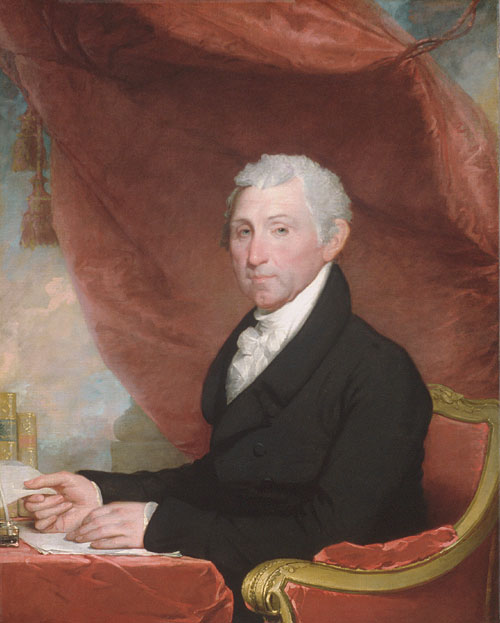
Credit: James Monroe, oil on canvas by Gilbert Stuart (Metropolitan Museum of Art, New York)

Monday, July 8, 2013

James Monroe, the Erie Canal, and "I Eat My Meals with Sal Each Day"

So did you know that during James Monroe’s presidency, many canals were built, mostly in the northeastern states? One of the most famous was the Erie Canal. Originally, it was forty feet wide, four feet deep, and 363 miles long, and stretched from Albany (on the upper Hudson River) to Buffalo (on the eastern shore of Lake Erie).

Teams of horses and mules trotted alongside the canal on a dirt road, called a "tow path," and pulled along flat-bottomed barges and boats called "packets". The opening of the canal in 1825 triggered the first major western migration in the United States, as countless thousands of pioneers and farmers rushed to the fertile lands of Ohio, Illinois, Indiana, and beyond.

Soon, settlers in the Midwest were shipping cargoes of wheat, corn and other foodstuffs to the big cities of the Northeast. On the return trip, farming supplies and other manufactured goods were shipped west. Realizing the great fortunes to be made from shipping the raw materials of the west to the big cities of the east, Americans embarked upon a “canal-building craze" that lasted until the rise of the railroads.

Historians say that the Erie Canal was the transportation marvel of its day. It reduced travel time from the Hudson River to the Great Lakes by more than a half and provided travelers with "a welcome alternative to the rutted, muddy road of the stage coach." In 1836, Thomas S. Woodcock made the trip from Schenectady, New York to Buffalo and described the abudance of food and other luxuries of life provided on a packet:

These boats are about 70 feet long, and with the exception of the Kitchen and bar, is occupied as a Cabin. The forward part being the ladies' Cabin, is separated by a curtain, but at meal times this obstruction is removed, and the table is set the whole length of the boat. The table is supplied with every thing that is necessary and of the best quality with many of the luxuries of life...

The Bridges on the Canal are very low, particularly the old ones. Indeed they are so low as to scarcely allow the baggage to clear, and in some cases actually rubbing against it. Every Bridge makes us bend double if seated on anything, and in many cases you have to lie on your back.

The Man at the helm gives the word to the passengers: 'Bridge,' 'very low Bridge,' 'the lowest in the Canal,' as the case may be. Some serious accidents have happened for want of caution. A young English Woman met with her death a short time since, she having fallen asleep with her head upon a box, had her head crushed to pieces. Such things however do not often occur, and in general it affords amusement to the passengers who soon imitate the cry, and vary it with a command, such as 'All Jackson men bow down.' After such commands we find few aristocrats.


Sadly nostalgic, the classic American folk song "Low Bridge” recalls the years from 1825 to 1880 when mule barges on the Erie Canal "made boomtowns out of Utica, Syracuse, Rochester, and Buffalo, and transformed New York into the Empire State." Maybe you remember the lyrics:

I've got an old mule and her name is Sal
Fifteen years on the Erie Canal
She's a good old worker and a good old pal
Fifteen years on the Erie Canal
We've hauled some barges in our day
Filled with lumber, coal, and hay
And we know every inch of the way
From Albany to Buffalo

Low bridge, everybody down
Low bridge for we're coming to a town
And you'll always know your neighbor
And you'll always know your pal
If you've ever navigated on the Erie Canal…

Don't have to call when I want my Sal
Fifteen miles on the Erie Canal
She trots from her stall like a good old gal
Fifteen miles on the Erie Canal
I eat my meals with Sal each day
I eat beef and she eats hay
And she ain't so slow if you want to know
She put the "Buff" in Buffalo…


Today, this classic old tune is part of American folk history and has been recorded by such popular folk singers as Pete Seeger and The Kingston Trio. Bruce Springsteen also recorded the tune on his 2006 album, "We Shall Overcome: The Seeger Sessions."

A LITTLE BACKGROUND: Shortly after taking office in 1817, James Monroe vetoed a bill to provide federal funds to build the Erie Canal. Like Jefferson and Madison, Monroe encouraged an American system of internal improvements to help the nation grow, but didn't believe that the federal government had the authority under the Constitution to use federal monies to fund state projects like the Erie Canal.

FAST FACT: Ten years after the Erie Canal opened, New York was the busiest port in the nation, moving more agricultural and industrial goods than Boston, Baltimore and New Orleans combined!