Showing posts with label Food History. Show all posts

Saturday, August 25, 2018

George Bush, Barack Obama, and the Politics of Peanut Butter and Jelly Sandwiches

George Bush's memoir Decision Points has been described by the New York Times as "an autobiography focused around 'the most consequential decisions' of his presidency and his personal life from his decision to give up drinking in 1986 to his decision to invade Iraq in 2003 to his decisions regarding the financial crisis of 2008." According to the Product Description of the book:

President Bush brings readers inside the Texas Governor’s Mansion on the night of the hotly contested 2000 election; aboard Air Force One on 9/11, in the hours after America’s most devastating attack since Pearl Harbor; at the head of the table in the Situation Room in the moments before launching the war in Iraq; and behind the Oval Office desk for his historic and controversial decisions on the financial crisis, Hurricane Katrina, Afghanistan, Iran, and other issues that have shaped the first decade of the 21st century...

With so many momentous issues to review, it's not surprising that Mr. Bush didn't bother to mention his favorite foods, but...in an interview with Oprah Winfrey during the 2000 presidential campaign, he did say that his favorite sandwich is peanut butter and jelly on white bread.
.

Eight years later, during the 2008 presidential campaign, peanut butter and jelly sandwiches once again made national headlines. Responding to charges that his economic policies were socialistic in nature, Barack Obama lightheartedly chided his opponent John McCain for constantly resorting to trivialities and distractions:

Now, because he knows that his economic theories don't work, he's been spending these last few days calling me every name in the book. Lately he's called me a socialist for wanting to roll-back the Bush tax cuts for the wealthiest Americans so we can finally give tax relief to the middle class. I don't know what's next. By the end of the week he'll be accusing me of being a secret communist because I shared my toys in kindergarten. I shared my peanut butter and jelly sandwich.
.

Although neither Bush nor Obama mentioned how they prefer their PB&Js to be made, we do know that John Harvey Kellogg, the cereal pioneer, was the first person to receive a patent for the process of making peanut butter in 1895. According to Andrew Smith's Peanuts: The Illustrious History of the Goober Pea, early peanut butters had several problems:

The first was that peanut oil has a melting point below room temperature. Gravity separated the oil, which then oxidized and turned rancid. Likewise, salt added to the peanut butter separated and crystallized. Grocers received peanut butter in tubs or pails and were advised to use a wooden paddle to stir it frequently...

During the early years of the twentieth century, William Norman, an English chemist, invented a method of saturating unsaturated and polyunsaturated fatty acids, thus preventing them from turning rancid. In 1922, Joseph L. Rosefield...applied these principles to peanut butter [and] developed a process to prevent oil separation and spoilage in peanut butter...The result was a semisolid peanut butter [that]...was thick and creamy and did not stick to the roof of the mouth as much as previous products.


Selecting the name "Skippy" for his product, Rosefield introduced creamy and chunky-style peanut butter in 1932. Three years later, the company inaugurated its first wide-mouth peanut-butter jar, which quickly became the industry standard. And in less than twenty five years, peanut butter had "evolved from a hand ground delicacy to a mass-produced commercial commodity sold in almost every grocery store in America."


FOOD FACT: Florence Cowles' 1928 cookbook Seven Hundred Sandwiches includes dozens of creative recipes for peanut butter sandwiches, including: Peanut Butter and Egg Sandwich, Peanut Butter and Cabbage Sandwich, Peanut Butter and Marshmallow Sandwich, Peanut Butter and Prune Sandwich, Peanut Butter and Cherry Sandwich, Peanut Butter and Cheese Sandwich, and Peanut Butter and Olive Sandwich made with Mayonnaise on Rye. Oh my!

Tuesday, July 9, 2013

Theodore Roosevelt, Upton Sinclair, and the Pure Food and Drug Act of 1906

So this story is kind of repulsive and certainly won't make you crave a juicy hamburger or steak, but it's a part of food history so here goes:

On June 30, 1906, President Theodore Roosevelt signed into law the Meat Inspection Act and Pure Food and Drug Act which provided for federal inspection of meat products and prohibited the manufacture, sale, or transportation of adulterated food products. The Acts arose in part due to articles and exposés written by muckrakers, like Upton Sinclair, whose popular 1906 novel The Jungle contains hair-raising descriptions of the ways in which meat was produced in Chicago slaughterhouses and stockyards.

Sinclair described how dead rats, putrid meat, and poisoned rat bait were routinely shoveled into sausage-grinding machines, how bribed inspectors turned a blind eye when diseased cows were slaughtered for beef, and how filth and guts were swept off the floor and then packaged and sold as “potted ham.”

Muckraker, of course, is a term that is applied to those novelists and journalists who sought to expose the corruption of American business and politics in the early twentieth century. It was President Roosevelt who first coined the term in a 1906 speech in which he compared writers like Sinclair to the “Man with the Muck-rake” (a character in John Bunyan's Pilgrim's Progress) who was so focused on "raking the filth at his feet” that he failed to look up and “behold the celestial crown.”

Similarly, Roosevelt argued that Sinclair and other muckrakers were so focused on the evils of American society that they failed to "behold the vision of America's promise.”

Saturday, February 25, 2012

Ulysses S. Grant, the Transcontinental Railroad, and Santa Fe Broiled Sage Hen

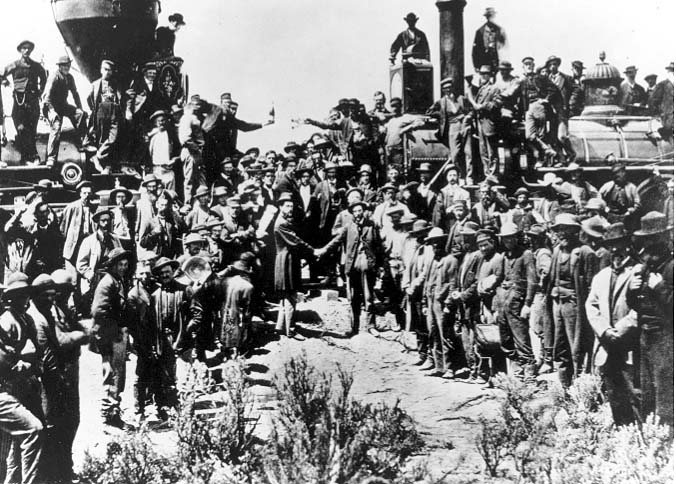
After the Civil War, peace between the North and South made it possible for the nation’s first Transcontinental Railroad to be completed. In 1863, the Union Pacific began laying track in Omaha, Nebraska, heading west. At the same time, the Central Pacific started laying track in Sacramento, California, heading east.

Work in the beginning was slow and difficult, as you can imagine. After less than 25 miles of track had been laid in California, the Central Pacific “faced the daunting task of laying tracks over terrain that rose 7,000 feet in less than a hundred miles.” To conquer the sheer embankments, workers, the vast majority of whom were Chinese immigrants, were lowered by rope from the top of cliffs. While dangling in mid-air, they chipped away at the granite with picks and axes and then planted explosives to blast tunnels through the cliffs.

On October 10, 1865, Leland Stanford, president of the Central Pacific, submitted a progress report to President Andrew Johnson:

A large majority of the white laboring class on the Pacific Coast find more
profitable and congenial employment in mining and agricultural pursuits, than in railroad work. The greater portion of the laborers employed by us are Chinese, who constitute a large element in the population of California. Without them it would be impossible to complete the western portion of this great national enterprise within the time required by the Acts of Congress...

Their wages, which are always paid in coin, at the end of each month, are divided among them by their agents…in proportion to the labor done by each person. These agents…furnish them their supplies of food, the value of which they deduct from their monthly pay. We have assurances from leading Chinese merchants that ...the [company] will be able to procure during the next year not less than 15,000 laborers. With this large force, the Company will be able to push on the work so as not only to complete it within the time required by the Acts of Congress, but so as to meet the public impatience.


Four and a half years later, the two tracks finally met and the final “Golden Spike” was driven in with great ceremony at Promontory, Utah on May 10, 1869. By the end of the century, four more railways crisscrossed the United States. By then, most trains had luxury dining cars where first class passengers like President Grant dined on superb regional fare. The Baltimore and Ohio, for example, was famous for fresh seafood from the Chesapeake Bay while the Santa Fe was reportedly known for its Prairie Chicken and Broiled Sage Hen.

Although those railway recipes would be difficult to duplicate today, you can try this simple and simply delicious recipe for Lemon Sage Roasted Chicken from Bon Appetit.

4 chicken breast halves with skin and bones
8 very thin lemon slices, seeded
12 fresh sage leaves
Olive oil
4 teaspoons fresh lemon juice
2 large garlic cloves, coarsely chopped
1 cup low-salt chicken broth

Preheat oven to 450°F. Slide fingertips under chicken skin to loosen. Arrange 2 lemon slices and 3 sage leaves under skin on each breast; smooth skin over to enclose. Place chicken on rimmed baking sheet; brush with oil. Drizzle 1 teaspoon lemon juice over each breast; sprinkle with garlic, salt, and pepper. Pour 1/2 cup broth onto sheet around chicken.

Roast chicken until brown and cooked through, basting once or twice with pan juices, about 25 minutes. Transfer chicken to platter. Place baking sheet directly atop 2 burners; add remaining 1/2 cup broth. Using back of fork, mash any garlic on baking sheet into broth and pan juices. Boil over high heat until broth reduces almost to glaze, scraping up browned bits, about 4 minutes. Spoon sauce over chicken and serve.

FAST FACT: For every track of mile laid, railroads were granted a certain sum of money and 20 square miles of free land. The transcontinental railroad brought rapid economic growth to the nation, as farming, cattle-ranching and other agricultural businesses rapidly developed along the main lines..

If you like this, click here for my new book from Simon and Schuster!

Saturday, July 17, 2010

Leonardo da Vinci Saffron Risotto

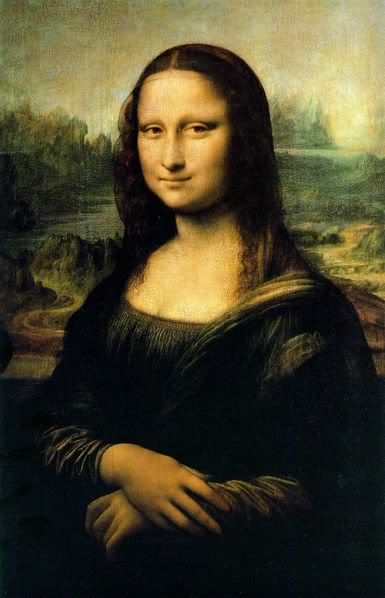
How Leonardo da Vinci used rudimentary pigments in 1503 to create such subtle shadows and light on the Mona Lisa has long baffled art historians. Now French researchers are "using X-ray fluorescence spectroscopy to isolate and study each ultra-thin layer of paint and glaze da Vinci used" to create the effect he was seeking, according to recent new stories.

By beaming x-rays on the Mona Lisa without removing it from the wall on which it is mounted in Paris' Louvre Museum, scientists found that da Vinci used a Renaissance painting technique known as sfumato, intricately mixing thin layers of pigment, glaze and oil to create the appearance of lifelike shadows and light. Scientists now believe that da Vinci used up to 30 layers of paint on his works.

While this research may solve one mystery about the Mona Lisa, others remain, like: "who is this enigmatic woman" and why does she hold her subtle half-smile? To these mysteries we can add another: what did this mysterious woman and da Vinci like to eat?

According to one researcher who studied the culinary habits of fifteenth and sixteenth century Italy, some Renaissance favorites were Risi e Bisi, Saffron Risotto with Duck and Mushrooms, and Spinach Soup with Hazelnuts. Although those recipes would be impossible to duplicate today, this one for Saffron Risotto with Mushrooms from the New York Times might just give you a sense of how and what Leonardo da Vinci ate.

4 cups beef or chicken stock
1/8 teaspoon ground saffron
3 tablespoons unsalted butter
2 tablespoons olive oil
1/4 cup finely minced scallions
1/4 cup finely minced onions
1 pound fresh wild mushrooms, trimmed, cleaned and sliced (see note)
1 1/2 cups Italian Arborio rice
Salt and freshly ground black pepper to taste
3/4 cup freshly grated Parmigiano-Reggiano cheese

Place stock in a heavy saucepan, and over medium heat bring to a simmer. Add saffron, stir, and leave to simmer very slightly.

Meanwhile, in a larger saucepan over medium heat, melt 1 tablespoon butter in olive oil. When foam subsides, add scallions and onions, and cook, stirring frequently, until softened and yellow but not browned. Add mushrooms and saute, stirring occasionally, until liquid has evaporated.

Add rice to mushrooms, and cook, stirring to coat well, with butter and oil. Add approximately 3/4 cup of simmering stock to rice and mushrooms. Stir well and continue to cook, stirring occasionally, until rice has absorbed most of stock. Continue adding stock to rice by the half-cupful, adding only after rice has absorbed previous addition. As cooking continues, you will have to stir more frequently. After 25 to 30 minutes, all the stock should be absorbed, and rice should be tender but still chewy.

Remove from heat. Add salt and pepper to taste. Stir in remaining butter and 1/4 cup of Parmigiano-Reggiano. Serve immediately, passing the rest of the cheese.

Thanks for stopping by THE HISTORY CHEF! For a free excerpt of my new book from Simon and Schuster click here

Friday, July 9, 2010

Dolley Madison Fresh Strawberry Ice Cream

Legend has it that in the early nineteenth century, a freed slave named Sallie Shadd went into her family’s catering business in Wilmington, Delaware. Sallie supposedly achieved fame among the free black population there for a new dessert sensation she created with frozen cream, sugar, and fruit.

When Dolley Madison heard about this new dessert, she supposedly travelled to Wilmington to try it. The First Lady must have loved it because a "magnificent dome of pink ice cream" was served at President Madison’s second Inaugural Ball in 1813, and ice cream often appeared as the official dessert on the White House menu during her husband's two terms of office.

This recipe for strawberry ice cream, which may be similar to the one used by the Madison’s chef, is adapted from The White House Cookbook by Hugo Ziemann, a nineteenth century steward of the White House, and Mrs. F. L. Gillette, a celebrated 19th century cookbook author.

1 1/2 cups sugar
4 cups fresh strawberries, sliced
1 quart heavy fresh cream

In a medium bowl, mix 1 cup sugar with strawberries, let stand for three hours, then mash and strain through a coarse towel.

Add 1/2 cup sugar and combine until dissolved. Beat in cream and freeze for at least three hours.

Thanks for stopping by THE HISTORY CHEF! For a free excerpt of my new book from Simon and Schuster click here

Thursday, July 8, 2010

George Washington Glazed Baked Ham

According to historians at Mount Vernon, Martha Washington carefully supervised the preparation of the hams and bacon that were eaten by their many guests. Of all the food produced at Mount Vernon it is said that Martha was “especially proud of her hams.”

After slaughtering and butchering the hogs in December and January, slaves smoked the meat over a fire pit in the smokehouse to preserve it for eating during the coming year. After smoking, the meat was aged and stored in the smokehouse.

Occasionally a thief would break into the smokehouse at night and steal a ham. However, the most notable “ham theft” supposedly occurred in broad daylight, right off the Washingtons' dining room table. The thief was a hound named Vulcan, who “made a running pass at the table and dashed out the door with the savory prize clenched between his teeth.”

A chase ensued, and the ham was recovered but nobody wanted to eat it after that! Although Martha was said to be furious, George reportedly thought the incident was very funny and “delighted in recounting it to guests.”

When preparing this recipe for Glazed Baked Ham, it's best to make the marinade the night before or early in the morning and let the ham marinate for several hours in the refrigerator.

1/3 cup light brown sugar, packed
1/2 cup honey
1/3 cup dry red wine
1/2 cup pineapple juice
1 fully cooked ham, about 6 pounds

In a large bowl, combine the brown sugar, honey, wine, and pineapple juice. Place the ham in the marinade, turn to coat well, and let marinate for 6 hours or overnight in refrigerator.

Preheat the oven to 350°. Place the ham on a rack in a roasting pan, reserving marinade for basting. Bake the ham, basting frequently with the reserved marinade, until a meat thermometer (not touching the bone) reads about 140°, or about 10 minutes per pound.

Thanks for stopping by THE HISTORY CHEF! For a free excerpt of my new book from Simon and Schuster click here!